
unarc.dll returned an error code: what the file is and how to fix the installation
unarc.dll is the unpacking library of FreeArc, a free archiver by Bulat Ziganshin. Setup programs that store their files in FreeArc archives copy unarc.dll to a temporary folder and call it to unpack the game or program onto your disk. When it reports an error code, the file itself is almost never the problem: the archive it was asked to unpack is damaged or incomplete, the disk or memory ran out, or something blocked the files.

Prefer to fix it yourself? The manual steps follow.
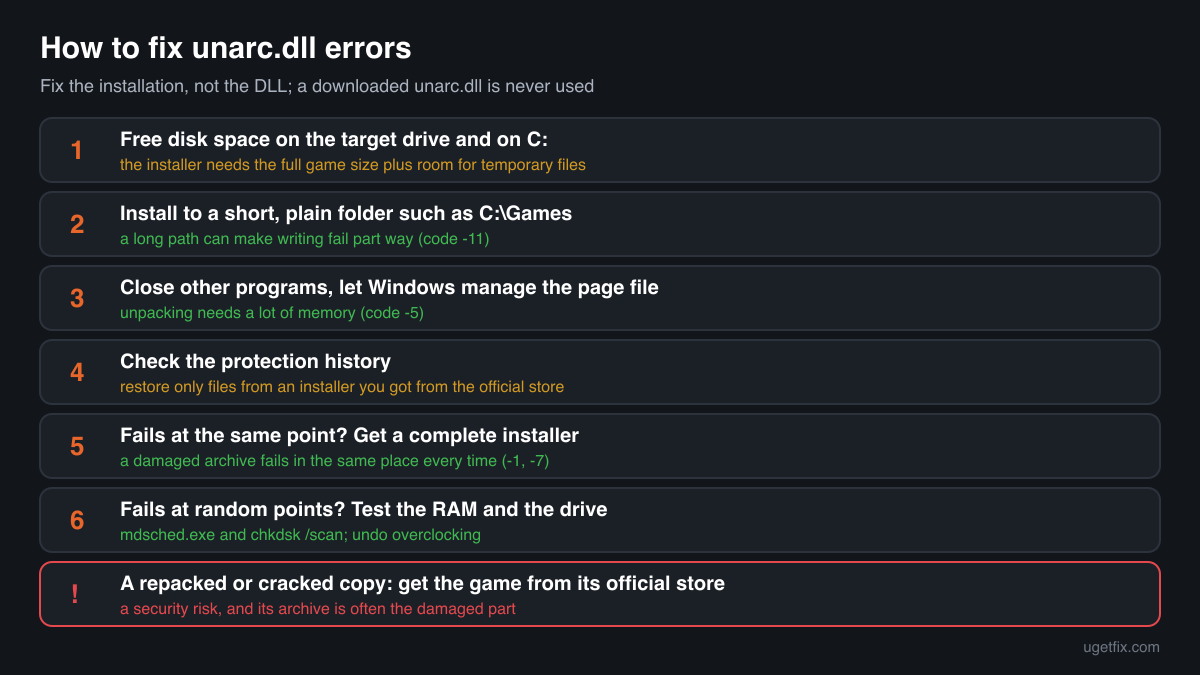
How to fix unarc.dll errors
Treat the message as a report about the installation. unarc.dll is a messenger: it tells the setup program that it could not unpack the data, and the number says why. Code -11 means it could not write, which is usually a full drive or a blocked folder. Code -5 means it could not get enough memory. Code -1 and code -7 mean the data could not be decompressed, which is most often a damaged or incomplete download, and sometimes faulty RAM or a failing disk. Free space on the target drive and the system drive, close other programs, install to a short folder such as C:\Games, and check whether your security software removed anything. If the error comes back at the same point, the archive is damaged: get a fresh copy of the installer from the place you bought the game.
Replacing unarc.dll with a copy from a DLL download site does not fix anything. The setup program brings its own copy and uses it from a temporary folder, so a file you put into System32 is never loaded. If the installer is a repacked or cracked copy of a game, the honest fix is the game from its official store: such downloads are a security risk, and their archives are often the damaged part.
Which installers and programs use unarc.dll
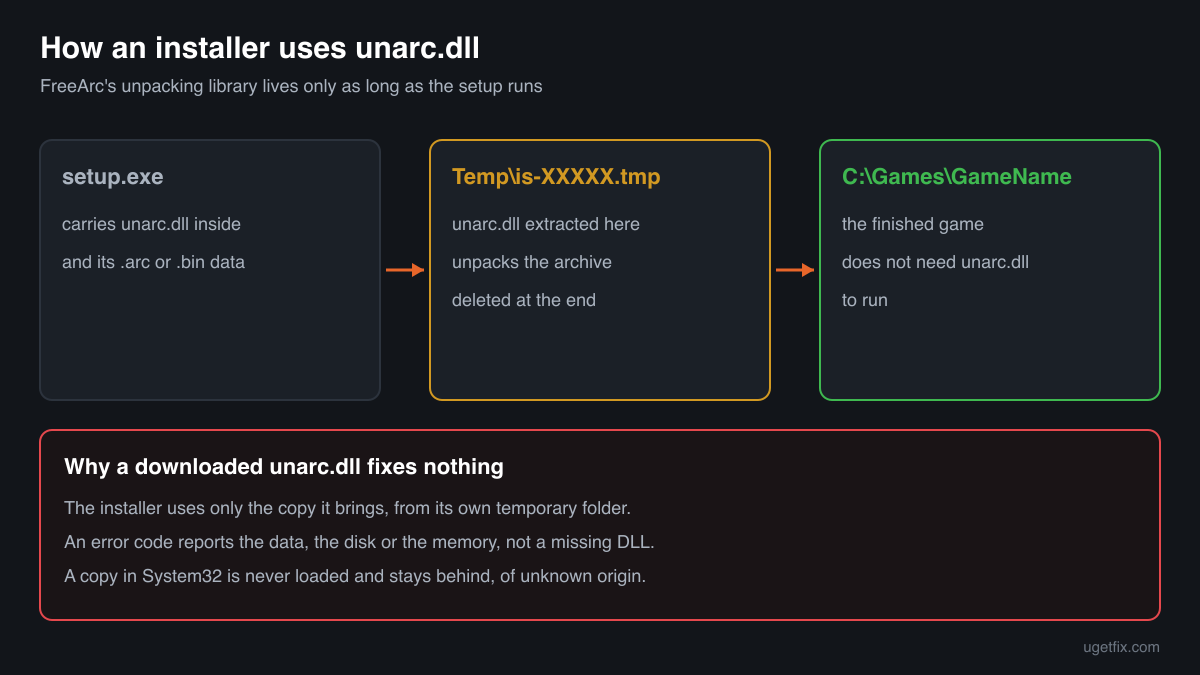
FreeArc packs data very tightly, which is why some setup programs use it to make large games and programs smaller to download. The library that does the unpacking is unarc.dll. FreeArc's own source code includes an example script that shows how an Inno Setup installer calls it, and installers built that way carry the file inside the setup .exe and unpack it to a temporary folder when they run. These are the cases you will meet.
| Program | Made by | What to know |
|---|---|---|
| Inno Setup installers that unpack FreeArc archives | FreeArc library by Bulat Ziganshin, added by the author of the installer | The setup program extracts unarc.dll to a temporary folder, unpacks its .arc or .bin data files with it, and deletes it at the end. An error code here is about the data, the disk or the memory, not about the DLL. |
| Repacked game installers | Unknown third parties, not the game's publisher | Most unarc.dll errors people search for come from these. They compress a game far more than its publisher did, need a lot of memory and time to unpack, and are often modified copies. A damaged part of such a download cannot be repaired on your PC. |
| The FreeArc archiver | Bulat Ziganshin | The archiver itself and its command-line unpacker can open .arc archives. unarc.dll is the part of it that only unpacks, made to be built into other programs. |
| Tools and programs that read FreeArc archives | Their own developers | Some developers wrap unarc.dll to open FreeArc archives from their own programs. Such a program ships the DLL in its own folder; a reinstall of that program restores it. |
| Games from official stores and launchers | Their publishers | A game installed through Steam, the EA app, Epic, GOG Galaxy, Ubisoft Connect or the Xbox app is downloaded and unpacked by the launcher with its own tools. A store copy that fails to install is fixed in the launcher, with a verify or repair. |
Step by step
- Free disk space on both drives. The setup program needs room for the finished installation on the target drive and, often, room for temporary files on the system drive, usually C:. A heavily compressed installer can need several times its own size while it unpacks. Leave at least the full installed size of the game free on the target drive plus a generous margin on C:, then run the installer again. Code -11, a write error, is the typical result of a full drive.
- Install to a short, plain folder. Choose a folder such as C:\Games\GameName instead of a deep path under your Documents or Desktop. Windows has a classic limit of 260 characters for a full path, and games contain deeply nested files, so a long target folder can make writing fail part way. Use plain letters and numbers in the folder name.
- Close other programs and give the installer memory. Unpacking a tightly compressed archive needs a lot of RAM. Close the browser, launchers and anything else heavy before you start, and do not run two installers at once. Check that Windows manages the paging file: open System, About, Advanced system settings, Performance Settings, Advanced, Virtual memory, and tick Automatically manage paging file size for all drives. Code -5 means the library could not get the memory it needed.
- Look at your security software's protection history. In Windows Security open Virus and threat protection, Protection history; other security programs have a quarantine of their own. If files were removed from the installer's temporary folder or the game folder during the install, the unpacking breaks. Restore and allow them only when the installer came from the game's official store or publisher. If it came from anywhere else, the detection may well be correct: leave the file in quarantine.
- Get a complete copy of the installer. If the error returns at the same percentage every time, the data in the archive is damaged or incomplete, and running the installer again will not change it. Download the installer again from the store or publisher you bought the game from, or verify it in the launcher. Where the publisher lists checksums for its setup files, compare yours before you run it.
- Test the RAM and the disk. If the error appears at different points each time, or with different installers, the hardware may be corrupting data while it unpacks. Run Windows Memory Diagnostic (type mdsched.exe in Start) and let it restart the PC. For the drive, open an administrator Command Prompt and run chkdsk C: /scan, and the same for the target drive. If you overclocked memory or the processor, return them to default speeds for the installation.
- Install the game from its official store. If the installer is a repacked or cracked copy, stop here. Such a copy cannot be made reliable from your side, and it is a security risk: these downloads are a common way malware reaches PCs. The clean fix is the game from its official store, where the launcher downloads, checks and repairs every file for you.
What not to do
Do not download unarc.dll from a DLL site.
The installer carries its own copy and extracts it to a temporary folder every time it runs, so a downloaded file is never the one it uses. It only leaves a library of unknown origin on your PC, and the archive that failed to unpack is still the same.
Do not put unarc.dll into System32 or SysWOW64.
Windows does not need it, and the installer does not look there for its own copy. A file in the Windows folders fixes nothing and stays behind for any program that might load it.
Do not turn off your security software to get an installer through.
Installers that ask you to switch protection off before they run are the usual way malware bundled with game downloads gets in. A clean installer from an official store does not need it.
Do not keep re-running a failing installer that stops at the same point.
A damaged archive fails at the same place each time. Repeating the install wastes hours and wears the drive; get a fresh copy instead.
Do not use a cracked or repacked copy as the fix.
Another repack of the same game is not a cleaner copy: it comes from the same kind of unknown source, with the same risks. The fix is the game from its official store.
Check the copy on your PC
Choose the unarc.dll you found. Its checksum is calculated in your browser and compared with 1 copy of the file collected from PCs. Installers delete their copy after they finish, so you only need this for a copy left somewhere else.
The file stays on your computer. Nothing is uploaded: the checksum is computed locally.
Found an unarc.dll outside an installer's temporary folder, in a game folder that came from a repack, or one that your security program flagged? Then the question is whether that copy and the download it came with are safe, and that is a security question rather than an unpacking one. Is unarc.dll safe or part of a cracked download? On 2-Spyware
The error messages and what each one means
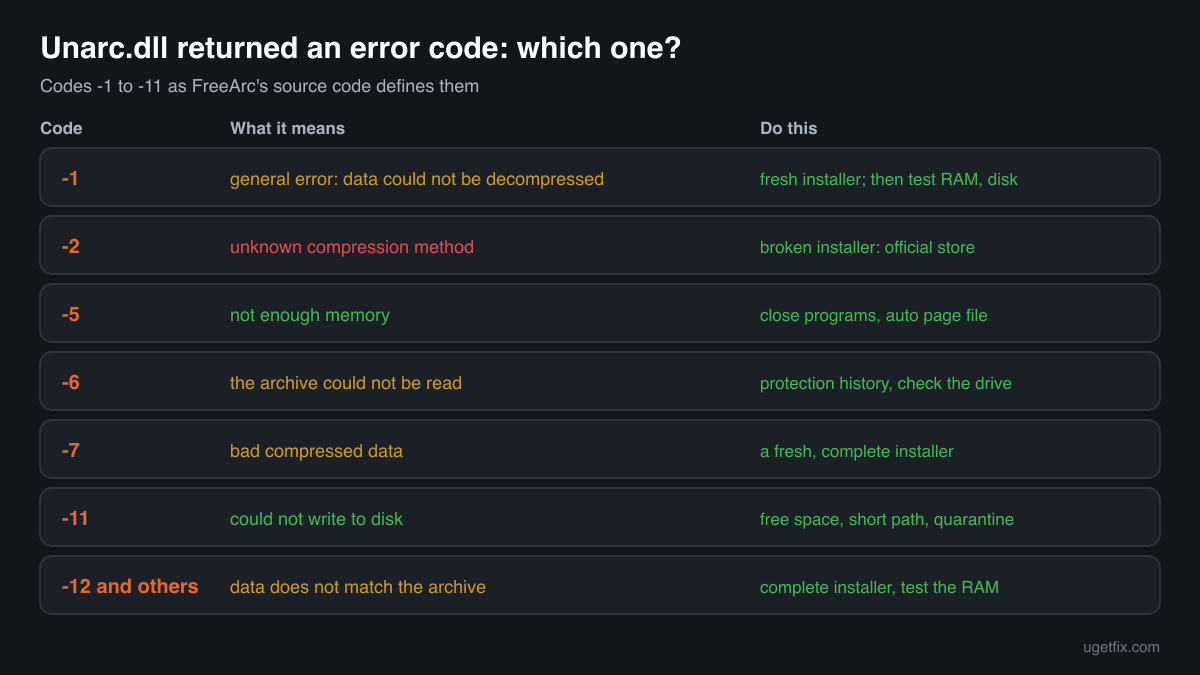
Installers show the library's result as a number. FreeArc's source code defines what each number means, so the code tells you what failed. These are the texts installers show, with the number filled in.
An error occurred when unpacking! Unarc.dll returned an error code: -1. ERROR: archive data corrupted (decompression fails)
Code -1 is FreeArc's general error: the data could not be decompressed. Most often the installer's archive is damaged or incomplete. When it fails at different points each time, suspect RAM or the disk. Get a fresh copy of the installer, then test memory and drive.
Unarc.dll returned an error code: -11
Code -11 is a write error: the library unpacked data and could not write it to disk. A full target drive or system drive, a path that is too long, or a folder blocked by security software or permissions. Free space, install to C:\Games and check the protection history.
Unarc.dll returned an error code: -12
Codes beyond -11 are not described in the FreeArc header we read. In practice installers show them on the same kind of failure as -1 and -7: data that does not match what the archive expects. Get a complete copy of the installer and test the RAM before anything else.
Unarc.dll returned an error code: -7
Bad compressed data: the archive contains data that cannot be decompressed. A damaged download or a damaged part of the installer. A fresh copy is the only fix.
Unarc.dll returned an error code: -5
Not enough memory: the library could not allocate the RAM it needs to unpack. Close other programs, let Windows manage the paging file, and run the installer again.
Unarc.dll returned an error code: -6
A read error: the library could not read the archive. The installer's data files are missing, on a failing drive or blocked by security software. Check the protection history and the drive.
Unarc.dll returned an error code: -2
Invalid compression method: the archive uses a method this copy of unarc.dll does not know. The installer and its archive do not belong together, which means a modified or broken installer. Get the game from its official store.
ISDone.dll: An error occurred when unpacking
ISDone.dll is another helper some installers use to drive the unpacking, and it often shows unarc.dll's code in the same window. Read the code number in the message and follow it.
File facts
unarc.dll is the decompression part of FreeArc, an archiver Bulat Ziganshin released as free software. It only unpacks, which makes it small enough to ride along inside a setup program. The installer gives it the name of an archive and a target folder, and the library unpacks the files and reports progress and errors back. Its error codes are the ones defined in FreeArc's Compression.h, from -1 (general error) to -11 (write error). What the catalogue copies of the file report:
- Description in the file
- -
- Company in the file
- FreeArc (Bulat Ziganshin)
An Inno Setup installer built on FreeArc's example extracts unarc.dll into its own temporary folder, a folder named is- followed by random letters and .tmp under your user's Temp folder, uses it while it unpacks, and deletes the folder when it finishes. That is why you usually find no unarc.dll on your PC after an install, and why a copy elsewhere is never the one the next installer uses. Some installers leave a copy in the game folder. The copy in the DLL catalogue is a 32-bit build of about 300 KB that reports no company, version or description, so a blank Details tab on your copy is expected and proves nothing either way. FreeArc's author has also published 64-bit builds of the unpacker.
Copies of unarc.dll found on PCs
Public DLL catalogues have collected 1 copy of unarc.dll uploaded from PCs. It is a 32-bit build that reports no company, no description and version 0.0.0.0, so a blank Details tab on your copy is not a warning sign by itself. The table lists it with its checksums, so you can tell whether your file is the same one.
A match or no match says little about your problem. Every installer brings the build its author chose, and unarc.dll errors come from the data being unpacked, not from the library's version. Use the check only to identify a copy you found somewhere you did not expect.
| Version | Build | Size | MD5 | SHA-1 |
|---|---|---|---|---|
0.0.0.0 | 32-bit | 297 KB | d6c79afef36773206e479e0b1a7cf059 | 5faa19aa1629e401915001a3392e3d916be38578 |
Copies uploaded by users to a public DLL catalogue, read on 17 October 2026. We list their checksums so you can identify a file; we do not offer them for download and we could not verify them against a publisher's signature, because the catalogue copy reports no publisher.
Questions people ask
Is unarc.dll a virus?
FreeArc's unarc.dll is a harmless unpacking library. Security programs flag it often because it is so common in repacked and cracked game installers, which are a frequent way malware is spread. Read the security page linked above if you found a copy you cannot explain.
Can I download unarc.dll to fix the error?
No. The installer carries its own unarc.dll and extracts it to a temporary folder each time it runs, so a downloaded file is never used. The error reports a problem with the data, the disk or the memory, and a new DLL does not change any of them.
What does unarc.dll error code -1 mean?
It is FreeArc's general error: the data could not be decompressed, usually shown with archive data corrupted. The installer's archive is damaged or incomplete in most cases. If it fails at a different point on every try, test the RAM with Windows Memory Diagnostic and check the drive.
What does unarc.dll error code -11 mean?
It is a write error. The library unpacked data but could not write it to the disk, because the target drive or the system drive is full, the path is too long, or the folder is blocked. Free space on both drives and install to a short folder such as C:\Games.
Why does the installer always fail at the same percentage?
Because the archive is damaged at that point. The library reaches the same broken data on every run and stops there. Running it again, as administrator or in compatibility mode, does not change the data. A fresh, complete copy of the installer from where you bought the game is the fix.
Will more RAM or a bigger page file fix unarc.dll errors?
It fixes code -5, which means the library could not get enough memory, and it helps when several heavy programs run at once. Let Windows manage the paging file and close other programs. It does not fix a damaged archive, and faulty RAM needs a test, not more of it.
What is the difference between ISDone.dll and unarc.dll?
unarc.dll is FreeArc's library that does the unpacking. ISDone.dll is a separate helper some installers use to run the unpacking and show progress, and its error window often quotes unarc.dll's code. Both are part of the installer, and both errors are fixed the same way.
Is it safe to use a repacked installer if I fix the error?
A repacked or cracked copy is a security risk whether it installs or not: you cannot know what was changed in it, and such downloads often carry malware. The clean fix is the game from its official store, where the launcher installs and repairs it for you.
Related guides
unarc.dll returned an error code: what the file is and how to fix the installation
Sources
- FreeArc source code: Compression.h (error codes)
- FreeArc source code: example of using unarc.dll in an Inno Setup installer
- FreeArc'Next by Bulat Ziganshin on GitHub (64-bit unarc builds, issue 18)
- Microsoft Learn: Maximum Path Length Limitation
File data read on October 17, 2026.

The editors who write and check uGetFix guides and reference pages. File facts are read from Microsoft's own installers and documentation, and every page shows the date its data was read.
Questions and experiences
Ask about this page: members and our editors answer. Reading is open; writing needs a free account.
…