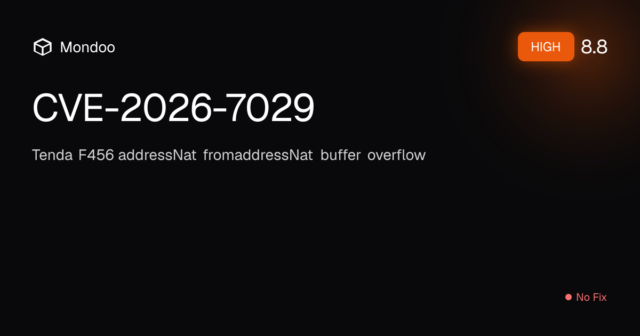
Critical CVE-2026-7029 in Tenda F456 firmware 1.0.0.5 enables remote buffer overflow
CVE-2026-7029 affects Tenda F456 firmware 1.0.0.5 and carries a CVSS 3.1 score of 8.8. NVD published the advisory on 2026-04-26, and the flaw can be triggered remotely through the /goform/addressNat interface.
The weakness centers on the fromaddressNat function and the menufacturer/Go argument. According to the published description, manipulating that input can lead to a buffer overflow, and exploit code has already been made publicly available.
The affected configuration listed in the advisory points to Tenda F456 firmware 1.0.0.5, with the device itself also named in the known vulnerable CPE entry. That makes the issue specific, not theoretical, because the published analysis ties the flaw to a concrete firmware build and a reachable web function.
The technical classification lines up with a classic memory corruption problem. VulDB mapped the weakness to CWE-119 and CWE-120, and the cited vector shows network access, low attack complexity, no user interaction, and high impact on confidentiality, integrity, and availability.
The public exploit disclosure raises the urgency further. Once code is circulating, remote flaws in router management functions can move quickly from disclosure to active abuse, especially when the vulnerable path is already identified and the trigger parameter is known.
Router web handlers like /goform/addressNat normally process configuration data submitted through the administration interface. When that input is not checked correctly, a crafted request can overflow the buffer used by fromaddressNat and alter program flow before the device has any chance to reject the request.
Possible steps
- Open the Tenda F456 administration interface and confirm the installed firmware version.
- Check whether the device is running firmware 1.0.0.5.
- Review any vendor security notices for fixed firmware or mitigation guidance.
- Restrict access to the router management interface from untrusted networks.
- Stop sending administrative requests that interact with the vulnerable addressNat path.
- Disconnect exposed management access until a patched build is available.
- Test any replacement firmware in a controlled setting before broad deployment.
- Document the affected hardware so it can be tracked during remediation.
- Treat the issue as urgent if the router is reachable from outside your network.
- Segment affected devices from broader administrative access where possible.
- Monitor for unusual requests to /goform/addressNat.
- Replace or retire devices that cannot be brought onto a fixed firmware build.
- Verify whether your Tenda F456 runs firmware 1.0.0.5.
- Check vendor advisories for a fixed firmware release.
- Remove remote exposure from the router management interface.
- Limit access to the addressNat administration path.
- Watch for requests tied to menufacturer/Go.
- Prioritize replacement if no remediation is available.
Šaltiniai: nvd.nist.gov, tenable.com, mondoo.com, vicarius.io, cve.imfht.com

Report an issue
What's wrong with this guide? We review every report and update or remove content.
Report received — thank you. We'll review and fix it.
You need a free account to submit a report.
Be the first to comment