How to fix
Ole32.dll missing or not found error
on Windows
Resolve the ole32.dll missing error in Windows 10 or 11 easily. Get quick, reliable solutions from our expert-tested guide, fixed in minutes.

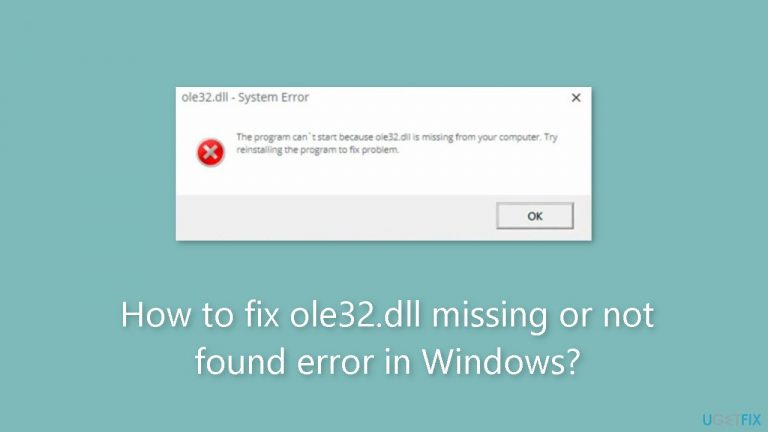
What causes How to fix ole32.dll missing or not found error in Windows?
- Corrupted ole32.dll file
- Damaged ole32.dll file
- Accidental deletion of ole32.dll file
- Issues with OLE capabilities
- Software instability due to missing ole32.dll
Repairs Windows system files, removes malware, and restores a clean OS state — without reinstalling.
Hello. When I try to open certain files and documents I get the "ole32.dll is missing" error. Any way to fix this problem quickly?
Windows's "ole32.dll missing or not found" error is a frequent problem that can seriously impair users' ability to run different programs and carry out particular tasks on their computers. The dynamic link library (DLL) file known as ole32.dll, or Object Linking and Embedding (OLE) 32-bit Library, is essential to the Microsoft Windows operating system. This file plays a crucial role in enabling OLE technology, developed by Microsoft, which allows applications to create and manipulate compound documents containing multiple types of data. OLE essentially makes it easier for various software components to interact and integrate, which improves the user experience as a whole.
When users encounter the "ole32.dll missing or not found" error, it typically indicates that the ole32.dll file is either corrupted, damaged, or has been accidentally deleted from the system. This problem may show up in a variety of ways, such as error warnings when you run particular programs or carry out actions that rely on OLE capabilities. Users may notice software instability, trouble viewing documents or files with embedded objects, or in extreme circumstances, system crashes.
Users may experience frustration and disruption as a result of this issue, which may prevent them from using crucial features and applications. If the affected programs are essential to the user's everyday duties, it can result in productivity setbacks. Additionally, the issue could befuddle and worry less tech-savvy individuals who are ignorant of DLL files and their function in the Windows operating system.
Users frequently need to repair or restore the damaged or missing ole32.dll file in order to address the "ole32.dll missing or not found" error. This can be done in a number of ways, including running a system file checker (SFC) scan, utilizing Windows' built-in System File Checker tool, or uninstalling and reinstalling the problematic application. In certain instances, utilizing Windows' System Restore feature or manually copying a healthy ole32.dll file from a reliable source can also help fix the issue.
In this guide, you will find 7 steps that should help you fix ole32.dll missing or not found error in Windows. You can also run a maintenance tool like [d1] that can fix most system errors, BSODs, corrupted files, and registry issues. Otherwise, follow the step-by-step instructions below.

Solution 1. Fix Corrupted System Files
Use Command Prompt commands to repair system file corruption:
- Open Command Prompt as administrator
- Use the following command and press Enter:
sfc /scannow

- Reboot your system
- If SFC returned an error, then use the following command lines, pressing Enter after each:
DISM /Online /Cleanup-Image /CheckHealth
DISM /Online /Cleanup-Image /ScanHealth
DISM /Online /Cleanup-Image /RestoreHealth
Solution 2. Reinstall the Affected App
- Click the Start button and type control panel.
- Press Enter to open the Control Panel.
- Click on Programs and go to the Programs and Features tab.
- Find the app from the list and select it.

- Click Uninstall at the top of the tab.
- Click OK and restart your PC.
- Reinstall the app.
- Check if the error persists.
Solution 3. Change the File Directory
- Right-click the Start button and select Task Manager.
- Left-click the Start button.
- Type cmd.
- Select Run as administrator.
- Input the following and press Enter to get to root:
cd \
- Then, input the following to locate all the versions on the disk:
dir ole32.dll /s

- Locate a good version, perhaps in DLLcache or SP2QFE or SP3QFE directories.
- Copy the file and Paste it into either:
C:\Windows\System32
C:\Windows\System32\DLLcache
- Restart your PC and check if the error persists.
Solution 4. Install Windows Updates
- Click Start and select Settings.
- Go to the Windows Update section.
- Click Check for updates and wait.

- Go to the Advanced options and install optional updates.
- Reboot your system.
Solution 5. Scan for Malware
It is possible that a malware infection may be the cause of ole32.dll missing or not found error in Windows. It is important to run a comprehensive security scan to rule out this possibility and ensure that the computer is not infected. This can help to prevent further issues with the Windows operating system and ensure that it is functioning properly.
If you have access to a security scanner, or if your organization pays for one, you can use it to scan your entire system to check for a virus infection. Otherwise, you can use Windows Defender to scan your system:
- Click on the Windows Start menu or press the Windows key on your keyboard.
- Type Microsoft Defender in the search bar and click on Microsoft Defender Antivirus to open the application.
- Click on the Virus & threat protection option in the left-hand menu.
- Click on the Quick scan or Full scan option, depending on your preference.

- If you choose Quick scan, Microsoft Defender Antivirus will scan the most vulnerable and commonly infected areas of your computer.
- If you choose Full scan, Microsoft Defender Antivirus will scan your entire computer, including all files, folders, and programs.
- Click on the Scan now button to start the selected scan type and wait for the scan to complete.
- The time it takes will depend on the size of your hard drive and the number of files being scanned.
- Once the scan is complete, you will be informed of any detected threats, and you can choose to quarantine or remove them.
- If no threats are found, Microsoft Defender Antivirus will inform you that your device is secure.
Solution 6. Use System Restore
System Restore is a feature in Microsoft Windows that allows users to revert their computer's state to a previous point in time. This can be helpful if you have made changes to your system that are causing problems.
- Press the Windows key + R on your keyboard to open the Run box.
- Type SystemPropertiesProtection and press Enter.
- Go to the System Protection tab.

- You will see the System Restore… button. Click it to run System Restore.
- Follow the prompts until you can select a restore point.
- Select the one you want (ideally before the issue started occurring) and go ahead with the process.
Solution 7. Repair Install Windows
- Visit Microsoft's official website.
- Choose the desired product language and OS edition for Windows 11.
- Download the Windows 11 ISO file.
- Locate the downloaded ISO file and double-click it.
- In the prompt that appears, click Open.
- Run the setup.exe file.

- When the UAC (User Account Control) dialog box appears, click Yes to continue.
- Click Next to proceed with the installation.
- Accept Microsoft's license terms by clicking Accept.
- Make sure the setup option reads Keep personal files and apps.
- Click Install to begin the Windows 11 repair upgrade.
- Wait patiently for the repair upgrade to complete.
Bottom line
To fix the 'ole32.dll missing or not found' error, users can run a System File Checker (SFC) scan, utilize the built-in System File Checker tool, or uninstall and reinstall the problematic application. Additionally, using Windows' System Restore feature or manually copying a healthy ole32.dll file from a reliable source may help. If none of these solutions work, further troubleshooting may be necessary.
Frequently asked questions
You can restore the ole32.dll file by running the System File Checker tool; open Command Prompt as an administrator and type 'sfc /scannow'. This will scan and repair corrupted or missing system files including ole32.dll.
If the ole32.dll error occurs with a specific application, try reinstalling that application to replace any corrupted files. Additionally, ensure that your Windows 11 is updated to the latest version to avoid compatibility issues.
Downloading dll files from third-party websites is not recommended as it can introduce malware or unstable versions; it's best to restore the file through official Windows tools or system restore options.




Report an issue
What's wrong with this guide? We review every report and update or remove content.
Report received — thank you. We'll review and fix it.
You need a free account to submit a report.
Be the first to comment