How to fix
Java Error 1723
on Windows
Resolve Java Error 1723 on Windows 10 and 11 effortlessly. Follow our expert-tested guide for quick fixes and seamless performance. Updated 2025.

What causes How to Fix Java Error 1723 in Windows?
- Corrupted DLL file responsible for registry entries
- Windows unable to run particular files correctly
- False attempts to delete Java leading to issues
- Deleted DLL file required for uninstallation
- Outdated software causing security issues
Repairs Windows system files, removes malware, and restores a clean OS state — without reinstalling.
I tried to update Java on my computer. However, this process has failed, and I received error 1723. The full error message says "How to Fix Java Error 1723 in Windows”. What is it? Could you tell me how to fix this error and install Java? Thanks.
Many computer users are dealing with the same Java Error 1723 when trying to install, uninstall or update Java. There are many reasons why this error shows up. Though, most often it occurs due to the corrupted DLL file which is responsible for making registry entries when installing Java on the computer. This error indicated that Windows operating system is unable to run particular files correctly. As a result, users fail to install, update, uninstall or in some cases run this program. Sometimes people receive this message after updating software or upgrading the system:
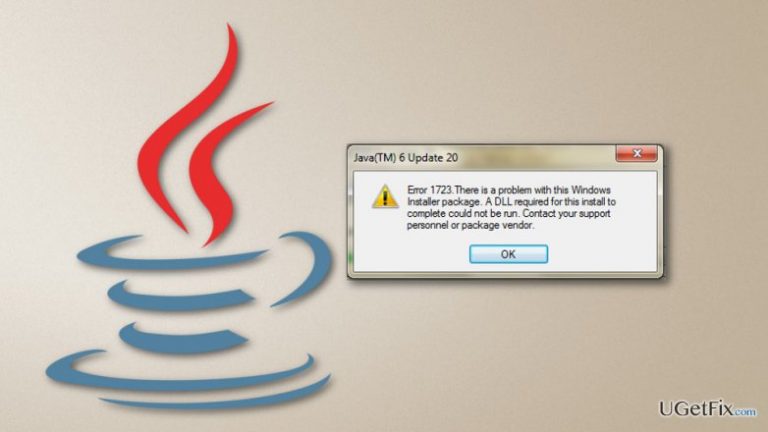
Error 1723. There is a problem with this Windows Installer package. A DLL required for this install could not be run. Contact your support personnel or package vendor.
Usually, this error is triggered by the false attempts to delete Java. Thus, if you haven’t run uninstallation programs and just deleted whole JRE directory, this action might have triggered the error. This error is related to some issues with the registry. During Java installation, a particular DLL file creates some registry entries. The same file is used to remove these entries during uninstallation. Thus, if you have deleted this DLL file, you receive Java Error 1723 message. This error might also prevent you from installing the latest version of Java or updating it. Having and outdated software might lead to serious security issues. Thus, you need to fix this error immediately.
How to Fix Java Error 1723?
In order to fix 1723 error, you need to uninstall Java from the computer and install it again. Depending on the Windows version, you need to go to the Programs’s list and uninstall it like any regular program. Bear in mind that you might need administrator rights to perform uninstallation. However, if you have some difficulties with this procedure, you might need to run the Microsoft utility. This tool helps to repair corrupted files and registry entries that might be preventing from uninstalling Java.
Additionally, you can try to fix Java Error 1723 manually by following these steps:
1. Delete all folders that are related to Java from the computer. Check C:/Program Files/Java and/or C:/Program Files x86/Java directories.
2. Next steps require making changes in the registry. Hence, we highly recommend making registry backups in order to prevent the possible damage. Once you make backups, open regedit: go to Start, select or search Run, and type regedit.
3. When in Windows Registry, expand these directories:
- HKEY_LOCAL_MACHINE
- SOFTWARE
- Microsoft
- Windows
- CurrentVersion
- Uninstall
There you will find files that are named like this:
Mix-Of-Numbers-Letters-And-Dashes
5. Single Click on the very top one. Look through all files that are listed below. Look for the entries that identifies Java, Oracle or has the destination of the Java Install. If you find them, delete that registry folder.
6. When you delete all necessary folders, go to the Program’s list and make sure that Java was successfully uninstalled.
The final step includes reinstalling Java on your computer. Go to the official website - java.com and download the latest version of the program. Now you won’t be bothered by Java Error 1723. What is more, after making changes in the Windows registry it as also recommended scanning computer with some PC optimization tool, such as [rev id=”RegCure Pro”], to fix all files that might have been corrupted.
Bottom line
To fix Java Error 1723, you need to uninstall Java from your computer and then reinstall it. Ensure you have the necessary administrator rights for uninstallation. If these steps do not resolve the issue, further troubleshooting may be required.
Frequently asked questions
Java Error 1723 occurs due to a corrupted installation of Java or missing Windows components necessary for the installation. This can often be resolved by repairing or reinstalling Java.
To fix Java Error 1723 on Windows 11, you can run the Windows Installer Troubleshooter or manually register the Windows Installer service. Additionally, ensure that all Windows updates are installed.
Yes, you can use the command 'msiexec /x {ProductCode}' to uninstall Java and then reinstall it to repair any issues causing Error 1723 on both Windows 10 and Windows 11.




Report an issue
What's wrong with this guide? We review every report and update or remove content.
Report received — thank you. We'll review and fix it.
You need a free account to submit a report.
Be the first to comment