
opencl.dll is missing or OpenCL fails: what the file is and how to fix it
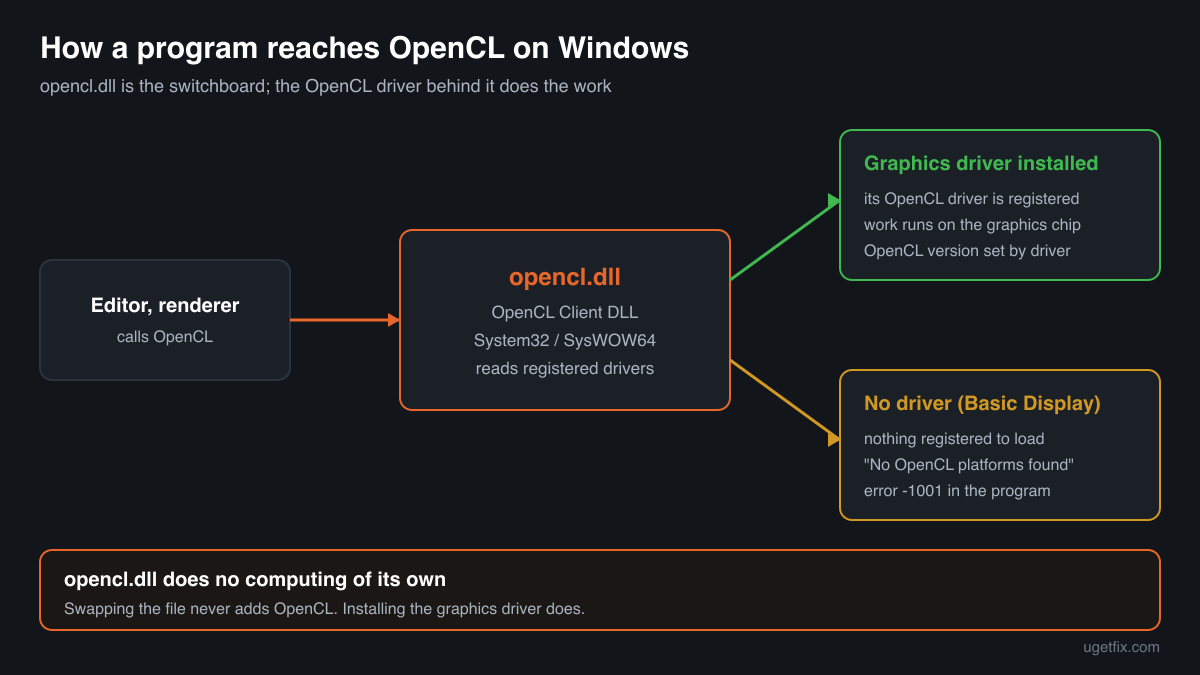
opencl.dll is the OpenCL Client DLL, the Windows library that programs load to run calculations on the graphics card: video editors, 3D renderers, photo tools, scientific software and benchmarks. It is part of Windows, so there is nothing to install. The file itself does no computing. It looks for the OpenCL driver of your graphics hardware and hands the work to it, which is why most opencl.dll errors are fixed with the right graphics driver, not with a file.

Prefer to fix it yourself? The manual steps follow.
How to fix opencl.dll errors
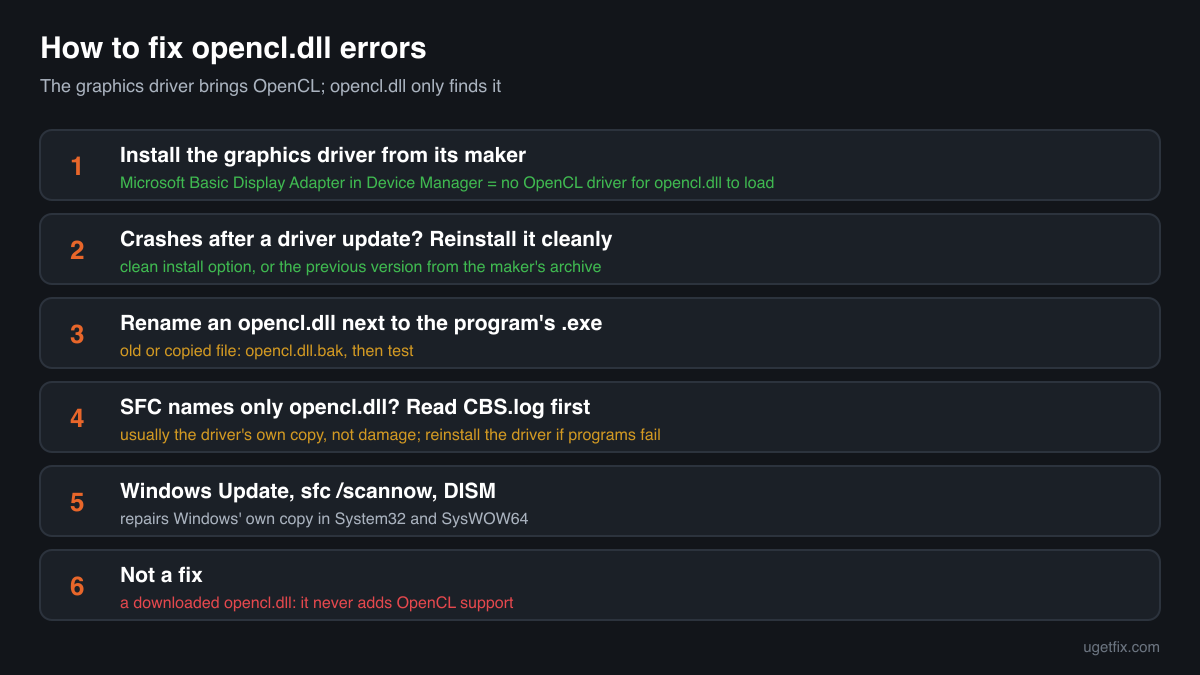
First install the graphics driver from the maker of your graphics chip, the card itself or, on a laptop, the laptop maker. OpenCL itself comes with that driver: without it, opencl.dll finds no OpenCL device and programs report that OpenCL is not available. Next, look in the folder of the program that fails, next to its .exe: an opencl.dll there is not Windows' copy, so rename it to opencl.dll.bak and test. If neither applies, repair Windows: install the pending updates, then run sfc /scannow and DISM.
A downloaded opencl.dll never adds OpenCL support. Windows already has the file in System32 and SysWOW64, and graphics drivers often install their own copy as well. If System File Checker names opencl.dll after a graphics driver was installed, read the step about that report below before you replace anything.
Step by step
- Check which display driver Windows uses. Right-click Start, open Device Manager and expand Display adapters. You should see the name of your graphics chip from its maker. If you see Microsoft Basic Display Adapter, or a device with a yellow warning sign, no working graphics driver is installed. opencl.dll then has no OpenCL driver to load, and every program that needs OpenCL reports that no OpenCL device or platform was found.
- Install the graphics driver from its maker. Download the current driver for your exact graphics chip from the chip maker's site, or from the laptop maker's support page if the laptop uses its own driver package. Install it and restart. The full driver package includes the OpenCL support for your hardware, which opencl.dll finds through the registry when a program starts. This one step fixes most "OpenCL not available", "no OpenCL platforms found" and "OpenCL device not supported" messages.
- Started after a driver update? Reinstall it cleanly. If OpenCL programs began to fail or crash right after a graphics driver update, reinstall the driver: use the clean installation option of the maker's installer if it has one, or uninstall the display device in Device Manager, tick the option to remove the driver software, restart and install the driver again. If the new driver is the problem, install the previous version from the maker's archive and wait for the next release.
- Look in the program folder. Right-click the program's shortcut and choose Open file location. An opencl.dll next to the .exe is not Windows' copy. Some programs ship their own, others got one from a DLL fix guide, a forum post or a copied folder. Windows loads that copy instead of its own, and an old one lacks the functions newer programs call. Rename it to opencl.dll.bak, start the program, and keep the rename if it now works.
- Check that the program runs on the right graphics chip. On a PC with two graphics chips, choose in the program's settings which OpenCL device it uses, and set the program to High performance under Settings, System, Display, Graphics. Over Remote Desktop or inside a virtual machine without graphics acceleration, the graphics card's OpenCL driver may not be reachable at all: start the program on the PC itself.
- System File Checker names opencl.dll? Read the log first. Graphics drivers often replace the Windows copy of opencl.dll with their own. System File Checker compares the file with the copy Windows stored, finds a different file, and can report it as corrupt or as a file it could not repair. To see which files the report is about, run findstr /c:"[SR]" %windir%\Logs\CBS\CBS.log > "%userprofile%\Desktop\sfc.txt" in an administrator Command Prompt and open sfc.txt. If opencl.dll is the only file listed and your OpenCL programs work, the driver's copy is the cause, not damage. If System File Checker does put Windows' copy back and OpenCL programs fail afterwards, reinstall the graphics driver.
- Install Windows updates and restart. Open Settings, Windows Update, install everything that is offered and restart, even if Windows does not ask. Updates replace system files, opencl.dll included, with the current build for your Windows release. Windows Update can also offer a driver for the graphics chip, though the maker's own driver is often newer and more complete.
- Run System File Checker. Type cmd in the Start menu, right-click Command Prompt and choose Run as administrator. Run sfc /scannow and wait until it reaches 100%. It compares protected Windows files with the stored originals and repairs a damaged or missing opencl.dll in System32 or SysWOW64. Restart afterwards.
- If System File Checker cannot repair everything, run DISM. In the same administrator window run DISM /Online /Cleanup-Image /RestoreHealth. It repairs the store that System File Checker copies its originals from, using Windows Update. When it finishes, run sfc /scannow once more, then restart. A remaining report that lists only opencl.dll on a PC with a graphics driver is the case from the step above.
- Still failing: repair Windows in place. On Windows 11, Settings, System, Recovery offers Fix problems using Windows Update, which reinstalls the current version of Windows and keeps your files, apps and settings. On Windows 10 the same result comes from running Microsoft's installation media and choosing to keep personal files and apps. Install the graphics driver again afterwards.
Download the genuine opencl.dll for your Windows version
Each file below is Microsoft's own opencl.dll for one Windows release, fetched from Microsoft's own server and checked against Winbindex, the index of the files in Windows images and updates. Pick your Windows version (Settings, System, About shows it) and the build: 64-bit for System32, 32-bit for SysWOW64. The repair steps above are still the better fix: the file contains no OpenCL support for your graphics card, Windows protects these folders and keeps its copy updated, and your graphics driver may install a newer opencl.dll of its own. Use a file here to compare it with a copy you have, or when System File Checker and DISM cannot repair the file.
Older Windows releases
A free uGetFix account is needed to download. Sign in, or create one in a minute, and you come straight back here.
What not to do
Do not expect a downloaded opencl.dll to make OpenCL work.
opencl.dll only finds the OpenCL driver of your hardware. If no graphics driver with OpenCL support is installed, every genuine opencl.dll, from any Windows release or download site, finds nothing, and the program reports the same error as before.
Do not download opencl.dll from a DLL collection site.
You cannot tell which Windows release, driver or architecture the file comes from, or whether it was changed. A copy that matches nothing Microsoft has published is how tampered files get onto a PC. Use the genuine files above, and the checker below for a file you already have.
Do not copy a file into System32 or SysWOW64 by hand.
These copies are protected Windows files, and every OpenCL program on the PC goes through them. A hand-placed file of the wrong build or architecture can break all of them at once, and the next update, driver installation or System File Checker run may replace it anyway.
Do not chase a System File Checker report that names only opencl.dll.
On a PC with a graphics driver, that report usually means the driver's copy differs from Windows' stored one. Running sfc /scannow again and again, or replacing the file by hand, does not change that and can leave OpenCL programs without the driver's copy.
Do not put a Windows copy into the program folder.
A Windows opencl.dll next to the .exe adds nothing, because Windows already loads the one in System32 or SysWOW64. It stays behind, out of date, when Windows or the driver updates its own, and a 32-bit or 64-bit mismatch there causes error 0xc000007b.
Check the copy on your PC
Choose the opencl.dll you are unsure about, for example the one in a program folder. Its checksum is calculated in your browser and compared with 65 Microsoft builds of the file from Windows releases and updates.
The file stays on your computer. Nothing is uploaded: the checksum is computed locally.
Found an opencl.dll you did not expect, in a folder you did not change, in Downloads, Temp or AppData? Programs load a file with this name from their own folder, so the name is also useful to malware. That is a security question, not a missing-file one. Is opencl.dll outside System32 safe? On 2-Spyware
The error messages and what each one means
The wording tells you which problem you have. The first four are the texts Windows shows, with the file name filled in; the others are the kind of message programs, System File Checker and the Windows event log show when OpenCL itself is the problem.
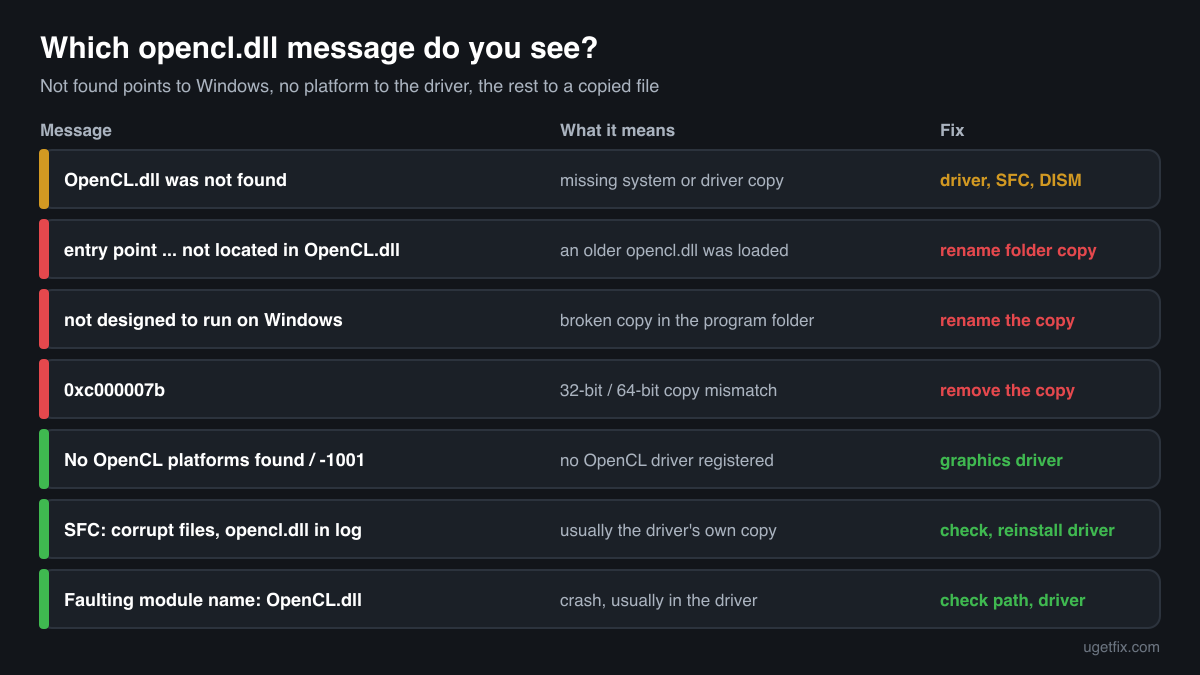
The code execution cannot proceed because OpenCL.dll was not found. Reinstalling the program may fix this problem.
The wording of Windows 10 and Windows 11. Windows includes opencl.dll, so this points to a missing system file, a removed driver copy or, for a 32-bit program, a missing file in SysWOW64. Install the graphics driver, then install updates and run sfc /scannow and DISM.
The procedure entry point clCreateCommandQueueWithProperties could not be located in the dynamic link library OpenCL.dll.
Windows names a function in this message. The program was built for a newer OpenCL than the opencl.dll it loaded, most often an old copy in the program folder. Rename that copy. If there is none, reinstall the graphics driver, which brings current OpenCL support, and install Windows updates.
OpenCL.dll is either not designed to run on Windows or it contains an error. Try installing the program again using the original installation media or contact your system administrator or the software vendor for support.
An opencl.dll was found but could not be loaded. Almost always this is a copy in the program folder: a damaged download, a file of the wrong build, or a file blocked by security software. Rename the program folder copy and test again.
The application was unable to start correctly (0xc000007b). Click OK to close the application.
This one does not name a file, but after a DLL was copied by hand it often means a 32-bit opencl.dll next to a 64-bit program, or the other way round. Remove the copy from the program folder.
No OpenCL platforms found, OpenCL is not available, or error -1001.
Programs word this in their own way; -1001 is the code the OpenCL loader returns when it finds no OpenCL driver at all. opencl.dll is there and working, but no graphics driver with OpenCL support is registered. Install the graphics driver from its maker, and do not run the program over Remote Desktop.
Windows Resource Protection found corrupt files but was unable to fix some of them, with opencl.dll in CBS.log.
System File Checker's report. On a PC with a graphics driver, it usually means the driver replaced Windows' copy with its own. If OpenCL programs work and no other file is listed, it is not damage. If programs fail, reinstall the graphics driver.
Faulting module name: OpenCL.dll
A line from the Application log in Event Viewer after a crash. Look at the Faulting module path line of the same event. If the path is the program folder, the crash happened inside a copy that is not Windows': remove or update it. If it is System32 or SysWOW64, the crash usually started in the OpenCL driver that opencl.dll called: reinstall or change the graphics driver, update the program, then run sfc /scannow.
File facts
opencl.dll is the OpenCL Client DLL. OpenCL is an open interface from the Khronos Group for running calculations on graphics chips and other processors, used by video and photo editors, 3D renderers, scientific software and benchmarks. A program that uses OpenCL loads opencl.dll, which reads from the registry which OpenCL drivers are installed, loads them and passes every call to the one the program chooses. The drivers come with the graphics driver package of each chip maker. Without such a driver, opencl.dll has nothing to offer, and the program sees no OpenCL device. What Windows reports for the genuine file:
- Description in the file
- OpenCL Client DLL
- Where the genuine opencl.dll belongs
C:\Windows\SysWOW64C:\Windows\System32\DriverStore\FileRepository\rdvgwddmdx11.inf_amd64_4d3a1b424a257b28C:\Windows\System32\DriverStore\FileRepository\rdvgwddmdx11.inf_amd64_56e80bfaf9ee788bC:\Windows\System32\DriverStore\FileRepository\rdvgwddmdx11.inf_amd64_6a3f427b9fd7b6a4C:\Windows\System32\DriverStore\FileRepository\rdvgwddmdx11.inf_amd64_91ab86e886645695C:\Windows\System32\DriverStore\FileRepository\rdvgwddmdx11.inf_amd64_b3ecd559f2f47852
On 64-bit Windows, System32 holds the 64-bit file and SysWOW64 the 32-bit one; the folder names are historical. Copies inside Windows' own driver packages under System32\DriverStore\FileRepository are normal too. When a program starts, Windows looks for opencl.dll in the program's own folder first, so a file with this name next to the .exe is loaded instead of the Windows copy. The genuine file describes itself as OpenCL Client DLL (Properties, Details, File description) and is small: in Windows 11 24H2 and 25H2 the 64-bit file is 98,304 bytes and the 32-bit file 66,560 bytes, in Windows 10 22H2 they are 28,672 and 23,552 bytes. A copy installed by a graphics driver has another version number and size.
opencl.dll versions by Windows release
Every Windows release has its own build of opencl.dll, updated together with Windows: version 1.2.11.0 in Windows 10, 3.0.1.0 and 3.0.6.0 in Windows 11. Winbindex lists 53 distinct Microsoft builds; the table shows the newest one indexed for each release and the update that delivered it. Which OpenCL version your programs get does not depend on this build: it comes from the graphics driver.
| Windows release | File version | Delivered by | Size, 64-bit |
|---|---|---|---|
| Windows 11 26H1 | 3.0.6.0 | KB5127646, October 13, 2026 | |
| Windows 11 25H2 | 3.0.6.0 | original release | 98,304 bytes |
| Windows 11 24H2 | 3.0.6.0 | original release | 98,304 bytes |
| Windows 11 23H2 | 3.0.1.0 | KB5126653, October 13, 2026 | 118,784 bytes |
| Windows 11 22H2 | 3.0.1.0 | KB5066793, October 14, 2025 | 118,784 bytes |
| Windows 11 21H2 | 3.0.1.0 | KB5044280, October 8, 2024 | 114,688 bytes |
| Windows 10 22H2 | 1.2.11.0 | KB5066198, September 25, 2025 | 28,672 bytes |
| Windows 10 21H2 | 1.2.11.0 | KB5126657, October 13, 2026 | 28,672 bytes |
| Windows 10 21H1 | 1.2.11.0 | original release | 28,672 bytes |
| Windows 10 20H2 | 1.2.11.0 | KB5026361, May 9, 2023 | 28,672 bytes |
| Windows 10 2004 | 1.2.11.0 | KB5008212, December 14, 2021 | 28,672 bytes |
| Windows 10 1909 | 1.2.11.0 | KB5013945, May 10, 2022 | 27,648 bytes |
Older copies of opencl.dll found on PCs
Public DLL catalogues have collected 12 copies of opencl.dll uploaded from PCs, from version 1.0.0.0 to 24.20.11021.1000. Most were installed by graphics drivers rather than by Windows, which is why their version numbers look so different. The table lists each with its checksums, so you can tell which one you have.
None of these replaces the file your Windows ships, and none adds OpenCL support: the newest build indexed for Windows is 3.0.6.0, and each release keeps its own. If the check on this page finds your file in this list, it is most likely a driver's copy or an older build that was copied somewhere by hand. Remove a copy from the program folder, reinstall the graphics driver if OpenCL fails, and let Windows and the driver keep their own.
| Version | Build | Size | MD5 | SHA-1 |
|---|---|---|---|---|
24.20.11021.1000 | 64-bit | 174 KB | 9abd85d472c411a1991ff350656bc9fe | 845168ae143fbab26f08f2904ea74f7ed2899216 |
23.20.15002.11 | 64-bit | 164 KB | d09538bcdaf1bd0facdc6e400ef9880c | e102bc0d6f798bb6b9e8c5053d47ad8d30aca4f8 |
23.20.793.1024 | 64-bit | 164 KB | 7fcf1e9832d2252d269a1d077e3ae096 | 959ec8cd1bbd060fae90c8a78f1a7ae003da2944 |
2.2.2.0 | 64-bit | 430 KB | db7fc9c087085235e672dc11c2756b33 | 9631c8ce94b17e74741d9a510741e932eaeccf49 |
2.2.1.0 | 32-bit | 451 KB | 8b57a359749e656db9f0fb3e4c2cc358 | 82a996e550c53caea90ac3067477eda82407284b |
2.0.4.0 | 64-bit | d2075893570da1b6766977d858fb9508 | 9c6f37fd3d4a4f6f67e1a9cbb9ef810ad408ff4b | |
2.0.4.0 | 32-bit | f7600db8216a8fc167eb759063f01ce0 | d2874e06c1d92e2f03bfb4b425f834b02720c0d7 | |
1.2.11.0 | 32-bit | 195 KB | 4cbacc9461232bdd5e97fec916246038 | 894f5369d8facc3184df3f5ecbbf38381fc62c5f |
1.2.11.0 | 32-bit | c9afba8b2b96a9ef3bde2c3753079121 | 9cadcc53222f3ea9e1c8d27ca4ba2675f9b39dad | |
1.0.0.0 | 32-bit | 54327e0d9111e17d140089a74ece2c6f | c1ece7d0ac5f6d8c2417deea6419e12a2290a131 | |
1.0.0.0 | 32-bit | 8bdb447b46fb96ec17062833383e64a1 | d42eb5a56d17a4133d59c82d724c3f5044908889 | |
1.0.0.0 | 32-bit | c4f271897205db916f46ce88f910eb5b | 6223d0d1146c8c3624bdb0db7576c5e915ead8a7 |
Copies uploaded by users to a public DLL catalogue, read on 18 October 2026. We list their checksums so you can identify a file; we do not offer them for download and we did not verify each one against a digital signature.
Questions people ask
Is opencl.dll a virus?
The copies in System32 and SysWOW64 are genuine files, from Windows or from your graphics driver, and are harmless. An opencl.dll anywhere else was put there by a program or by hand. Check the file with the tool on this page and read the security page linked above.
How do I install or update OpenCL on Windows?
By installing or updating the graphics driver. OpenCL is not a separate download for most PCs: the driver of your graphics chip brings the OpenCL support, and opencl.dll finds it. Install the current driver from the chip maker or laptop maker, and the OpenCL version your hardware supports comes with it.
Why does System File Checker say opencl.dll is corrupt?
Usually because a graphics driver installed its own opencl.dll over the Windows copy. System File Checker sees a file that differs from the one it stored and reports it. If OpenCL programs work and no other file is listed, the PC is fine. If System File Checker replaced the file and programs now fail, reinstall the graphics driver.
Why does a program find no OpenCL device?
Because no OpenCL driver is registered for it. The usual causes are a missing graphics driver (Microsoft Basic Display Adapter in Device Manager), a driver installed without its OpenCL part, a program running on the wrong graphics chip, Remote Desktop, or a virtual machine without graphics acceleration.
Can I delete opencl.dll?
Not the copies in System32 or SysWOW64: every OpenCL program needs them, and Windows treats them as protected system files. An opencl.dll in a program folder can be removed or renamed safely as far as Windows is concerned; the program then uses the copy in the Windows folders and your graphics driver.
Should I use the 32-bit or the 64-bit file?
Windows needs both and already has both: the 64-bit file in System32 for 64-bit programs and the 32-bit file in SysWOW64 for 32-bit ones. A program uses the one that matches it. Copying either into a program folder causes error 0xc000007b when the build does not match the program.
Why do OpenCL programs crash after a graphics driver update?
The crash usually happens inside the new driver, even when Event Viewer names OpenCL.dll as the faulting module, because the program reaches the driver through that file. Reinstall the driver cleanly, try the previous version from the maker's archive, and update the program.
Related guides
opencl.dll is missing or OpenCL fails: what the file is and how to fix it
FixHow to fix AMDRSServ.exe - System Error in Windows?
Sources
- Winbindex, the Windows binaries index (m417z)
- Microsoft Learn: Use the System File Checker tool to repair missing or corrupted system files
File data read on October 18, 2026.

The editors who write and check uGetFix guides and reference pages. File facts are read from Microsoft's own installers and documentation, and every page shows the date its data was read.
Questions and experiences
Ask about this page: members and our editors answer. Reading is open; writing needs a free account.
…