How to fix
Clicking hard drive
on windows
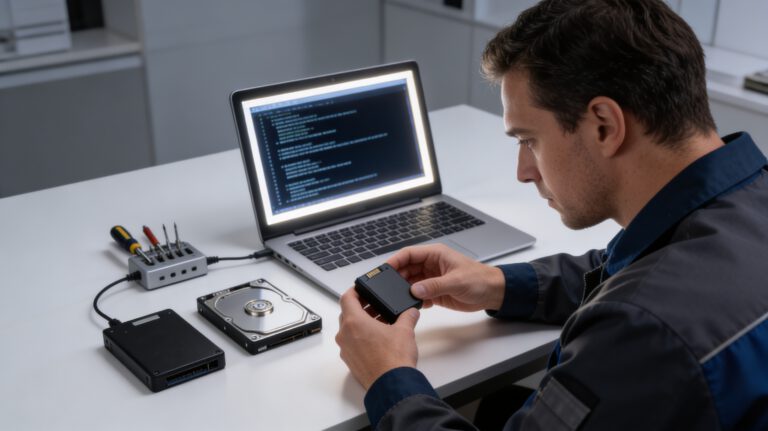
A clicking hard drive is a warning sign of potential storage failure, often indicating issues with read and write operations. This guide outlines steps to address the problem effectively.

Is this your error?
Match two or more signs — you are likely dealing with clicking hard drive.
What causes clicking hard drive?
- Power delivery issues
- Connection quality problems
- Physical damage inside the drive
- Overheating
- Dust buildup
- Aging components
- Faulty external enclosure
Fix in 2 steps
Download and install the recovery tool on another healthy drive. Connect the clicking hard drive to the Windows PC. Open the recovery program and select the clicking disk or partition. Start a scan for lost data on the selected drive. Review the scan results and use the filter or search field. Select the files you need and recover them to another location.
Stop using the clicking drive as soon as it becomes unstable. Prepare the drive details for a recovery evaluation. Contact the data recovery service from the source material. Submit the drive for manual inspection.
Repairs Windows system files, removes malware, and restores a clean OS state — without reinstalling.
Hard Drive Clicking? See How to Fix Click Hard Drive On Your Own
A clicking hard drive is usually the first audible sign that the drive is struggling to complete normal read and write operations, and the sound often arrives before the system stops detecting the disk altogether. On Windows 10, Windows 8, and Windows 7, the symptom can show up when the computer starts, when an external drive is connected, or while files are being opened from an internal drive. The noise may be faint and intermittent, or it may turn into a rapid, repeated click that users often describe as a “click, click, click” pattern. In the source material, the problem is treated as a storage failure warning, not a harmless sound effect, because the drive may still appear powered on while the mechanical parts inside are no longer working correctly.
That distinction matters because the user can still see a drive letter, a light on the enclosure, or even partial access to the disk while the clicking continues. In that state, the drive may be readable for a short time, but file listings can come back empty, folders can fail to open, or the system may freeze when it tries to access the device. The source also separates two broad conditions: a clicking hard drive that is still accessible and a clicking hard drive that is no longer detected. Those two states do not behave the same way, and they do not demand the same first move. When the drive is still opening files, the urgent task is to protect the data before any further troubleshooting. When the drive is no longer recognized, the user is already dealing with a deeper hardware or connection fault that can keep the system from mounting the disk at all.
The sound itself can be misleading because not every click from a disk means the same thing. A low, slight click can appear when a drive is still alive and performing some activity, while a louder and faster sequence can signal a more serious head or service-area problem. The source material calls the severe version a “death of click” issue, which reflects a drive that is no longer able to recover its normal operation cycle. That is why the article separates symptom patterns instead of treating all clicking as one generic failure. The state of the noise gives a clue about whether the disk is merely having trouble communicating or whether it is already moving toward physical breakdown.
The cause is often tied to power delivery, connection quality, or physical damage inside the drive. An external hard drive can click when it is not getting enough power through the USB port or enclosure, and the mechanism behind that problem is simple: the motor or actuator cannot keep a stable operating state, so the drive repeatedly attempts and fails to spin or initialize. A loose or broken cable can create the same effect because the drive keeps losing the signal or supply it needs to stay online. A mismatch between connection standards, such as using an incompatible cable or port, can also leave the drive in a partial startup state where it never fully initializes and only repeats its startup noises.
Hardware damage is the other major category, and it is the most serious one described in the source. A worn or displaced disk head, a damaged service area, or a damaged PCB can interrupt the drive’s ability to read its own instructions and locate data correctly. Once that happens, the drive may keep trying to recalibrate, and the repeated mechanical attempt creates the clicking sound users hear. The source also points to fire, water exposure, and high temperature as physical damage sources, which can deform parts inside the drive or weaken the electronics that coordinate movement. Those failures do not usually produce a simple software symptom, because the problem sits below Windows and below the file system level.
Heat can create a separate route to the same sound. When a drive overheats, the internal components can expand enough to interfere with precise movement, and the motor or head assembly may begin failing to track correctly. The source pairs this with dust buildup and poor cooling, which makes sense for systems where the drive shares the case with other warm components. The issue is not just temperature alone, but the combination of heat, stale airflow, and aging parts that makes the drive operate outside its normal tolerance. In that state, the clicking may fade when the drive cools, but the underlying wear remains.
Windows matters here because the operating system depends on storage to hold the registry, installed programs, user profiles, cached settings, and the files needed to boot and log in. When a drive clicks, the operating system can only work with whatever portion of the device still responds. The storage subsystem is expected to surface a disk cleanly through the controller, the enclosure, the cable, and the file system layer, but a clicking drive often breaks that chain at the hardware level. That is why a failure may show up as a missing drive, a raw volume, a folder that will not open, or a drive that appears once and disappears the next time Windows refreshes the device list.
The external enclosure adds another layer because it can fail independently of the disk inside it. A bad enclosure bridge, a weak USB connection, or a loose power adapter can make a healthy drive appear defective. That is why the source includes connection troubleshooting before it moves toward more invasive repair options. If the disk is actually fine and the enclosure is not, replacing the cable or moving the drive into another computer can restore access without touching the disk internals. That difference matters because a user can misread an enclosure fault as a catastrophic drive failure and lose time while the files remain recoverable.
Recovery is the first concern because repeated power cycles, repeated clicking, and repeated read attempts can make the damage worse. The source makes that point by placing data recovery before repair, and by separating a still-accessible disk from a failing one. If the drive still opens, the priority is to copy the files out. If it does not, the priority shifts to a recovery service rather than forcing the disk to keep retrying. That order reflects the real-world behavior of failing hard drives, where every extra attempt can push the mechanism farther from a readable state.
The final cause category in the source is outright mechanical or electrical failure, which usually means the drive needs specialist attention or replacement. A replacement path appears in the source alongside manufacturer support and local repair centers, because a drive with a weak head or a damaged control board is no longer a normal Windows troubleshooting case. Once the clicking reaches that stage, Windows can no longer solve the fault on its own, but the system still matters as the place where the first signs are visible and where the recovery attempt begins.
Fix 1. Recover Data Before Troubleshooting
This method addresses the most urgent condition first, which is a clicking drive that still responds enough to copy files off it.
- Download and install the recovery tool on another healthy drive.
- Connect the clicking hard drive to the Windows PC.
- Open the recovery program and select the clicking disk or partition.
- Start a scan for lost data on the selected drive.
- Review the scan results and use the filter or search field.
- Select the files you need and recover them to another location.
Fix 2. Use Data Recovery Service
This option fits drives that still detect but cannot be restored with software, especially when the disk is RAW or corrupted.
- Stop using the clicking drive as soon as it becomes unstable.
- Prepare the drive details for a recovery evaluation.
- Contact the data recovery service from the source material.
- Submit the drive for manual inspection.
- Let the specialists handle corrupted partitions, RAW drives, or damaged virtual disks.
- Wait for the recovery result before making any repair attempts.
Fix 3. Check the Connection Chain
This method targets the most common external-drive cause in the source, which is a cable, port, or power problem that keeps the disk from initializing correctly.
- Turn off the PC and disconnect the external drive.
- Inspect the connection cable for visible damage.
- Reconnect the power cable tightly if the drive uses one.
- Try a different USB port on the computer.
- Connect the drive to another Windows PC.
- Remove the drive from its enclosure and connect it directly if possible.
Fix 4. Cool the Drive and Clear Dust
This fix is aimed at overheating, which can make mechanical parts misbehave and produce clicking during repeated attempts to read or spin up.
- Shut down the computer.
- Open the case and remove dust from the fan area.
- Add extra cooling if the system has poor airflow.
- Leave the drive idle until it cools down.
- Restart the computer after the temperature drops.
- Back up the drive immediately if it becomes accessible again.
Fix 5. Contact Repair Support or Replace the Drive
This approach is for persistent clicking that points to failed heads, damaged components, or another hardware fault beyond normal Windows repair.
- Check whether the drive is still under warranty.
- Contact the manufacturer support team.
- Take the drive to a local repair center if needed.
- Ask for control board or disk head replacement where appropriate.
- Replace the drive if the damage is beyond repair.
- Move recovered data to a new storage device as soon as possible.
Bottom line
Addressing a clicking hard drive promptly can prevent data loss and further damage. If the drive is unresponsive, consider professional recovery services.
References



Report an issue
What's wrong with this guide? We review every report and update or remove content.
Report received — thank you. We'll review and fix it.
You need a free account to submit a report.
Be the first to comment