
Gdrv2.sys "A driver cannot load on this device": how to fix it in Windows 11 and 10

Prefer to fix it yourself? The manual steps follow.
- 6methods
- 5 to 15 minutes
- Easy
Applies to Windows 11 and Windows 10 PCs with Gigabyte utilities that show "A driver cannot load on this device" for gdrv2.sys
6 methods in this guide
Every time I start my computer, I get a message saying that the Gdrv2.sys driver can't load on my device. I'm using a Gigabyte system with Windows 11, and I'm not sure if it's something serious or how to fix it. Is there a way to stop it?
Gdrv2.sys is a kernel driver that Gigabyte utilities install, and Windows stops it at startup because it detects it as a vulnerable driver. Your PC is protected, not broken. Remove the old Gigabyte tool that loads it, or replace it with the current version, and keep Memory integrity on.
The message means Windows Security blocked gdrv2.sys, a Gigabyte utility driver, because it is on Windows' list of vulnerable drivers. Uninstall the Gigabyte tools you do not use, such as App Center, EasyTune or System Information Viewer (Fix 1). If you need one, install its current version from your board's Gigabyte support page (Fix 2). Do not turn Memory integrity off to make the message go away.
| Error | "A driver cannot load on this device" from Program Compatibility Assistant, naming Driver: gdrv2.sys |
|---|---|
| Where it appears | A small window at every Windows sign-in, or when a Gigabyte utility starts |
| Main cause | An older Gigabyte utility (App Center, EasyTune, System Information Viewer, @BIOS and similar) tries to load gdrv2.sys, and the Microsoft vulnerable driver blocklist or Memory integrity stops it |
| Fastest fix | Uninstall the Gigabyte tools you do not use (Fix 1); install the current one only if you need it (Fix 2) |
| Also written as | gdrv2.sys, gdrv2 sys, gdrv2, driver gdrv2 sys, gdrv2.sys driver; the older file is gdrv.sys |
| Affects | Windows 11 (25H2, 26H2) and Windows 10 22H2 PCs with a Gigabyte motherboard, graphics card or laptop utility installed |
| Microsoft's view | A blocked driver has a vulnerability and is most likely not malicious; look for an updated driver first, and ask the maker if none exists |
| Security background | The older gdrv.sys from Gigabyte tools has four public flaws (CVE-2018-19320 to CVE-2018-19323) that let a program read and write kernel memory |
| Time to fix | 5 to 15 minutes, with one restart |
Facts checked on 15 October 2026. Steps written for Windows 11 (25H2 and 26H2) and Windows 10 22H2.
What gdrv2.sys is and what "A driver cannot load on this device" means
Gdrv2.sys is a kernel mode driver that Gigabyte utilities install so they can talk to the motherboard or graphics card directly: read sensors, change clock speeds, control RGB lighting or flash the BIOS from Windows. To do that, the driver gets very wide access to memory and hardware. That access is exactly what Windows now checks.
The window comes from Program Compatibility Assistant. It says Windows Security refused to load the driver. The text is clear about why: the driver was detected as vulnerable, not as broken or missing.
- Title
- A driver cannot load on this device
- Driver line
- Driver: gdrv2.sys
- Reason line
- A security setting is detecting this as a vulnerable driver and blocking it from loading. You'll need to adjust your settings to load this driver
- Buttons
- Learn more, Cancel and a box Don't show this message again
- Which setting
- The Microsoft vulnerable driver blocklist, which is on by default since the Windows 11 2022 update and is always enforced while Memory integrity is on
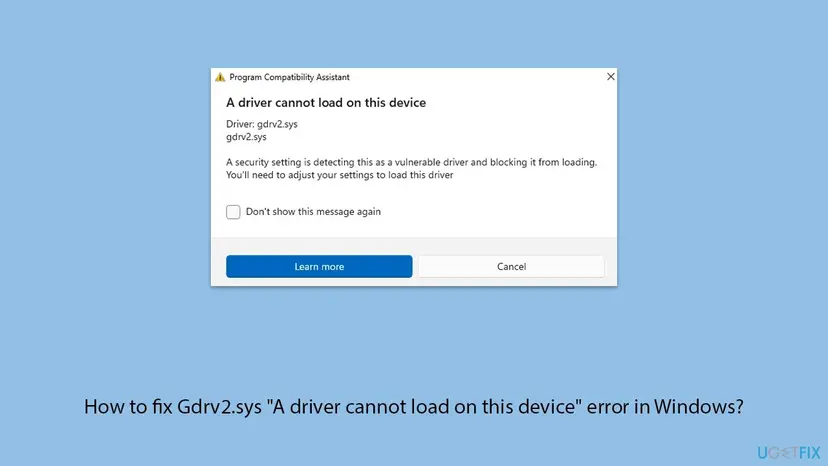
Attackers use signed but flawed drivers to get into the Windows kernel, a trick called "bring your own vulnerable driver". The older Gigabyte driver gdrv.sys has four published flaws (CVE-2018-19320, -19321, -19322, -19323) that allow reading and writing physical memory and hardware registers. Microsoft calls such drivers most likely not malicious: Gigabyte did not make malware. But any program on your PC could misuse the driver once it is loaded, so the block protects you.
We could not confirm in a Gigabyte or Microsoft document which exact flaw puts gdrv2.sys on the list, or which Gigabyte versions ship it. What is certain is what the window says: Windows treats this driver as vulnerable.
Why the gdrv2.sys error appears on Windows 11, from most to least common
Most often an old Gigabyte utility, installed years ago or bundled with a motherboard driver disc, still starts with Windows and tries to load gdrv2.sys. Less often you use the tool and it is simply out of date. Rarely, the tool is gone but a leftover driver entry still tries to load.
| Cause | How common | What you see | Fix |
|---|---|---|---|
| Old Gigabyte utility you no longer use still installed | Most cases | The message at every sign-in, Gigabyte entries in Installed apps | Fix 1 |
| Gigabyte utility you still need is an old version | Common | The tool opens but its sensor, fan or overclocking parts do not work | Fix 2 |
| A Windows update or a new PC turned the blocklist or Memory integrity on | Common | The message started after an update, nothing else changed | Fix 1 or Fix 2, then Fix 3 |
| Driver from the device maker is newer on Windows Update | Less common | An optional Gigabyte driver is offered | Fix 4 |
| Leftover driver entry after the tool was removed | Rare | No Gigabyte app installed, the message still appears | Fix 5 |
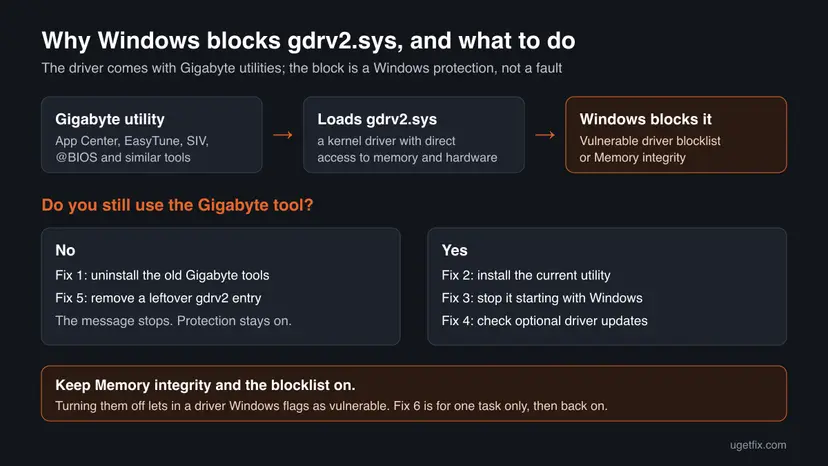
How to fix the gdrv2.sys "A driver cannot load on this device" error on Windows 11 and Windows 10
Start with Fix 1: most readers do not use the Gigabyte tool that loads the driver. Fix 2 and Fix 3 are for those who do. Fix 6 exists because Microsoft mentions it, but it lowers protection and is meant for one task only. You need an administrator account.
| What you see or have | Start with |
|---|---|
| You do not know what App Center, EasyTune or SIV are, or never open them | Fix 1 |
| You use a Gigabyte tool for fans, RGB lighting or monitoring | Fix 2, then Fix 3 |
| You want to keep the old tool and just stop the window | Fix 3 |
| No Gigabyte app is installed but the message still appears | Fix 5 |
| You must run an old Gigabyte tool once, for example to flash the BIOS from Windows | Fix 6, then turn protection back on |
Fix 1. Uninstall the Gigabyte utilities you do not use
5 minutesLow riskEveryone who does not open the Gigabyte tool regularly. This is most readers with the message.
The driver only tries to load because a Gigabyte program asks for it. When the program is gone, nothing requests gdrv2.sys and the window stops. Windows does not need the driver for the motherboard to work.
- Windows 11: open Settings > Apps > Installed apps. Windows 10: open Settings > Apps > Apps & features.
- Type
Gigabyteinto the search box above the list, then also tryApp Center,EasyTune,SIVand@BIOS. - Select ... next to each Gigabyte utility you do not use and choose Uninstall. Some App Center modules show as separate entries.
- Accept the Gigabyte uninstaller's prompts.
- Restart the PC and sign in again.
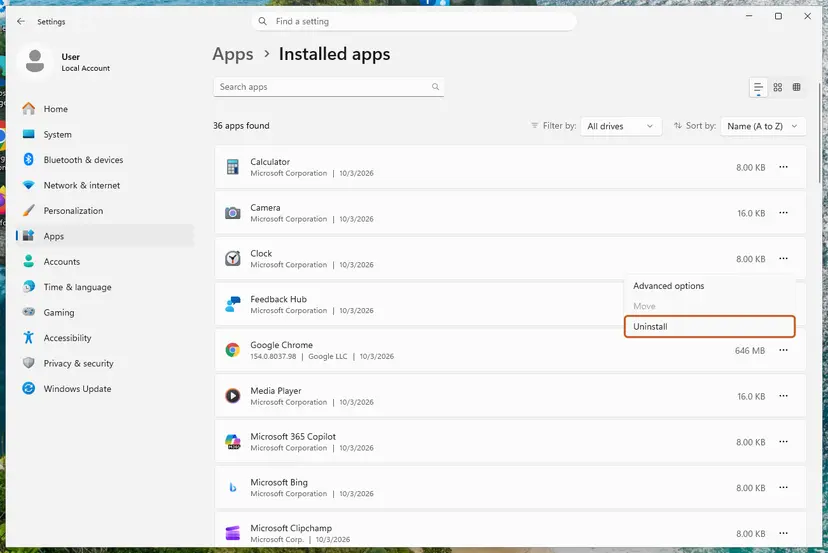
Chipset, LAN, audio and graphics drivers are not utilities: leave them. The tools to remove are the ones you open by hand to tune, monitor or light up the PC. The general steps are in Uninstall a program or app in Windows.
It worked if: After the restart no "A driver cannot load on this device" window appears.
If not: If the window still names gdrv2.sys and no Gigabyte app is left, go to Fix 5. If you need the tool back, use Fix 2.
Fix 2. Install the current Gigabyte utility for your board from Gigabyte's support page
10 minutesLow riskReaders who use a Gigabyte tool for fan curves, RGB lighting, monitoring or overclocking.
Microsoft's first advice for a blocked driver is an updated driver from the maker. The utility page for your exact board lists the version Gigabyte offers today, and installing it with protection on shows at once whether its driver is accepted.
- Uninstall the old Gigabyte tool first (Fix 1), so its driver is not left behind.
- Find your model: press Win + R, type
msinfo32and read BaseBoard Product (motherboard) or System Model (laptop). - Open the Gigabyte website, go to Service/Support and search for that model.
- Open Support > Utility, choose your Windows version and download the current utility listed there.
- Install it and restart.
- Check whether the message still appears at sign-in.

Newer Gigabyte boards list one combined tool instead of separate App Center modules; the query "gigabyte control center won't open" comes from it. We could not confirm from Gigabyte which of its current tools still use a gdrv driver, so the test after installing is the only reliable check.
It worked if: The tool works and no gdrv2.sys window appears at sign-in.
If not: If the current version still triggers the window, Gigabyte has not shipped a driver Windows accepts for your board yet: use Fix 3 to keep the tool quiet, and ask Gigabyte support when a fixed driver comes.
Fix 3. Stop the Gigabyte tool from starting with Windows, or hide the notice
3 minutesNo riskReaders who want to keep an old Gigabyte tool installed for now, without the window at every sign-in.
The window appears because the tool runs at sign-in and asks for the driver. If it does not start on its own, nothing asks. The protection stays on, and only the parts of the tool that need gdrv2.sys stay unavailable.
- Windows 11: open Settings > Apps > Startup. Windows 10: open Task Manager with Ctrl + Shift + Esc and select the Startup tab.
- Turn off every Gigabyte entry, for example App Center, EasyTune or SIV.
- Restart and sign in.
- If the window still appears once, tick Don't show this message again and select Cancel. That only hides the notice: the driver stays blocked.
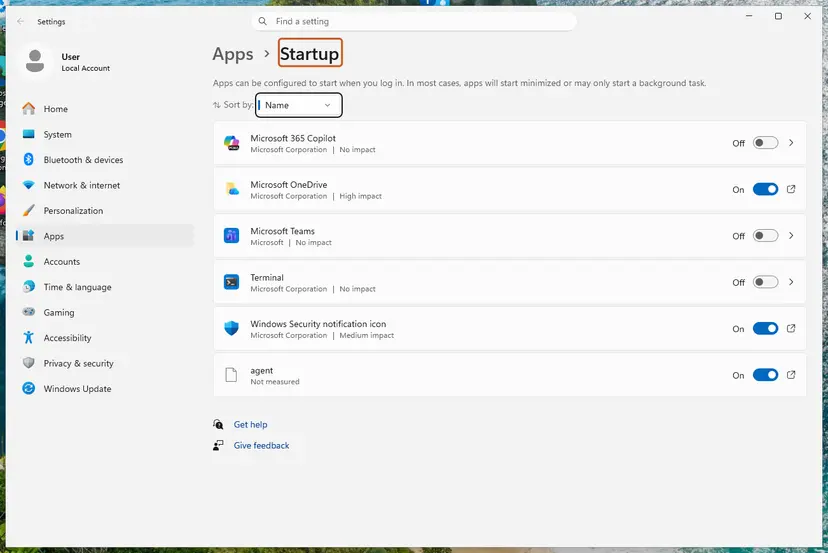
Full steps with both Windows versions: Stop apps from opening at startup.
It worked if: You sign in without the gdrv2.sys window, and Memory integrity is still on.
If not: If the window keeps coming, a Gigabyte service starts the driver, not the app: remove the tool (Fix 1) or the leftover entry (Fix 5).
Fix 4. Look for an updated driver in Windows Update optional updates
5 minutesNo riskReaders who need the Gigabyte tool and found nothing newer on Gigabyte's site.
Microsoft lists Windows Update as the first place to look for an updated, compatible driver. Device makers sometimes publish drivers there before their own pages change. We could not confirm that Gigabyte offers a gdrv2 replacement this way.
- Windows 11: open Settings > Windows Update > Advanced options > Optional updates. Windows 10: open Settings > Update & Security > Windows Update > View optional updates.
- Expand Driver updates and look for a Gigabyte entry.
- Tick it, select Download & install and restart if asked.
Updating a device driver through Device Manager is shown in Update, roll back or reinstall a driver.
It worked if: A newer Gigabyte driver installs and the message does not return.
If not: If nothing from Gigabyte is offered, keep the tool off at startup (Fix 3) and contact Gigabyte support with your board model.
Fix 5. Remove a leftover gdrv2 driver entry with Autoruns
10 minutesRead the warningAdvanced readers who see the window although no Gigabyte utility is installed any more.
An uninstaller can leave the driver's service entry behind, and Windows then tries to load the file at every start. Autoruns, a free Microsoft Sysinternals tool, lists every driver Windows tries to load and can delete that entry.
Deleting an entry in Autoruns removes its registry key. Deleting the wrong driver can stop a device or Windows from starting. Make a restore point or registry backup first: Back up the registry before editing it.
- Download Autoruns from Microsoft's Sysinternals page on learn.microsoft.com and extract the ZIP file.
- Right-click Autoruns64.exe, select Run as administrator, then Yes.
- Open the Drivers tab and type
gdrvinto the filter box. - Check that the entry's image path ends in
gdrv2.sys(orgdrv.sys) and the publisher is Gigabyte. - Right-click that entry, select Delete and confirm.
- Restart the PC.
It worked if: No gdrv entry is left in Autoruns and the window no longer appears at sign-in.
If not: If the entry comes back after a restart, a Gigabyte program is still installed somewhere: check Installed apps again for any Gigabyte or AORUS entry.
Fix 6. Only for one task: switch the protection off, then straight back on
10 minutes plus two restartsRead the warningReaders who must run an old Gigabyte tool once, for example to finish a BIOS update from Windows, and have no other way. Not a fix for the message.
Microsoft names turning Memory integrity off as the option when no updated driver exists. Because gdrv2.sys is blocked as vulnerable, the separate vulnerable driver blocklist switch may have to be off too. Both should be on again as soon as the task is done.
While Memory integrity and the blocklist are off, any program on the PC could use the loaded Gigabyte driver to reach the Windows kernel. On a Secured-core PC, Microsoft says turning Memory integrity off takes the device out of its Secured-core state. Back up important files first, close everything else, and do not browse or open downloads during the task.
- Type
Core isolationinto the taskbar search box and open it. Windows 11 path: Settings > Privacy & security > Windows Security > Device security > Core isolation details. Windows 10: Settings > Update & Security > Windows Security > Device security > Core isolation details. - Set Memory integrity to Off. If the page also shows a Microsoft Vulnerable Driver Blocklist switch, set it to Off as well.
- Restart, run the Gigabyte tool and finish the one task.
- Uninstall the tool again (Fix 1).
- Go back to Core isolation details, set both switches to On and restart.
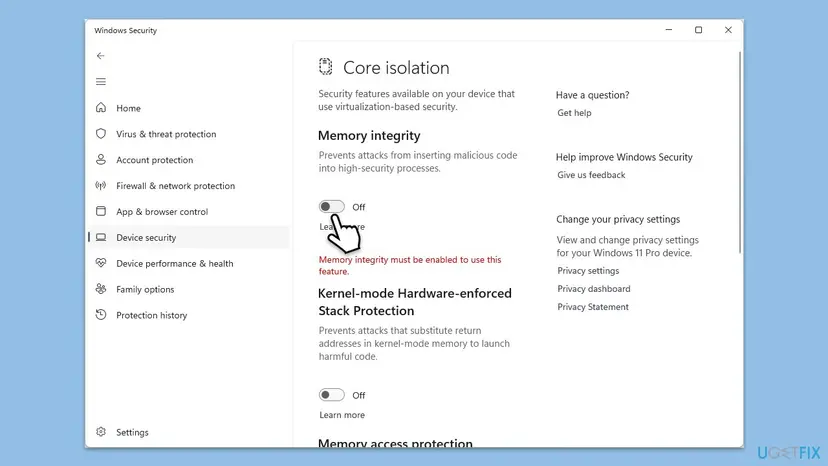
It worked if: The task is done, both switches show On again after the restart, and the Gigabyte tool is gone.
If not: If Memory integrity will not turn back on, Windows Security lists the incompatible driver under Review incompatible drivers: remove that tool and its driver (Fix 1, Fix 5), then try again.
The gdrv2.sys window still appears: what to check and what to send Gigabyte
The window itself is the most direct log: it names the driver Windows blocked. If it now names another file than gdrv2.sys, the same approach applies to that file and its maker. Microsoft notes that the driver name and company name in the notice are the only reliable details it has about the driver.
- Core isolation details lists incompatible drivers: select Review incompatible drivers to see each file and its published name. Remove the program that installed it.
- Another file name appears, such as RTCore64.sys or AsrDrv103.sys: those belong to other vendors' tuning tools (MSI Afterburner with RivaTuner, ASRock utilities). Treat them the same way.
- The Gigabyte tool opens but fans, RGB or sensors do nothing: that is the blocked driver. Fix 2 is the only lasting way to get it back with protection on.
- The switch is greyed out: an organisation manages the PC, or the processor does not support Memory integrity. That is not caused by gdrv2.sys.
Your board or laptop model from msinfo32, your Windows version from winver, the name and version of the Gigabyte utility, and a photo or screenshot of the "A driver cannot load on this device" window.
Keep gdrv2.sys from coming back after a Gigabyte install
- Install only the Gigabyte utilities you really use, from your model's Utility page.
- Skip bundled tools on old motherboard driver discs; install chipset and network drivers only.
- Check Core isolation once after every Gigabyte install.
- Turn Memory integrity or the vulnerable driver blocklist off for good to keep an old tool working.
- Download gdrv2.sys or gdrv.sys from file download sites.
- Use "driver updater" programs to look for this driver.
Microsoft updates the vulnerable driver blocklist through the monthly Windows updates. That is why the message can appear one day with no change on your side. Windows 10 left support on 14 October 2025, so a PC that stays on Windows 10 no longer gets those updates.
Frequently asked questions
What is gdrv2.sys?
It is a kernel mode driver from Gigabyte that its utilities, such as App Center, EasyTune and System Information Viewer, use to read sensors and change hardware settings from Windows. It is not a Windows file and Windows does not need it to run. The message appears because Windows Security detects it as a vulnerable driver and stops it from loading. Microsoft says such drivers are most likely not malicious, but their flaws can be misused by other programs.
Is the gdrv2.sys message dangerous? Is it a virus?
No, the message itself is Windows protecting you, and gdrv2.sys is not a virus. The risk sits in the driver: a vulnerable kernel driver can be used by malware to gain full control of Windows, a known attack called bring your own vulnerable driver. The older gdrv.sys from Gigabyte has four public flaws of that kind. As long as the driver stays blocked, your PC is safe from it. If you want to be sure, run How to scan for malware with Microsoft Defender.
How do I fix gdrv2.sys on Windows 11?
Uninstall the Gigabyte utilities you do not use in Settings > Apps > Installed apps and restart (Fix 1). That ends the message for most people. If you need the tool, install the current version from your board's Gigabyte Utility page (Fix 2) and switch it off at startup if the message stays (Fix 3). Keep Memory integrity and the vulnerable driver blocklist on: they are what blocks the driver, on purpose.
Is there a gdrv2.sys update?
Gigabyte does not offer gdrv2.sys as a separate download; it comes inside its utilities. The way to get a newer driver is the current version of the utility on your board's support page (Fix 2), or a Gigabyte entry in Windows Update optional updates (Fix 4). We could not confirm which current Gigabyte tools ship a driver Windows accepts. Never download the .sys file from file sites.
What is gdrv.sys, and how is it different from gdrv2.sys?
Gdrv.sys is the older Gigabyte driver with the same job. It shipped with GIGABYTE APP Center v1.05.21 and earlier, AORUS GRAPHICS ENGINE v1.33 and earlier, XTREME GAMING ENGINE v1.25 and earlier, and OC GURU II v2.08. It has four published flaws (CVE-2018-19320 to CVE-2018-19323). Gdrv2.sys is the newer file name; Windows still flags it as vulnerable. The fixes on this page work the same for both names.
Should I just turn Memory integrity off?
No, not to silence this message. Memory integrity stops malicious code from getting into the most protected part of Windows, and it is what keeps a flawed driver like this one from being misused. Removing the Gigabyte tool takes five minutes and keeps both your PC and the protection. If you must run an old tool once, follow Fix 6 and turn the protection back on right after.
Will ticking "Don't show this message again" fix it?
It hides the window but fixes nothing. Gdrv2.sys stays blocked, so the Gigabyte features that need it, such as fan control, RGB or overclocking, still will not work. That is fine if you do not use them: your PC stays protected. If you do use them, install the current utility (Fix 2) instead. If you never use them, uninstalling the tool (Fix 1) is cleaner than hiding the notice.
What is usrdrv017964.sys?
We could not confirm who makes usrdrv017964.sys. People search it next to gdrv2.sys because Windows shows it in the same "A driver cannot load on this device" window. Microsoft notes that the driver name and company in the notice are the only reliable details. Read the company name in the window or in Core isolation details, and remove or update that maker's program in the same way as Fix 1 and Fix 2.
What about RTCore64.sys (RivaTuner) and AsrDrv103.sys?
They are the same kind of problem from other vendors. RTCore64.sys is loaded by MSI Afterburner with RivaTuner, and AsrDrv103.sys by ASRock utilities. Windows blocks them as vulnerable drivers too. The answer is also the same: update the tool to a version whose driver Windows accepts, or uninstall it, and keep Memory integrity on.
I need @BIOS to update my BIOS. What now?
Gigabyte boards also have a BIOS update tool built into the firmware, which Gigabyte calls Q-Flash and which needs no Windows driver. Check your board's manual for the exact steps and use a USB drive with the BIOS file from the board's support page. If you must use @BIOS from Windows, follow Fix 6 for that one session and turn the protection back on afterwards.
Sources
- Microsoft Support: A driver can't load on this device (support.microsoft.com)
- Microsoft Learn: Microsoft recommended driver block rules (vulnerable driver blocklist) (learn.microsoft.com)
- LOLDrivers: gdrv.sys (Gigabyte), CVE-2018-19320 to CVE-2018-19323 (loldrivers.io)
Did this fix work?
One click, no account. It tells the next reader which guides are worth their time.
Questions and experiences: Gdrv2.sys "A driver cannot load on this device": how to fix it in Windows 11 and 10
Still broken, or found a fix we did not cover? Ask here: members and our editors answer. Reading is open; writing needs a free account.
…