
How to fix the session 1 initialization failed BSOD (SESSION1_INITIALIZATION_FAILED, 0x6D)

Prefer to fix it yourself? The manual steps follow.
- 8methods
- 15 to 90 minutes
- Intermediate
Applies to Windows 11 and Windows 10 PCs that stop during startup with SESSION1_INITIALIZATION_FAILED (0x0000006D)
8 methods in this guide
My PC keeps crashing with a blue screen that says SESSION1_INITIALIZATION_FAILED. It usually happens right after I turn it on, and sometimes I can't even reach the desktop. I haven't installed any new hardware or software recently. Does anyone know what causes this or how to fix it?
Session 1 initialization failed is stop code SESSION1_INITIALIZATION_FAILED, value 0x6D: Windows itself failed to start during boot, before the sign-in screen. It most often follows a hardware or BIOS change, a failed update or a power cut. Undo the last change first, then run the repairs from the recovery screen.
SESSION1_INITIALIZATION_FAILED (0x6D) means the initialization of Windows failed during startup. Microsoft gives one clue only: an NT status code in the first parameter. Undo the last disk, memory or BIOS change and unplug extra devices first (Fix 1). If nothing changed, run Startup Repair and remove the latest update from the recovery screen (Fix 2), then use System Restore (Fix 3) and check the disk (Fix 4).
| Error | A stop screen with Stop code: SESSION1_INITIALIZATION_FAILED, bug check value 0x0000006D. The PC restarts and stops again at the same point. |
|---|---|
| Where it appears | During startup, before the sign-in screen, on Windows 11 and Windows 10. On Windows 11 24H2 and later the stop screen is black instead of blue. Often the PC then loops into Automatic Repair. |
| Main cause | Microsoft says only that the initialization of Windows failed. In practice: a changed disk, memory or BIOS setting, an unfinished update, or boot and system files damaged by a power cut. |
| Fastest fix | Undo the last hardware or BIOS change and unplug extra devices (Fix 1). With no change, Startup Repair and Uninstall Updates from the recovery screen (Fix 2). |
| Also written as | session 1 initialization failed, session1 initialization failed, session1_initialization_failed, stop code 0x6D, 0x0000006D. |
| Close relatives | PROCESS1_INITIALIZATION_FAILED (0x6B) and PHASE1_INITIALIZATION_FAILED (0x32) stop at the same early stage of startup. The fixes on this page work for them too. |
| Affects | Windows 11 and Windows 10. Windows 10 left support on 14 October 2025. |
| Vendor status | Microsoft documents 0x6D for developers only, with one parameter and no cause or known issue entry. |
| Time to fix | 15 to 30 minutes for Fix 1 to 3. 60 to 90 minutes when the disk must be checked or Windows reinstalled. |
Facts checked on 15 October 2026. Steps written for Windows 11 (25H2 and 26H2) and Windows 10 22H2.
What SESSION1_INITIALIZATION_FAILED and session 1 initialization failed mean
Microsoft's bug check reference says the SESSION1_INITIALIZATION_FAILED bug check has a value of 0x0000006D and indicates that the initialization of the Microsoft Windows operating system failed. Its first parameter is the NT status code that caused the failure; the other three are 0.
In plain words: Windows got far enough to load its core, but could not set up the session it needs before the sign-in screen. Microsoft does not say which file or driver is to blame, so the stop code alone does not point to one part. Windows shows it with the lines Your device ran into a problem and needs to restart and Stop code: SESSION1_INITIALIZATION_FAILED.
| What you see or type | What it is |
|---|---|
| Stop code: SESSION1_INITIALIZATION_FAILED | The text on the Windows 11 and Windows 10 stop screen |
| session 1 initialization failed, session1 initialization failed, session initialization failed | The same code, typed with spaces or without the number |
0x6D, 0x0000006D | The same code as a number, in Event Viewer, Reliability Monitor and crash tools |
PROCESS1_INITIALIZATION_FAILED (0x6B) | A sibling stop code. Microsoft blames the disk subsystem, a missing boot file or a disabled driver |
PHASE1_INITIALIZATION_FAILED (0x32) | A sibling stop code from the first phase of system startup |
| Initialization failed in a game or app window | Not a stop code. This page is about the stop screen at startup |
For 0x6B, PROCESS1_INITIALIZATION_FAILED, Microsoft names the causes. They are bad disks, bad or wrong cables, drives that are not available, a missing file on the boot partition, or a driver someone disabled. The code 0x6D gets no such list, but it stops at the same early stage, so those causes are the first ones to rule out.
Why session 1 initialization fails: the causes, most common first
Microsoft's consumer help for stop codes says an unexpected restart can come from a hardware device, its driver or software, and its first step is to remove new hardware. The ranking below follows that advice and what Microsoft lists for the sibling code 0x6B.
| How often | Cause | Sign | Fix |
|---|---|---|---|
| Most often | A changed system: a new or moved disk, a new RAM stick, an external drive left plugged in, or BIOS settings reset by a BIOS update | The crash started right after a hardware change, a BIOS update or a BIOS reset | Fix 1 |
| Often | A Windows update or upgrade did not finish installing | The first crash came on the restart that should have finished an update | Fix 2, Fix 3 |
| Often | A power cut or a forced shutdown damaged boot or system files | The PC lost power or was switched off during work or an update | Fix 4, Fix 3 |
| Less often | Damaged boot configuration or system files | Startup Repair cannot repair the PC and no restore point exists | Fix 5, Fix 6 |
| Rarely | A failing disk, cable or memory module | The disk is sometimes missing in the BIOS, or the stop codes change from crash to crash | Fix 4, Fix 7 |
Where the real cause is written
The one hard clue is the first parameter, the NT status code. The modern stop screen does not show it, so you read it from a dump file or from the event log once Windows starts again. Until then, the timing of the first crash is your best clue.
- What changed before the first crash: a disk, RAM, cable, BIOS setting or BIOS update, a Windows update, a power cut.
C:\Windows\Minidump: if Windows starts again later, a.dmpfile with the date of the crash may be there. Open it in WinDbg and run!analyze -v; it shows the bug check6Dand its first argument, the NT status code.C:\Windows\System32\Logfiles\Srt\SrtTrail.txt: the log that Startup Repair writes. It names the root cause it found, for example a boot configuration or a disk problem.- Event Viewer > Windows Logs > System: after a later successful start, look for BugCheck event 1001 and Kernel-Power event 41 at the crash time. Event 1001 lists the bug check code with its parameters.
Our guide to the I01 initialization failed BSOD covers 0x69, another early startup code with even less to read; the method there is the same.
How to fix the SESSION1_INITIALIZATION_FAILED blue screen
Start with Fix 1 if anything in the hardware or the BIOS changed. Fixes 2 and 3 cover a crash after an update or with no clear reason. Fixes 4 to 6 repair the disk, the boot files and the system files. Fixes 7 and 8 are for hardware and the last resort.
| What happened before the first crash | Start with | Then |
|---|---|---|
| You added or moved a disk or RAM, plugged in a new device, or updated or reset the BIOS | Fix 1 | Fix 4 |
| A Windows update installed or the PC restarted to finish one | Fix 2 | Fix 3 |
| A power cut, a hard shutdown, or nothing obvious changed | Fix 2 | Fix 4 |
| Startup Repair cannot repair the PC and there is no restore point | Fix 5 | Fix 6 |
| Other stop codes appear too, or the disk is sometimes missing in the BIOS | Fix 4 | Fix 7 |
Fix 1. Undo the last hardware or BIOS change and unplug extra devices
10 minutesLow riskYou added, moved or replaced a disk or RAM, plugged in a new USB drive or card, or updated or reset the BIOS before the first crash. Also try it when nothing changed, since it takes five minutes.
Microsoft's first step for any stop code is to remove new hardware. For the sibling code 0x6B it names disks, cables and drives that are not available as causes, and 0x6D fails at the same early stage of startup.
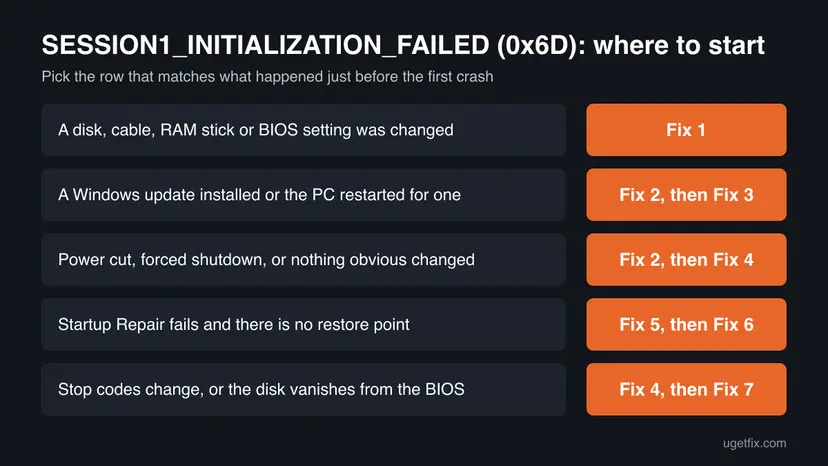
- Shut the PC down and unplug every USB device except the keyboard and mouse, including external drives, card readers and docks.
- If you added a disk, a RAM stick or a card, remove it. If you moved the system disk, put it back in its first port or slot.
- Start the PC. If it reaches the sign-in screen, add the parts back one at a time to find the one that causes the crash.
- If you updated or reset the BIOS, press the BIOS key at the logo screen, often Del, F2 or F10.
- Check the storage setting (names vary: SATA Mode, SATA Operation, VMD Controller) and set it back to the value Windows was installed with, then select Save and Exit.
- If you overclocked the CPU or turned on a memory profile (XMP or EXPO), turn it off for the test.
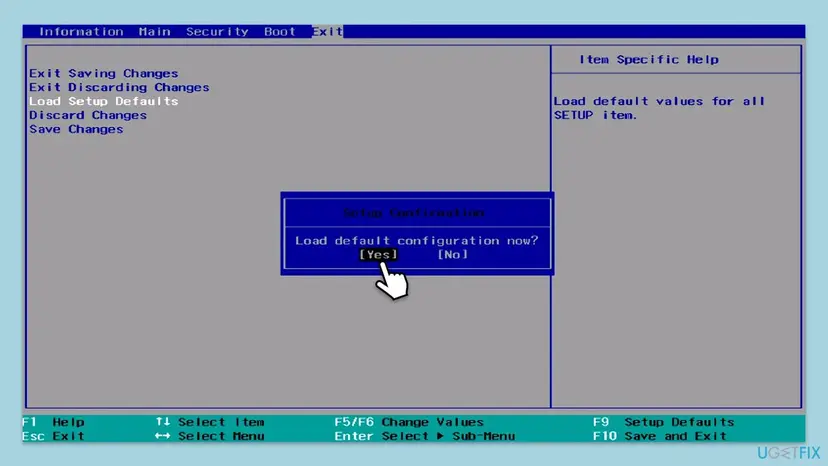
Loading BIOS defaults or changing the storage mode to a value Windows was not installed with can cause the same stop code or another boot error. Change one setting at a time, write down what it was, and change it back if the next start fails. Your files are not touched by these settings.
It worked if: The PC passes the logo screen and loads the sign-in screen without the stop code.
If not: If nothing changed, or the crash stays after you undo the change, go to Fix 2.
Fix 2. Run Startup Repair and remove the latest update from the recovery screen
20 minutesLow riskThe PC stops at every start, nothing changed in the hardware, or the crash came after an update.
The crash happens before the desktop, so the repair has to run from the recovery environment. Startup Repair fixes the boot files it can find, and a half-installed update can leave system files that do not match, which Uninstall Updates removes.
- Turn the PC on and, when the logo appears, hold the power button until it shuts down. Do this twice; the third start opens Automatic Repair.
- Select Advanced options > Troubleshoot > Advanced options.
- Select Startup Repair and pick your account. Step by step: Run Startup Repair
- If it says it could not repair the PC, go back and select Uninstall Updates > Uninstall latest quality update.
- If that does not help either, select Uninstall latest feature update if it is offered. Step by step: How to uninstall a Windows update
- Restart the PC after each step and see whether it reaches the sign-in screen.
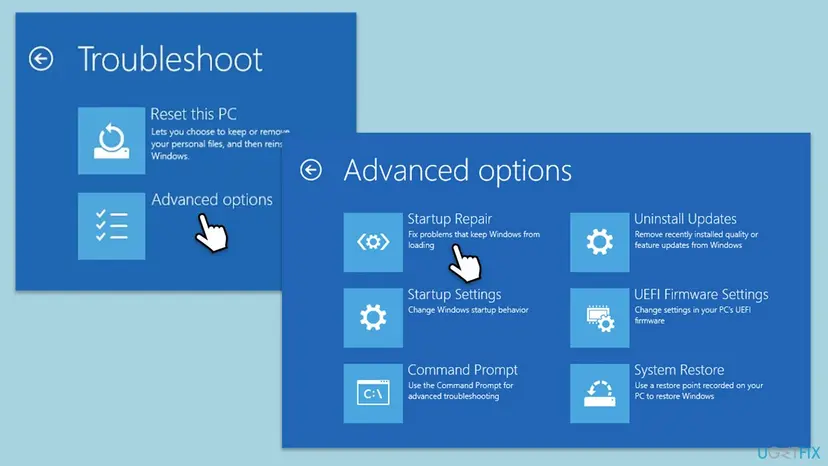
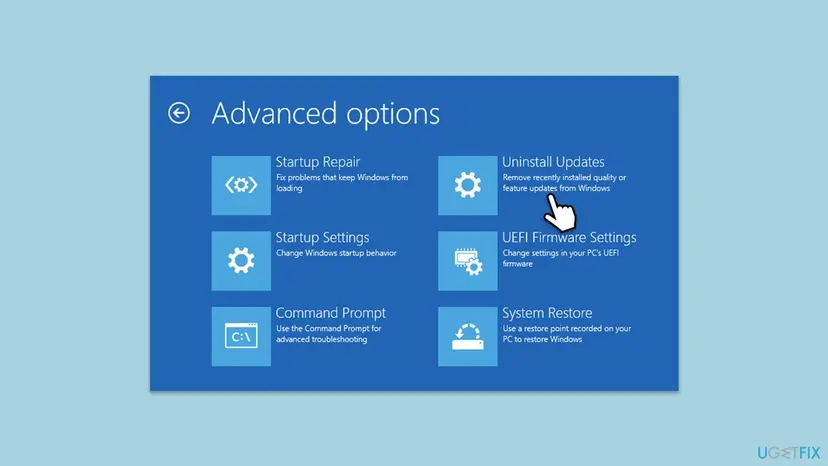
The recovery screen may ask for a BitLocker recovery key. If you sign in with a Microsoft account, the key is listed at account.microsoft.com/devices/recoverykey. Look it up on a phone or another PC.
It worked if: Startup Repair reports that it repaired the PC, or Windows starts after the update is removed.
If not: If Startup Repair fails, note what SrtTrail.txt says (see above) and go to Fix 3.
Fix 3. Return Windows to an earlier state with System Restore
20 minutesRead the warningThe PC worked a day or two ago, Fix 2 did not help, and System Protection was on.
System Restore brings back the registry, drivers and system files from a restore point. That covers the files and settings Windows reads while it sets up its first session, without touching your documents.
System Restore does not touch your documents and photos. It removes apps, drivers and updates installed after the restore point. Note them so you can install them again.
- Open the recovery screen as in Fix 2 and select Troubleshoot > Advanced options > System Restore.
- Choose your account and enter its password.
- Select a restore point dated before the first crash, then Next and Finish.
- Wait until the PC restarts. Do not turn it off during the restore. Step by step: Undo recent changes with System Restore
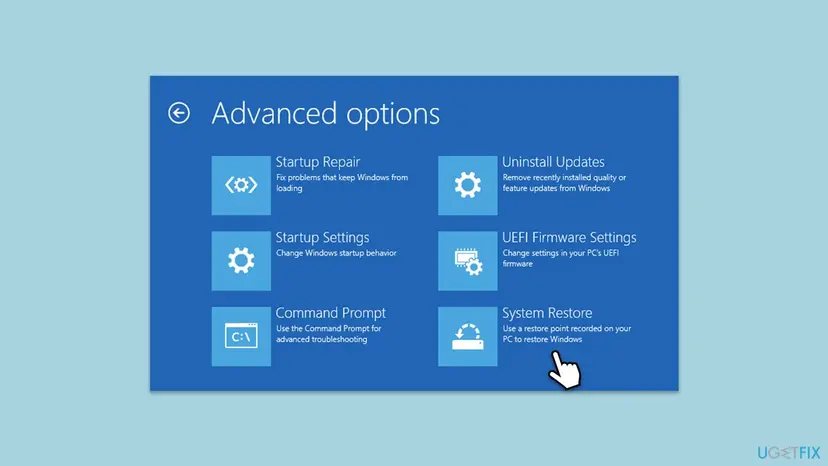
It worked if: Windows reports that System Restore completed successfully and starts to the sign-in screen.
If not: If there is no restore point or the restore fails, check the disk in Fix 4.
Fix 4. Check the system disk for errors and loose connections
30 to 60 minutesLow riskThe error followed a power cut or a forced shutdown, the disk is sometimes missing in the BIOS, or Startup Repair names a disk error.
Microsoft says any part of the disk subsystem can cause the sibling code 0x6B, including bad disks and bad or wrong cables. File system damage after a power loss can also stop Windows before its first session starts.
- Open the BIOS and check that the system disk is listed. If it is missing, shut the PC down, unplug it and reseat the disk's data and power cables, or the M.2 drive.
- Open the recovery screen as in Fix 2 and select Troubleshoot > Advanced options > Command Prompt.
- Type
bcdeditand press Enter. The lineosdeviceunder Windows Boot Loader shows the letter of the Windows drive; it is often notC:here. - Run
chkdsk C: /fwith that letter in place ofC:. Add/rto also look for bad sectors; it takes much longer. - Type
exitand select Continue to start Windows. Step by step: Check a disk for errors (chkdsk)
In the recovery Command Prompt (replace C: with the Windows drive):
bcdedit
chkdsk C: /f /r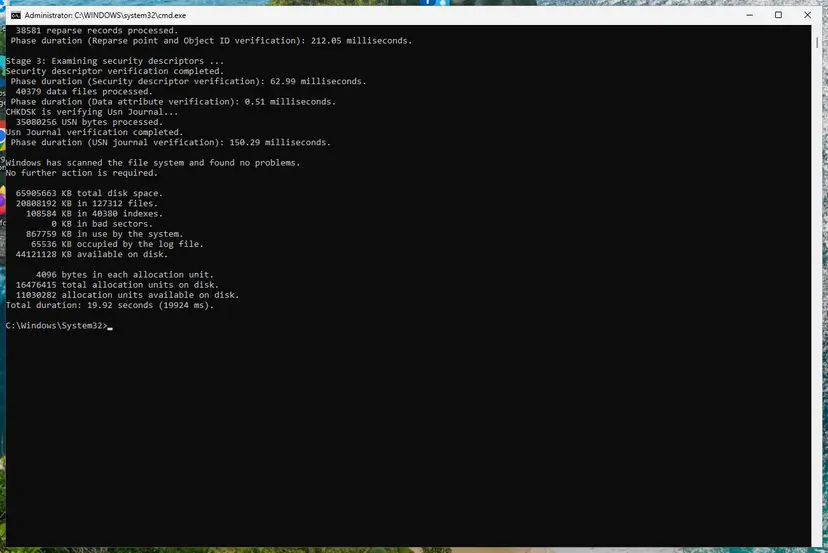
It worked if: CHKDSK reports that it made corrections, or that it found no problems, and the next start reaches the sign-in screen.
If not: If CHKDSK reports bad sectors, back up the disk soon and plan to replace it. If it finds nothing, go to Fix 5.
Fix 5. Rebuild the boot files from the recovery Command Prompt
15 minutesLow riskStartup Repair could not repair the PC, or the disk was cloned, moved or repartitioned.
Microsoft lists a missing file on the boot partition as a cause of the sibling code 0x6B. bcdboot writes fresh boot files from the Windows folder and a new boot entry that points to it.
- Open Troubleshoot > Advanced options > Command Prompt in the recovery screen.
- Find the Windows drive with
bcdeditas in Fix 4, or withdir C:\Windows,dir D:\Windowsuntil one lists the folder. - Run
bcdboot C:\Windowswith the right letter. It copies boot files to the system partition and creates a new boot entry. - On older PCs that start in legacy BIOS mode, also run
bootrec /fixmbrandbootrec /rebuildbcd. - Type
exitand restart.
In the recovery Command Prompt (replace C: with the Windows drive):
bcdboot C:\Windows
bootrec /rebuildbcdUsers report Access is denied when they run bootrec /fixboot on newer PCs. You can skip that command: on UEFI PCs, bcdboot does the same job.
It worked if: The command reports Boot files successfully created, and the PC starts without the stop code.
If not: If the stop code is still there, repair the system files in Fix 6.
Fix 6. Repair Windows system files offline with SFC and DISM
30 minutesNo riskFixes 2 to 5 did not help, or the PC starts only in Safe Mode.
The NT status code in the first parameter often points to a file Windows could not open or read. SFC replaces damaged system files from the component store, even while Windows does not start.
If Windows starts in Safe Mode (Start Windows or a Mac in Safe Mode), run DISM and then SFC there as usual. Step by step: Run DISM and SFC to repair Windows system files. If it does not start at all, run SFC offline from the recovery Command Prompt.
In the recovery Command Prompt (replace C: with the Windows drive):
sfc /scannow /offbootdir=C:\ /offwindir=C:\WindowsIn Terminal (Admin) once Windows starts, one after the other:
DISM.exe /Online /Cleanup-Image /RestoreHealth
sfc /scannowThe /Online switch repairs the running Windows. In the recovery Command Prompt the running system is the recovery one, so use the offline SFC line above there, and run DISM only after Windows starts.
It worked if: SFC reports that it found no integrity violations or that it repaired them, and the next start brings no stop code.
If not: If SFC cannot repair some files, or the crash returns, test the hardware in Fix 7.
Fix 7. Test the memory and the disk's health
60 minutes or moreLow riskThe stop codes change from crash to crash, the disk sometimes vanishes, or nothing above helped.
Bad memory corrupts the files Windows loads at startup, and a failing disk or controller does not answer in time. Both look like a software fault until you test them.
- If Windows starts in Safe Mode, test the RAM with the tool built into Windows: How to test your RAM with Windows Memory Diagnostic
- If the PC has two or more RAM sticks, start it with one stick at a time to find a bad one.
- Check the disk's health with its maker's tool, or in the BIOS if your board shows drive health.
- Update the BIOS and the chipset driver from your PC or motherboard maker's support page, then check the storage settings again as in Fix 1.
It worked if: The memory test reports no errors, the disk shows as healthy, and the PC starts with each RAM stick on its own.
If not: If the memory test reports errors, replace or reseat the RAM. If the hardware is clean, go to Fix 8.
Fix 8. Reinstall Windows and keep your files
60 to 90 minutesRead the warningEvery fix above failed and the hardware tests are clean.
A reinstall writes a fresh copy of every file Windows needs to start its first session, so it removes any software cause the repairs above missed.
Reset this PC with Keep my files keeps documents, pictures and the desktop, but removes the apps you installed. If Windows does not start, copy your files first by booting the PC from a Windows USB drive or by connecting the disk to another PC: Back up your files (Windows Backup, File History, Time Machine)
- In the recovery screen, select Troubleshoot > Reset this PC > Keep my files.
- Choose Cloud download to get fresh files from Microsoft, or Local reinstall.
- If the reset cannot start, create a Windows 11 USB drive with the Media Creation Tool on another PC and boot from it.
- In Windows Setup, choose Repair my PC to reach the recovery tools, or install Windows and keep the old files in
Windows.oldif the setup offers it. - After the reinstall, install the chipset and storage drivers from your PC maker first. Full method: Reinstall Windows without losing files
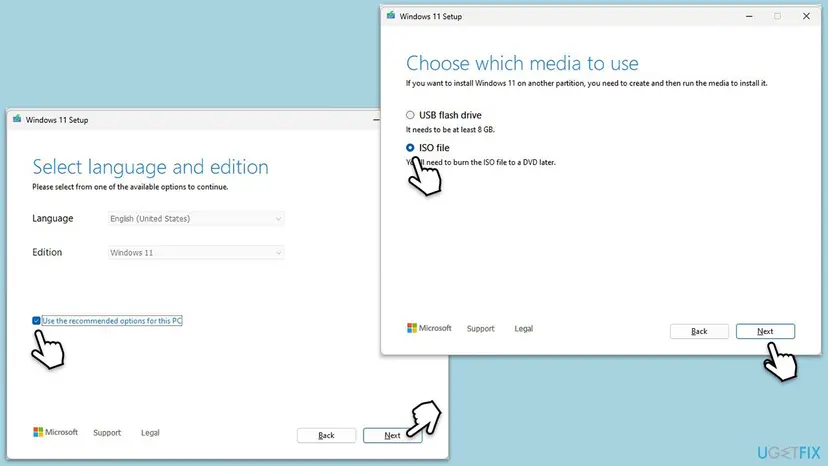
It worked if: Windows starts to a fresh desktop with your files in place, and the stop code does not come back.
If not: If the stop code appears even during Windows Setup, the disk, its controller, the memory or the board is at fault. Contact your PC maker or a repair shop.
Still stuck at SESSION1_INITIALIZATION_FAILED: what to collect and whom to ask
Support needs the NT status code from the first parameter and the story around the crash. Collect these facts once, then send them to the right place.
- What changed before the first crash, with the date: hardware, BIOS update or setting, Windows update, power cut.
- The text of
SrtTrail.txtfrom Startup Repair (Fix 2). - The BugCheck event 1001 or the
!analyze -voutput with the first parameter, if Windows started at any point. - The CHKDSK and memory test results (Fix 4 and Fix 7), and the model of the system disk.
| Where to ask | When |
|---|---|
| Your PC or motherboard maker's support | The error started after a BIOS update or a hardware change |
| Microsoft Support or Microsoft Q&A | The error started after a Windows update, with no hardware change |
| A repair shop or your disk's maker | The disk disappears from the BIOS, CHKDSK reports bad sectors, or the memory test fails |
When Windows starts but other stop codes follow, read the dump the way our guide to the WIN32K_CRITICAL_FAILURE blue screen shows, with WinDbg and !analyze -v.
How to keep SESSION1_INITIALIZATION_FAILED from coming back
- Write down your BIOS storage settings before a BIOS update, and check them after it.
- Keep System Protection on for the system drive, so a restore point exists.
- Let Windows updates finish their restarts, and plug a laptop in during them.
- Keep 10 to 15 percent of the system drive free, as Microsoft advises for stop code errors.
- Leave external drives and card readers plugged in while you troubleshoot startup.
- Hold the power button during an update unless the PC has frozen for a long time.
- Change the storage mode in the BIOS on a PC that already has Windows installed.
- Ignore CHKDSK errors or a disk that is sometimes missing in the BIOS.
Windows 10 left support on 14 October 2025. A Windows 10 PC gets fixes for boot and storage problems only through Extended Security Updates, so moving to Windows 11 keeps them coming.
Frequently asked questions
What does session 1 initialization failed mean?
It means the initialization of Windows failed during startup. The stop code is SESSION1_INITIALIZATION_FAILED, bug check 0x6D. Microsoft documents it with one parameter, the NT status code that caused the failure, and gives no cause list. In practice it follows a hardware or BIOS change, an unfinished update, or boot and system files damaged by a power cut. Start with Fix 1 and Fix 2 on this page.
How do I fix session 1 initialization failed on Windows 11?
Undo the last hardware or BIOS change and unplug extra USB devices first. If nothing changed, interrupt the start twice to open Automatic Repair, then run Startup Repair and Uninstall Updates from Advanced options. System Restore, CHKDSK, bcdboot and an offline SFC scan come next. The steps are the same on Windows 11 and Windows 10; only the stop screen on Windows 11 24H2 and later is black instead of blue.
Is SESSION1_INITIALIZATION_FAILED a hardware problem?
Not always, but hardware is high on the list. Microsoft's first advice for any stop code is to remove new hardware, and for the sibling code 0x6B it names bad disks and cables. It points to hardware when the disk is sometimes missing in the BIOS, CHKDSK reports bad sectors, the memory test fails, or the stop code appears even during Windows Setup. Otherwise the software repairs in Fix 2 to 6 usually come first.
What is PROCESS1_INITIALIZATION_FAILED on Windows 10?
PROCESS1_INITIALIZATION_FAILED is a sibling stop code with the value 0x6B. Like 0x6D, Microsoft says it indicates that the initialization of Windows failed. Unlike 0x6D, Microsoft names its causes: any part of the disk subsystem, such as bad disks or wrong cables, a missing file on the boot partition, or a driver that was disabled. The fixes on this page cover all of these, starting with Fix 1 and Fix 4.
What is phase 1 initialization failed?
PHASE1_INITIALIZATION_FAILED is another stop code, value 0x32, from the first phase of system startup. It stops at the same early stage as SESSION1_INITIALIZATION_FAILED, before the sign-in screen, and the same fixes apply: undo the last change, then Startup Repair, Uninstall Updates and System Restore from the recovery screen, then the disk check and boot file repair. Our I01 initialization failed guide covers it in more depth.
What is session 5 initialization failed?
SESSION5_INITIALIZATION_FAILED, value 0x71, is a later sibling in the same family of session startup stop codes. It also stops Windows before the sign-in screen. We could not confirm a separate cause list for it from Microsoft, so treat it like 0x6D. Undo the last hardware change, run the recovery screen repairs in Fix 2 to Fix 6, and test the hardware if it keeps coming back.
What is "session initialization failed (environment_deleted)"?
It is not a Windows stop code. It is a message from an app whose virtual machine or cloud session was removed, and users report it in a desktop AI app. It has nothing to do with the SESSION1_INITIALIZATION_FAILED blue screen and none of the fixes on this page apply. Restart the app, sign in again, or ask the app's support; this page is about the Windows startup crash.
Can I fix session 1 initialization failed without losing my files?
Yes, in most cases. Fixes 1, 2 and 4 to 7 do not touch your documents and photos. System Restore in Fix 3 removes only apps, drivers and updates installed after the restore point. Only the reinstall in Fix 8 removes installed apps, and even then Keep my files keeps your personal files. Back up your files before Fix 8, from a Windows USB drive or by connecting the disk to another PC.
How do I get past the blue screen if the PC restarts in a loop?
Interrupt the start twice: when the logo appears, hold the power button until the PC turns off. On the third start Windows opens Automatic Repair, and from there Advanced options lead to Startup Repair, Uninstall Updates, System Restore, Command Prompt and Startup Settings. If even that screen does not appear, boot from a Windows 11 USB drive made with the Media Creation Tool on another PC and select Repair your computer.
Sources
- Microsoft Learn: Bug Check 0x6D SESSION1_INITIALIZATION_FAILED (learn.microsoft.com)
- Microsoft Learn: Bug Check 0x6B PROCESS1_INITIALIZATION_FAILED (learn.microsoft.com)
- Microsoft Support: Troubleshooting Windows unexpected restarts and stop code errors (support.microsoft.com)
Did this fix work?
One click, no account. It tells the next reader which guides are worth their time.
Questions and experiences: fix the session 1 initialization failed BSOD (SESSION1_INITIALIZATION_FAILED, 0x6D)
Still broken, or found a fix we did not cover? Ask here: members and our editors answer. Reading is open; writing needs a free account.
…