
How to fix Windows update error 0x800f0823?

Prefer to fix it yourself? The manual steps follow.
- 6methods
- 10 minutes to 2 hours
- Intermediate
Applies to Windows 11, Windows 10 and Windows Server 2016 to 2025, physical PCs and virtual machines
6 methods in this guide
Hello. When I try to install new Windows updates, I get the 0x800f0823 error. How can I resolve this?
Error 0x800f0823 means the update needs a newer servicing stack, the part of Windows that installs updates, than the one on your PC. It appears after a PC skipped updates for a while. Update the servicing stack first, usually by installing the newest cumulative update, then try the failed update again.
Your servicing stack is older than the update requires. Open Settings > Windows Update, select Check for updates and install everything offered, restarting each time (Fix 1). If it fails again, download the newest cumulative update for your Windows version from the Microsoft Update Catalog and install it (Fix 2). On Windows 10 2004 and later and on Windows 11, that update carries the servicing stack.
| Error | Install error - 0x800f0823 in Settings > Windows Update, or 0x800f0823 (CBS_E_NEW_SERVICING_STACK_REQUIRED) in a log or in DISM output. |
|---|---|
| Where it appears | In the update list and Update history of Windows Update, after you open a .msu file by hand, and in C:\Windows\Logs\CBS\CBS.log. |
| Main cause | The servicing stack on the PC is out of date. Microsoft says this happens when a PC or virtual machine falls out of sync by skipping updates. |
| Fastest fix | Install the newest cumulative update for your Windows version (Fix 1 or Fix 2). It includes the latest servicing stack update (SSU). |
| Also written as | 0x800F0823, 800f0823, error 0x800f0823, CBS_E_NEW_SERVICING_STACK_REQUIRED, -2146498525 (the same number as a signed decimal). |
| Affects | All supported Windows 11 and Windows 10 versions, Windows Server 2016 to 2025 and Azure virtual machines, according to Microsoft. |
| Microsoft's status | A documented error with a documented fix, not a bug. Since February 2021 the SSU ships inside the monthly cumulative update on Windows 10 2004 and later. |
| Where the cause is written | CBS.log has a line saying the package requires Servicing Stack version X but current Servicing Stack is version Y. |
| Time to fix | 10 to 40 minutes for Fix 1 to Fix 4. About an hour or more for the repair reinstall in Fix 6. |
Facts checked on 16 October 2026. Steps written for Windows 11 (25H2 and 26H2) and Windows 10 22H2.
What Windows update error 0x800f0823 means
0x800f0823 is a code of Component Based Servicing (CBS), the engine that installs Windows updates. Its name is CBS_E_NEW_SERVICING_STACK_REQUIRED. In plain words: the update you are installing was built for a newer installer than the one your PC has, so Windows refuses to start.
Microsoft Learn says the error can appear whether you install from Windows Update or from a downloaded file. In Windows 11 Settings it is shown next to the update as Install error - 0x800f0823. Searches for install error - 0x800f0823 come from that line.
| What you see | Where | What it tells you |
|---|---|---|
| Install error - 0x800f0823 | Settings > Windows Update, next to a cumulative or security update | Windows Update could not install the update because the servicing stack is too old. |
| 0x800f0823 in Update history | Settings > Windows Update > Update history | The same failure, recorded with the KB number of the update. |
| requires Servicing Stack (version) but current Servicing Stack is (version). [HRESULT = 0x800f0823 - CBS_E_NEW_SERVICING_STACK_REQUIRED] | C:\Windows\Logs\CBS\CBS.log | The exact versions: what the package needs and what the PC has. |
| Error: 0x800f0823 | Command Prompt or Terminal after DISM /Online /Add-Package | DISM refused the package for the same reason. |
| -2146498525 | Scripts and management tools | The same code written as a signed decimal number. |
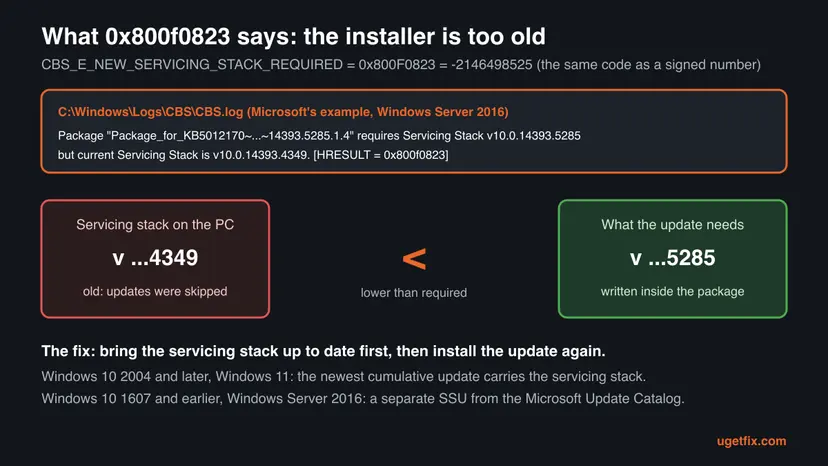
Microsoft Learn describes it as the component that installs Windows updates. It also drives DISM, System File Checker and turning Windows features on or off. That is why one old servicing stack can make every update fail.
Why error 0x800f0823 appears
The causes are ordered from the most likely to the least likely. The first one is Microsoft's own explanation. The others follow from how servicing stack updates are delivered.
| Cause | How often | How to tell | Fix |
|---|---|---|---|
| The PC skipped months of updates, so its servicing stack is older than the update requires. | Most often | The PC was off, offline or had updates paused for a long time, or it is a restored backup or an old virtual machine. | Fix 1, Fix 2 |
You installed an older KB or a single .msu by hand on a PC that never got the matching SSU. | Often | The error appears right after you open a downloaded file. | Fix 2 |
| The combined cumulative update itself fails, so its SSU never gets installed. | Sometimes | Even the newest cumulative update fails. Windows Update may show a different code, while CBS.log names 0x800f0823. | Fix 3 |
| An older Windows version where the SSU is still a separate update. | Sometimes | Windows 10 1607 or older, LTSB editions, Windows Server 2016. | Fix 4 |
| A damaged update cache or a damaged Windows installation. | Rarely | Fix 1 to Fix 4 do not change the result. | Fix 5, Fix 6 |
Microsoft Learn explains that Windows Update normally keeps the servicing stack current on its own. Since February 2021, starting with KB4601382, the monthly cumulative update on Windows 10 2004 and later includes the latest servicing stack update. Microsoft calls this a single combined cumulative update.
That is good news for the fix. On Windows 11 and on Windows 10 22H2 you do not hunt for a separate SSU: the newest cumulative update installs the new servicing stack first and the rest of the update after it.
In a Windows 10 example published by Michls Tech Blog, Windows Update showed the code 0x80242017 for the cumulative update, and only CBS.log named 0x800f0823. If Windows Update shows another code, search the log before you pick a fix.
How to fix Windows update error 0x800f0823
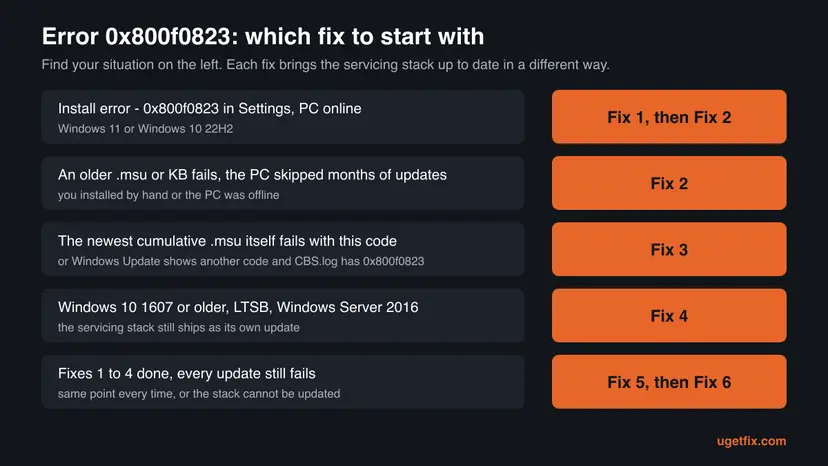
Fix 1 to Fix 4 all do the same thing in different ways: they put a newer servicing stack on the PC. Start with the first one that fits your situation. Fix 5 and Fix 6 are the general repairs when the stack cannot be updated at all.
| What you see or have | Start with |
|---|---|
| Install error - 0x800f0823 in Settings on Windows 11 or Windows 10 22H2, PC online | Fix 1, then Fix 2 |
You opened an older .msu file or a single KB by hand | Fix 2 |
The newest cumulative update fails too, or another code shows and CBS.log has 0x800f0823 | Fix 3 |
| Windows 10 1607 or older, an LTSB edition or Windows Server 2016 | Fix 4 |
| Fix 1 to Fix 4 did not change anything | Fix 5, then Fix 6 |
| An Azure virtual machine | Microsoft's servicing stack reset tool, see the section after the fixes |
Fix 1. Install every update Windows Update offers, then try again
15 to 45 minutesNo riskA home or office PC on Windows 11 or Windows 10 22H2 that shows Install error - 0x800f0823 in Settings.
Microsoft says Windows Update normally installs servicing stack updates by itself. A PC that skipped updates often still has the newer cumulative update queued, and that update brings the servicing stack the failed package asks for.
- Open Settings > Windows Update. On Windows 10 it is Settings > Update & Security > Windows Update.
- If updates are paused, select Resume updates.
- Select Check for updates and let Windows download and install everything offered.
- Restart the PC when asked. Use Restart, not Shut down.
- Open Windows Update again and select Check for updates once more. Repeat until nothing new is offered.
- Press Win + R, type
winverand press Enter. Note the OS build for the next fix if the error stays.
Do not insist on the exact KB that failed. Cumulative updates contain everything before them, so the newest one replaces the old one. If the newest update installs, the failed one no longer matters.
It worked if: Update history lists the newest cumulative update as successfully installed and Windows Update says you are up to date.
If not: If the same update fails again with 0x800f0823, install the newest cumulative update by hand with Fix 2.
Fix 2. Install the newest cumulative update from the Microsoft Update Catalog
20 to 40 minutesLow riskFix 1 failed, the PC skipped months of updates, or you tried to install an older KB by hand.
This is Microsoft's resolution for 0x800f0823 on current Windows versions. The newest security update includes the SSU and the cumulative update, so installing it updates the servicing stack before anything else.
To find the newest KB number, open Microsoft's update history page for your version: Windows 11 at support.microsoft.com/help/5065323, Windows 10 2004 and later at support.microsoft.com/help/5018682. Use the KB at the top of the list for your version, not the one that failed.
- Check your Windows version. Press Windows key + R, type winver and press Enter. Note the version (for example 25H2) and the OS build.
- Find the KB number. Open Settings > Windows Update. A failed or pending update is listed with its KB number; earlier ones are under Update history.
- Check the processor type. Open Settings > System > About and look at System type: an x64-based PC needs the x64 file, an ARM-based PC (for example Snapdragon) needs the arm64 file.
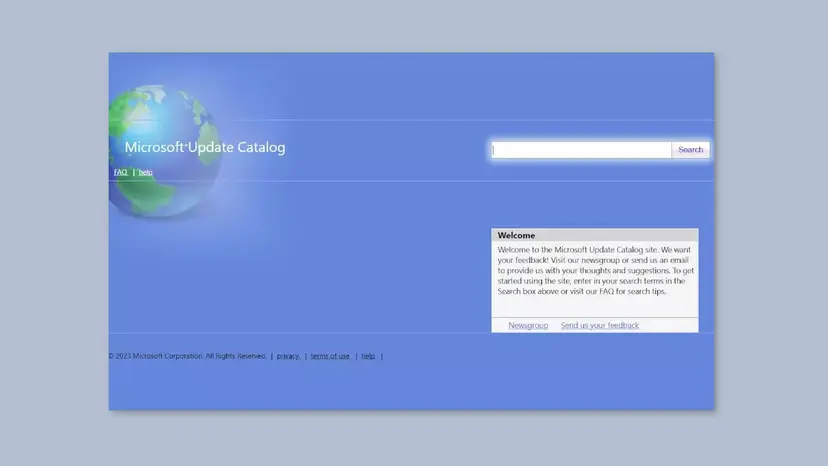
- Search the catalog. Open the Microsoft Update Catalog at catalog.update.microsoft.com in your browser, type the KB number (for example KB5124010) in the search box and press Enter.
- Pick the right row. Find the row whose title names your Windows version and your processor type (x64-based or arm64-based) and select Download on that row.
- Download every file listed. A window lists one or more .msu links. Download all of them into one empty folder, for example C:\packages. On Windows 11 24H2 and later the list can include earlier checkpoint updates that the new one needs.
- Install a single file. If there is only one file, double-click it and confirm the installation in the Windows Update Standalone Installer.
- Install several files with DISM. If there are several files, open an elevated Terminal or Command Prompt and run DISM with the newest file. DISM finds the other files in the same folder and installs them in the right order.
DISM /Online /Add-Package /PackagePath:C:\packages\<newest-file>.msu - Restart. Restart the PC when the installation finishes, then run winver again: the OS build should have changed.
These steps were written for Windows 11 24H2 and later; Windows 10 22H2. The full page with the other versions and what each result means: Install an update from the Microsoft Update Catalog
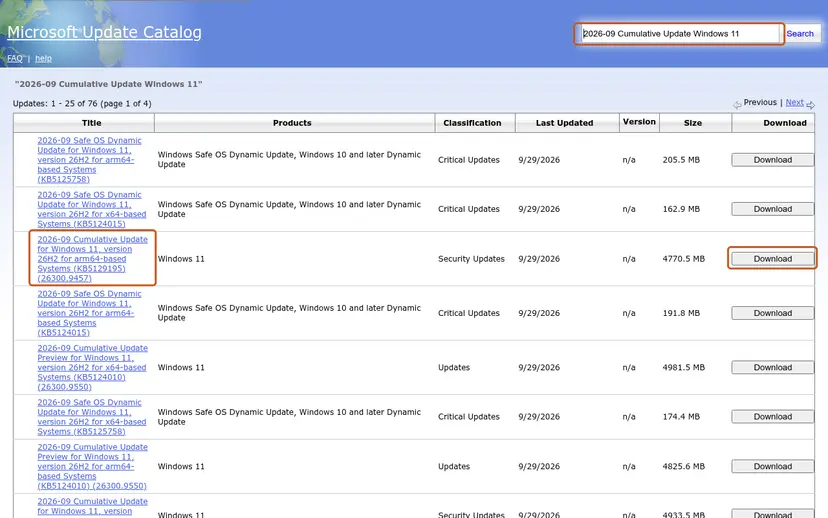
Microsoft notes that an update's support page may mention its SSU under a different KB number. The catalog has no separate entry for that number: search for the main KB number only.
It worked if: The installer or DISM finishes without an error, and after the restart winver shows the build of the newest update.
If not: If the newest update also fails, or Windows shows another code and CBS.log names 0x800f0823, install the SSU on its own with Fix 3.
Fix 3. Extract the servicing stack from the update file and install it first
15 to 30 minutesLow riskThe newest cumulative update fails as a whole, so its built-in servicing stack update never gets a chance to install.
A combined .msu file holds the SSU as a separate .cab file inside it. Michls Tech Blog showed that installing that file alone with DISM updates the servicing stack, after which the cumulative update installs.
- Download the newest cumulative update for your version and processor as in Fix 2, and copy the
.msufile toC:\packages. - Right-click Start and select Terminal (Admin) or Command Prompt (Admin). Select Yes when Windows asks for permission.
- Go to the folder and unpack the
.msufile into a new folder. Replace the file name with yours:cd C:\packages mkdir msu expand windows10.0-kb5004760-x64.msu -F:* msu - Run
dir msuand look for a file whose name starts withSSU-, for exampleSSU-19041.1081-x64.cabin the blog's Windows 10 example. - If the SSU file is not in
msudirectly, unpack the large KB.cabfile the same way and look again:mkdir ssu expand msu\Windows10.0-KB5004760-x64.cab -F:* ssu - Install only the SSU file with DISM. Replace the path with the file you found:
DISM /Online /Add-Package /PackagePath:C:\packages\ssu\SSU-19041.1081-x64.cab - Wait for The operation completed successfully., restart the PC, then install the full
.msufile again.
The file names above are from the blog's Windows 10 example of 2021. We could not confirm that every current Windows 11 .msu still holds a separate SSU- file. If you find none, the package does not split it out: go on with Fix 5.
It worked if: DISM reports The operation completed successfully. for the SSU, and the cumulative update then installs without 0x800f0823.
If not: If DISM refuses the SSU file too, the update cache or the component store is damaged: go to Fix 5.
Fix 4. Install the standalone servicing stack update on older Windows versions
15 to 30 minutesLow riskWindows 10 version 1607 or older, an LTSB edition built on those, or Windows Server 2016.
On these versions the servicing stack still ships as its own update. Microsoft's resolution is to find the newest SSU in the catalog, install it, restart and then retry the update that failed.
- Open the Microsoft Update Catalog at catalog.update.microsoft.com.
- Search for
ssu "Windows 10"on Windows 10 1607 and older, orssu "Windows Server 2016"on Windows Server 2016. Keep the quotation marks. - Sort by Last Updated and pick the newest update that matches your version and processor type.
- Select Download and save the file.
- Double-click the file and confirm the installation. Restart the PC when it finishes.
- Install the update that failed with 0x800f0823 again.
Microsoft also lists the newest SSU per Windows version on its advisory page ADV990001 in the Security Update Guide. Look for the FAQ question "When was the most recent SSU released for each version of Microsoft Windows?"
It worked if: The SSU installs, and after the restart the update that failed installs without the error.
If not: If the SSU itself fails, reset the update cache with Fix 5. On Windows 10 1607 also read the support note in the next section.
Fix 5. Reset the Windows Update components
10 minutesLow riskWindows Update fails at the same point every time, even after Fix 1 to Fix 4.
A damaged download in the update cache is used again at every retry, so a new SSU may never be read correctly. Renaming SoftwareDistribution and catroot2 makes Windows download the update again from zero.
- Open Command Prompt as administrator. Type cmd in the search box, right-click Command Prompt and select Run as administrator. Select Yes when Windows asks for permission.
- Stop the update services. Type the commands below and press Enter after each one. If Windows says that other services depend on Cryptographic Services, it stops them too. A message that a service is not started is fine.
net stop wuauserv net stop bits net stop cryptsvc - Delete the download queue files. This clears the list of downloads that the Background Intelligent Transfer Service keeps. If Windows says it cannot find the files, continue.
del "%ALLUSERSPROFILE%\Application Data\Microsoft\Network\Downloader\qmgr*.dat" - Rename the update cache folders. Renaming keeps a copy in case you need it; Windows creates new, empty folders when the services start again. If you get Access is denied, a service is still running: repeat the previous step.
ren %systemroot%\SoftwareDistribution SoftwareDistribution.old ren %systemroot%\System32\catroot2 catroot2.old - Start the services again. Type the commands below and press Enter after each one. The requested service has already been started is fine: Windows started it on its own.
net start cryptsvc net start bits net start wuauserv - Restart and check for updates. Restart the PC. Then select Start > Settings > Windows Update > Check for updates. The first check can take longer than usual because everything is downloaded again.
These steps were written for Windows 11 and Windows 10 (the steps are the same). The full page with the other versions and what each result means: Reset Windows Update components

It worked if: Windows Update downloads the newest cumulative update again and installs it without 0x800f0823.
If not: If the error stays, the servicing stack cannot be updated in place: use the repair reinstall in Fix 6.
Fix 6. Reinstall Windows over itself and keep your apps and files
1 to 2 hoursLow riskNothing could update the servicing stack, and every update still fails with 0x800f0823.
A repair reinstall replaces Windows, including the servicing stack, with a current copy of the same version. The new copy no longer needs the old stack to be updated, and apps, files and settings stay.
- Open Recovery in Settings. Open Settings > System > Recovery. Next to Fix problems using Windows Update, select Reinstall now. This keeps your apps, files and settings.
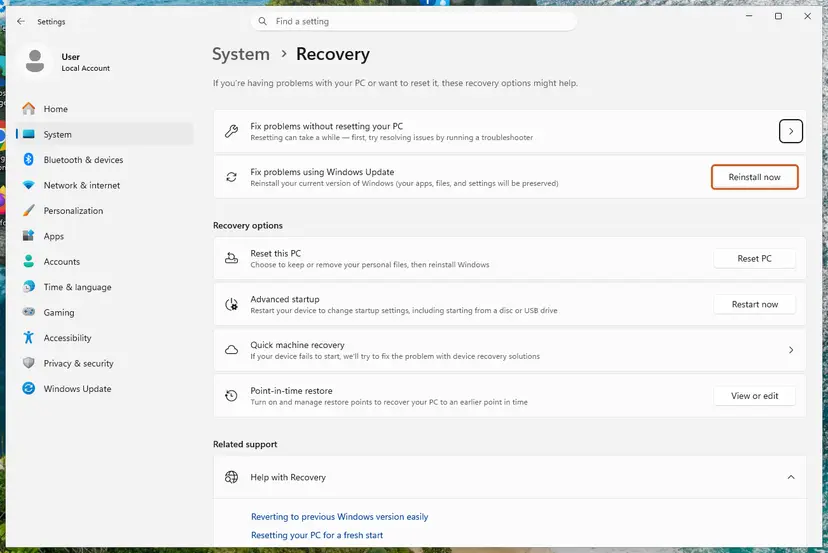
Fix problems using Windows Update reinstalls the current version and keeps apps, files and settings. Screenshot: Windows 11 26H2. - Start the reinstall. Choose whether the PC may restart on its own 15 minutes after the installation, then select OK.
- Wait and restart. Windows Update downloads and installs a repair copy of your current Windows version. Keep the PC plugged in and online, and restart it when asked.
These steps were written for Windows 11 22H2 and later. The full page with the other versions and what each result means: Reinstall Windows without losing files
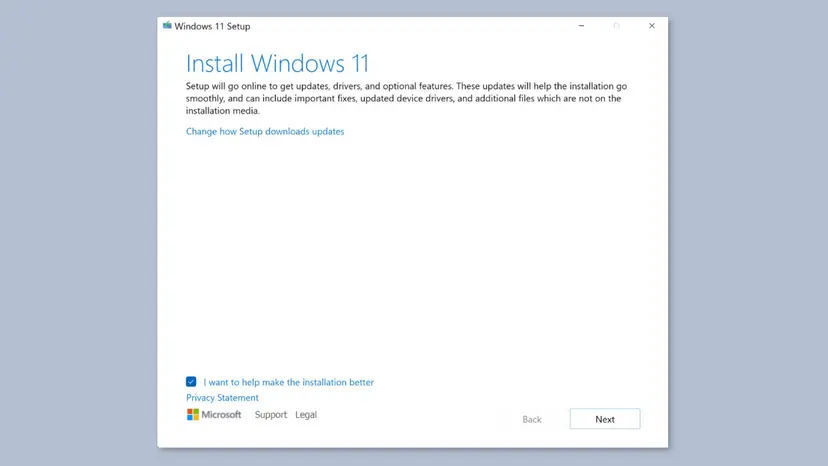
If Fix problems using Windows Update is missing, download the Windows 11 installation files from Microsoft, open the ISO, run setup.exe and keep Keep personal files and apps. On Windows 10 22H2 use the Windows 10 media the same way.
Your files are meant to stay, but a failed reinstall can leave Windows unable to start. Back up what you cannot lose first: Back up your files (Windows Backup, File History, Time Machine). Keep a laptop plugged in until it finishes.
It worked if: The PC starts into the same desktop with your apps and files, and Windows Update installs the newest update.
If not: Read the next section: it lists what to send to support and the last resort.
If error 0x800f0823 is still there
Read the servicing log before you try anything else. It names the package and both servicing stack versions, which tells you how far behind the PC is.
- Press Win + R, type
%windir%\Logs\CBSand press Enter. - Copy
CBS.logto the Desktop and open the copy in Notepad. - Press Ctrl + F and search for
0x800f0823. - Read the line: requires Servicing Stack shows what the update needs, but current Servicing Stack is shows what the PC has.
- Compare the needed version with the build of the newest update you installed. If it is still lower, the SSU did not install.
| Situation | What to do |
|---|---|
| Work or school PC, updates from WSUS, Configuration Manager or Intune | Send the administrator the code, the KB number, the build from winver and a copy of CBS.log. Microsoft asks for the same CBS.log data in a support request. |
| An Azure virtual machine | Microsoft points to its Azure Virtual Machine (VM) Windows servicing stack reset tool. Back up the OS disk first, as Microsoft advises. |
| The repair reinstall fails or is not offered | Use Reset this PC with Keep my files and Cloud download: Reinstall Windows without losing files. Apps are removed, your files stay. |
| The PC lost power or froze during an earlier update | Check the drive for errors first: Check a disk for errors (chkdsk) |
| You only saw 0x800f0823 in CBS.log and no update fails | Nothing needs fixing. The line matters only when an update actually fails. |
Nothing about 0x800f0823 points to memory, the drive or the processor. Microsoft ties it only to an out-of-date servicing stack. The exception is a drive that reports errors in chkdsk.
How to keep error 0x800f0823 from coming back
- Let Windows Update install the monthly update every month. It keeps the servicing stack current.
- Start a PC or virtual machine that sat unused for months and update it before you use it.
- When you install by hand, install the newest cumulative update, not an old KB.
- Restart when Windows asks, so a half-installed update does not block the next one.
- Do not pause updates for months on end.
- Do not download update files from sites other than catalog.update.microsoft.com.
- Do not restore an old system image and leave it offline: update it first.
- Do not delete files in
C:\Windows\WinSxSby hand to save space.
Windows 10 reached end of support on 14 October 2025. A Windows 10 22H2 PC gets new updates only through Extended Security Updates. Once its updates stop, keeping the stack current no longer helps: move to Windows 11.
Frequently asked questions
What does error 0x800f0823 mean?
It means the update you are installing needs a newer servicing stack than the one on your PC. Its internal name is CBS_E_NEW_SERVICING_STACK_REQUIRED. The servicing stack is the part of Windows that installs updates, and Microsoft says it gets out of date when a PC skips updates. The update file is not damaged. Install the newest cumulative update, which carries the new servicing stack, and then try again.
What does Install error - 0x800f0823 mean in Windows Update?
It is how Windows 11 Settings shows the same failure next to the update that did not install. Windows Update tried to install the package, found that the servicing stack was too old, and stopped. Install every other update offered and restart. If the error stays, download the newest cumulative update for your version from the Microsoft Update Catalog and install it by hand, as in Fix 2.
What is a servicing stack update (SSU)?
It is an update for the servicing stack itself, the component that installs Windows updates. Microsoft Learn says it also drives DISM, System File Checker and turning Windows features on or off. Servicing stack updates are small and not released every month. Since February 2021 they ship inside the monthly cumulative update on Windows 10 2004 and later, so most PCs never see them as separate updates.
Where do I download the servicing stack update for Windows 11 or Windows 10 22H2?
You do not download it separately. Microsoft Learn says that on Windows 10 2004 and later, and on Windows 11, the security update includes both the SSU and the cumulative update. Find the newest KB number on Microsoft's update history page for your version, search the Microsoft Update Catalog for that number and install it. If it fails as a whole, Fix 3 shows how to extract the SSU file.
Does error 0x800f0823 happen on Windows 11?
Yes. Microsoft's article on the error lists all supported Windows client and server versions and Azure virtual machines. On Windows 11 it shows in Settings as Install error - 0x800f0823. The fix is the same as on Windows 10 22H2: install the newest cumulative update, through Windows Update or from the catalog. On Windows 11 24H2 and later, the catalog may also list a checkpoint update that must be installed with it.
Why does Windows Update show a different code when CBS.log says 0x800f0823?
Windows Update reports the result of the whole installation, and CBS.log records the reason inside it. In the Windows 10 example on Michls Tech Blog, Windows Update showed 0x80242017 for the cumulative update, and only CBS.log named 0x800f0823 with both servicing stack versions. When the log has that line, treat the problem as an old servicing stack and follow Fix 2 or Fix 3.
Can SFC or DISM RestoreHealth fix error 0x800f0823?
Not by themselves. SFC and DISM repair damaged system files, but they do not install a newer servicing stack, and 0x800f0823 is about the version of that stack, not about damage. Microsoft's resolution is to install the newest SSU or cumulative update. DISM is useful here in a different way: with /Add-Package it can install the SSU file, as in Fix 3.
Can I fix 0x800f0823 by turning off my antivirus?
No. Microsoft ties this code only to an out-of-date servicing stack, and no source we read links it to security software. Turning protection off would leave the PC exposed without changing the servicing stack version. Install the newest cumulative update instead, as in Fix 1 or Fix 2. If you think another program blocks updates in general, test with a clean boot rather than removing protection.
Do I lose my files if I reinstall Windows to fix this?
Not with the repair reinstall in Fix 6. Fix problems using Windows Update, and Windows Setup with Keep personal files and apps, reinstall the same Windows version and keep apps, files and settings. Reset this PC with Keep my files is different: it keeps your files but removes installed apps. Back up the files you cannot lose before any reinstall, and keep a laptop plugged in until it finishes.
Is this page also the answer for як виправити 0x800f0823?
Yes. The code is the same in every language of Windows, and only the words around it are translated. The fixes on this page work on a Ukrainian or any other Windows. The menu names in the steps are the English ones, so follow the position of the items in Settings. The DISM and expand commands and the file names are typed the same way on every PC.
Sources
- Microsoft Learn: Troubleshoot Windows Update error code 0x800F0823 (learn.microsoft.com)
- Microsoft Learn: Servicing stack updates (learn.microsoft.com)
- Michls Tech Blog: Windows: Could not install updates due to an outdated servicing stack (michlstechblog.info)
Did this fix work?
One click, no account. It tells the next reader which guides are worth their time.
Questions and experiences: fix Windows update error 0x800f0823
Still broken, or found a fix we did not cover? Ask here: members and our editors answer. Reading is open; writing needs a free account.
…