
version.dll is missing or crashes a program: what the file is and how to fix it
version.dll is the Windows library that programs use to read version information from files: the file version, product name and company you see under Properties, Details. It is part of Windows itself, so there is nothing to install. When a program or game reports it missing or crashes in it, the cause is usually a copy of version.dll in that program's folder, placed there by a mod, patch or other tool, and only rarely a damaged Windows file.

Prefer to fix it yourself? The manual steps follow.
How to fix version.dll errors
Open the folder of the program or game that fails, the one with its .exe file. A version.dll there is not Windows' copy: a mod loader, a plugin loader, a frame rate or resolution patch, an overlay or another tool put it there, and the program loads it instead of the genuine file in System32. Rename it to version.dll.bak and start the program again. If it now starts, update or remove the tool that brought the file. If there is no copy in the program folder, read the crash in Event Viewer to see which program is really at fault, then repair Windows: install the pending updates, and run sfc /scannow and DISM from an administrator Command Prompt.
No runtime package, DirectX or Visual C++ installer contains version.dll, so installing one does not fix these errors. The file is part of Windows 10 and Windows 11 and is repaired and updated only by Windows itself.
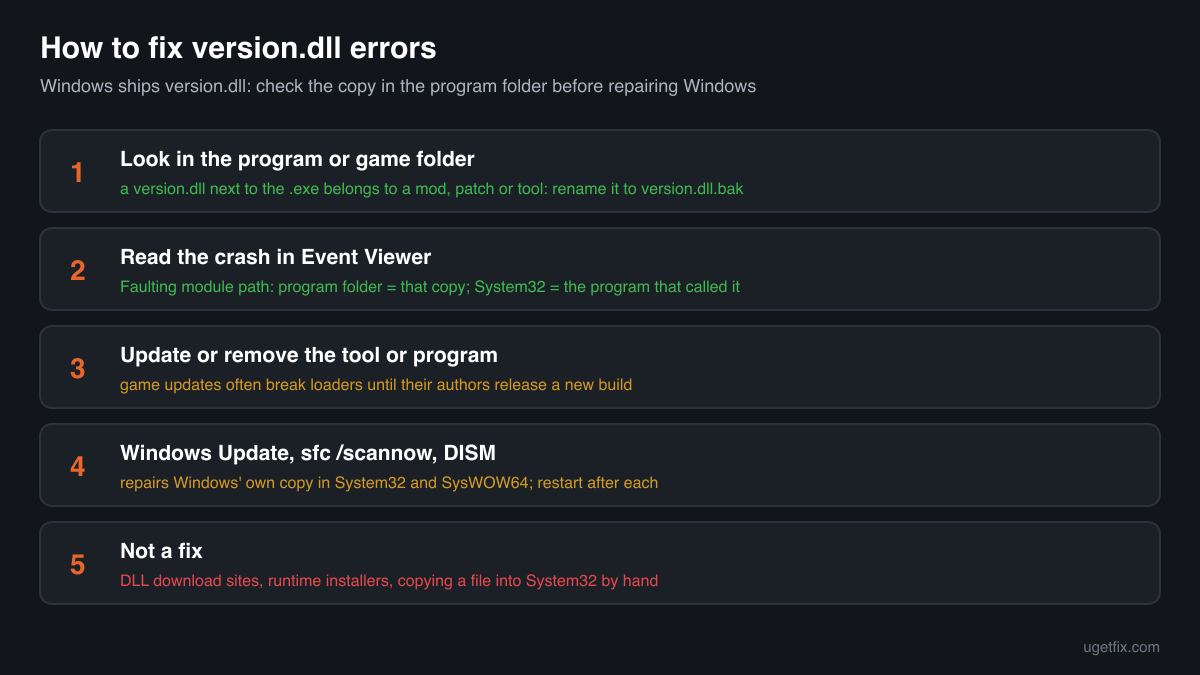
Step by step
- Look in the program or game folder. Right-click the shortcut and choose Open file location, or in a game launcher use the option to browse local files. A version.dll next to the .exe, often together with an .ini file, a plugins or mods folder, or .asi files, was put there by a tool. Programs do not need their own copy of this Windows file.
- Rename that copy and test. Rename it to version.dll.bak rather than deleting it, so you can put it back. Start the program. If it runs, the copy was the cause. A game or program update often breaks such tools until their authors release a new version, so install that update or leave the tool disabled.
- Verifying the game files will not remove it. The verify or repair option of a launcher checks the files the game shipped and replaces damaged ones. It usually leaves extra files alone, so a mod's version.dll stays in place after a verify. Remove or rename it yourself.
- Read the crash in Event Viewer. Press Win+R, type eventvwr.msc, open Windows Logs, Application and find the Error event from the time of the crash. Note the Faulting application name and the Faulting module path. A path in the program folder points to the copy there; a path in System32 or SysWOW64 points to the program that called the genuine file, which is usually the one to update or reinstall.
- Install Windows updates and restart. Open Settings, Windows Update, install everything that is offered and restart, even if Windows does not ask. Cumulative updates replace system files, version.dll included, with the current build for your Windows release.
- Run System File Checker. Type cmd in the Start menu, right-click Command Prompt and choose Run as administrator. Run sfc /scannow and wait until it reaches 100%. It compares protected Windows files with the stored originals and repairs a damaged or replaced version.dll in System32 or SysWOW64. Restart afterwards.
- If System File Checker cannot repair everything, run DISM. In the same administrator window run DISM /Online /Cleanup-Image /RestoreHealth. It repairs the store that System File Checker copies its originals from, using Windows Update. When it finishes, run sfc /scannow once more, then restart.
- Still failing: repair Windows in place. On Windows 11, Settings, System, Recovery offers Fix problems using Windows Update, which reinstalls the current version of Windows and keeps your files, apps and settings. On Windows 10 the same result comes from running Microsoft's installation media and choosing to keep personal files and apps.
Download the genuine version.dll for your Windows version
Each file below is Microsoft's own version.dll for one Windows release, fetched from Microsoft's own server and checked against Winbindex, the index of the files in Windows images and updates. Pick your Windows version (Settings, System, About shows it) and the build: 64-bit for System32, 32-bit for SysWOW64. The repair steps above are still the better fix, because Windows protects these folders and keeps its copy updated. Use a file here to compare it with a copy you have, or when System File Checker and DISM cannot repair the file.
Older Windows releases
A free uGetFix account is needed to download. Sign in, or create one in a minute, and you come straight back here.
What not to do
Do not download version.dll from a DLL collection site.
You cannot tell which Windows release, build or architecture the file comes from, or whether it was changed. version.dll is one of the names attackers use for side-loaded malware, so an unknown copy is a real risk. Use the genuine files above, and the checker below for a file you already have.
Do not copy a file into System32 or SysWOW64 by hand.
These copies are protected Windows files owned by the system. A hand-placed file of the wrong build or release can break the installers and tools that read file versions, and the next update or System File Checker run may replace it anyway. Repair with sfc /scannow instead.
Do not put a downloaded Windows copy into the program folder.
A program folder copy of version.dll only makes sense for a tool that is built to be loaded that way. A Windows copy there adds nothing, because Windows already provides the one in System32, and it stays behind, out of date, when Windows updates its own.
Do not restore a quarantined copy without knowing where it came from.
If Microsoft Defender removes a version.dll from a program folder, find out which tool installed it before you restore it. Mod loaders are often flagged because of how they work, but the same name is used by malware that hides next to a legitimate program. The security page linked below explains how to tell them apart.
Do not reinstall Windows first.
A version.dll error rarely means Windows is broken. The copy in the program folder, the program that crashes and the repair tools above cover almost every case, and none of them touches your files.
Check the copy on your PC
Choose the version.dll you are unsure about, for example the one in a program or game folder. Its checksum is calculated in your browser and compared with 357 Microsoft builds of the file from Windows releases and updates.
The file stays on your computer. Nothing is uploaded: the checksum is computed locally.
42 genuine programs have been documented loading a planted copy of version.dll. Found a version.dll you did not expect, in a program folder you did not mod, in Downloads, Temp or AppData? The name is used by mod loaders and patches, and by malware that hides next to a legitimate program. That is a security question, not a missing-file one. Is the version.dll you found genuine? On 2-Spyware
The error messages and what each one means
The wording tells you which problem you have. These are the texts Windows shows, as written, with the file name filled in.
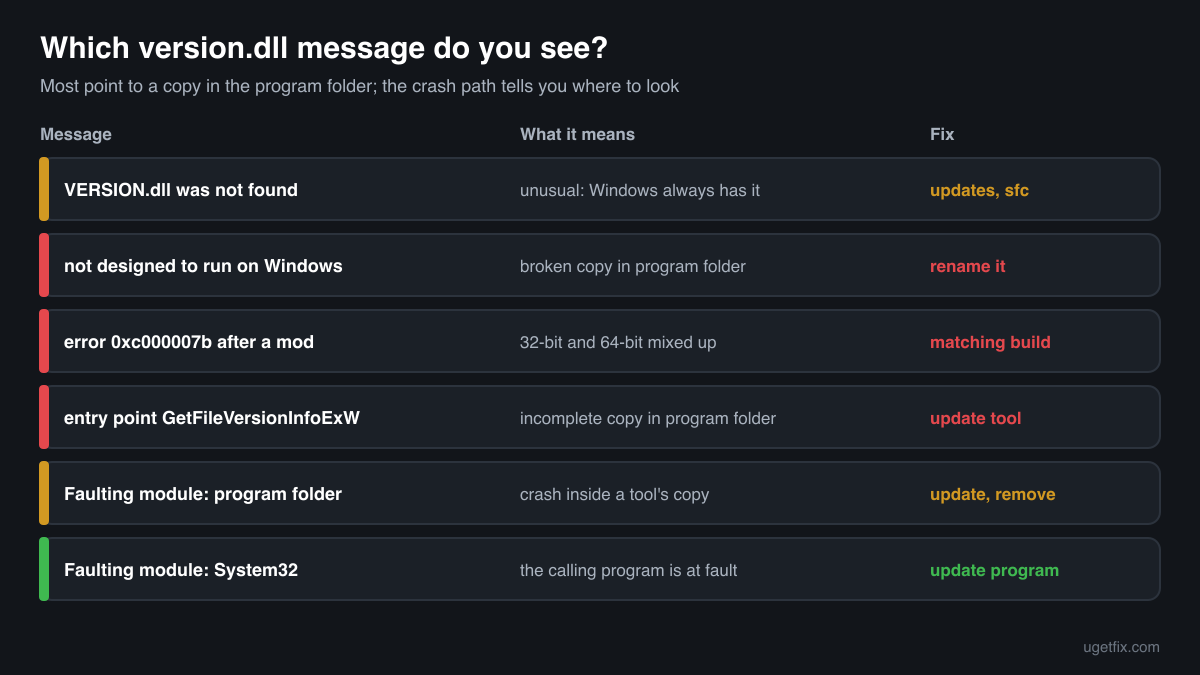
The code execution cannot proceed because VERSION.dll was not found. Reinstalling the program may fix this problem.
The wording of Windows 10 and Windows 11. Windows did not find a usable copy for that program. Because every Windows release ships the file, this is unusual: check the program folder for a broken copy or a leftover .bak, then install updates and run sfc /scannow and DISM.
The program can't start because VERSION.dll is missing from your computer. Try reinstalling the program to fix this problem.
The same situation in the older wording of Windows 7 and 8. Same fix.
VERSION.dll is either not designed to run on Windows or it contains an error. Try installing the program again using the original installation media or contact your system administrator or the software vendor for support.
A version.dll was found but could not be loaded. Almost always this is a copy in the program folder: a tool of the wrong build, a damaged download, or a file blocked by security software. Rename the program folder copy and test again.
The application was unable to start correctly (0xc000007b). Click OK to close the application.
This one does not name a file, but after adding a mod or patch it often means a 32-bit version.dll in a 64-bit program folder, or the other way round. Such tools come in two builds: use the one that matches the program.
The procedure entry point GetFileVersionInfoExW could not be located in the dynamic link library VERSION.dll.
Windows names a function in this message, here one of the version functions. The program asked the version.dll it loaded for a function this copy does not provide. The genuine file of Windows 10 and Windows 11 has all of them, so this points to an incomplete or outdated copy in the program folder.
Faulting module name: VERSION.dll
A line from the Application log in Event Viewer after a crash. Look at the Faulting module path line of the same event. A program folder path means the crash happened inside a tool's copy: update or remove it. A System32 or SysWOW64 path usually means the program passed bad data to the genuine file: update or reinstall that program, then run sfc /scannow if it keeps happening.
File facts
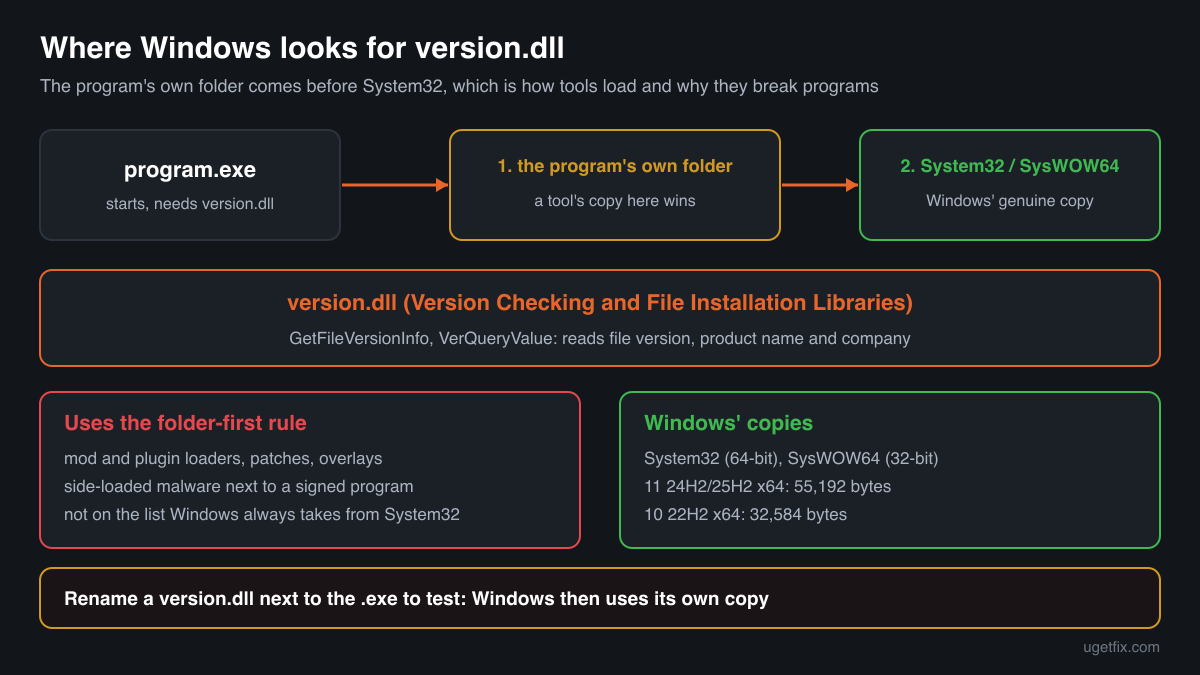
version.dll holds the Windows version information functions, such as GetFileVersionInfo, GetFileVersionInfoSize and VerQueryValue. Installers use them to decide whether a file on the PC is older or newer than the one they carry, and programs use them to show their own version or to check the version of another file. It is a small library that many programs load at start, which is also why tools and malware like to use its name. What Windows reports for the genuine file:
- Description in the file
- Version Checking and File Installation Libraries
- Where the genuine version.dll belongs
C:\Windows\System32C:\Windows\SysWOW64- Signed by
- Microsoft Windows, with a Windows catalog signature: the file's Properties show no Digital Signatures tab, which is normal. Check it in PowerShell: Get-AuthenticodeSignature <path to the file> (Status: Valid).
On 64-bit Windows, System32 holds the 64-bit file and SysWOW64 the 32-bit one; the folder names are historical. version.dll is not on the short list of libraries that Windows always takes from System32, so when a program starts, Windows looks for it in the program's own folder first. That is exactly what tools rely on: a file with this name next to the .exe is loaded instead of the Windows copy. The genuine 64-bit file is small: 55,192 bytes in Windows 11 24H2 and 25H2, 32,584 bytes in Windows 10 22H2. A tool's copy usually shows another description, another size, and no Microsoft signature.
version.dll versions by Windows release
Every Windows release has its own build of version.dll, updated together with Windows. Winbindex lists 341 distinct Microsoft builds; the table shows the newest one indexed for each release and the update that delivered it.
| Windows release | File version | Delivered by | Size, 64-bit |
|---|---|---|---|
| Windows 11 26H1 | 10.0.28000.1251 | KB5127646, October 13, 2026 | 55,224 bytes |
| Windows 11 25H2 | 10.0.26100.1150 | original release | 55,192 bytes |
| Windows 11 24H2 | 10.0.26100.1150 | original release | 55,192 bytes |
| Windows 11 23H2 | 10.0.22621.1 | original release | 50,976 bytes |
| Windows 11 22H2 | 10.0.22621.1 | original release | 50,976 bytes |
| Windows 11 21H2 | 10.0.22000.1 | original release | 49,936 bytes |
| Windows 10 22H2 | 10.0.19041.3636 | KB5126657, October 13, 2026 | 32,584 bytes |
| Windows 10 21H2 | 10.0.19041.3636 | KB5126657, October 13, 2026 | 32,584 bytes |
| Windows 10 21H1 | 10.0.19041.3636 | KB5126657, October 13, 2026 | 32,584 bytes |
| Windows 10 20H2 | 10.0.19041.3636 | KB5126657, October 13, 2026 | 32,584 bytes |
| Windows 10 2004 | 10.0.19041.3636 | KB5126657, October 13, 2026 | 32,584 bytes |
| Windows 10 1909 | 10.0.18362.1 | original release | 30,680 bytes |
Older copies of version.dll found on PCs
Public DLL catalogues have collected 16 copies of version.dll uploaded from PCs, from version 5.1.2600.2180 to 10.0.18362.1. Many come from older Windows releases. The table lists each with its checksums, so you can tell which one you have.
None of these replaces the file your Windows ships: the newest build indexed for Windows is 10.0.28000.1251, and each release keeps its own. If the check on this page finds your file in this list, it is most likely an older Microsoft build that was copied somewhere by hand. Confirm the Microsoft signature, remove the copy from the program folder, and let Windows use its own.
| Version | Build | Size | MD5 | SHA-1 |
|---|---|---|---|---|
10.0.18362.1 | 64-bit | 2c7c14627cff3384c52e61d4dbd0ecc3 | 119724cc09bb52731d86a6b9f94003ed88e0e3fe | |
10.0.18362.1 | 32-bit | 7864763b087bbf4800f5274384c1e065 | 8108450cbcad9fc79198fc9cc9c5ba1c417900f5 | |
10.0.17763.1 | 64-bit | 5719b3abd0fc28e1284f2515ae17613a | d1f1344156c1f8431cf7350a09245455525359d4 | |
10.0.14393.0 | 64-bit | cfdb018ac09f879caae7a66ca7880d57 | 2b2ec18e5d4c80b33191034d313370e98470e323 | |
10.0.14393.0 | 32-bit | 181fe38c3fe164fbfc1a5a8399ccc2da | d8920f3614f78557ac1bc8b2966cf70751c21bc6 | |
10.0.10586.0 | 64-bit | b32d772e48f1a49cebdb04cc33f693f7 | 3184675e4286f3610ee0c17790128fa480d4b851 | |
10.0.10586.0 | 32-bit | 85bd82333fc4ae6cff706f140a67b1b0 | f26a92fdc8b3b12090883a10c29d0bfb8b54b324 | |
6.3.9600.16384 | 32-bit | db530b4c83dc2439ea2397613c841af4 | a94bcb2e8e1f039e0f7f05324c415ab99bc1fbd9 | |
6.2.9200.16384 | 32-bit | 682c3d4982b5375732a4273809365a0a | 3e069aa5d47ed3bb1a0fb627b01a3d48adbeb079 | |
6.1.7600.16385 | 32-bit | 702254574e7e52052de39408457b7149 | d27f1672e605ba6fe202226f942e6cc635328bc5 | |
6.0.6002.18005 | 32-bit | 69827805a221c21450ba22f4326a2ee3 | 386c1e507ced6854e17a5f5b39dc513de33511b3 | |
6.0.6001.18000 | 64-bit | 8777e0d0f6ac09ca26aff1bb43fbb004 | a6fd5662684a6d3ab563515481cd74c5c11b7430 | |
6.0.6001.18000 | 32-bit | 187d588f7a1a45de48b8540401a90850 | 3b1d0c732e4d0ad41e2dd49b258ff77678743b20 | |
5.1.2600.5512 | 32-bit | c7ce131408739b0b3a318be2d0032719 | adf263b658136ccb3cde72d0e6dd634c5a5e5143 | |
5.1.2600.5512 | 32-bit | ed8775b4f9d11aa2e102624cc4110e93 | f503b05347f4b6bc0fddcc6a638c98c770bc9256 | |
5.1.2600.2180 | 32-bit | e1f32fdd68451516a7386abe70943e82 | 4e8fd6f14ebe20e00225554495bf53665a61ad5a |
Copies uploaded by users to a public DLL catalogue. We list their checksums so you can identify a file; we do not offer them for download and we did not verify each one against Microsoft's signature.
Questions people ask
Is version.dll a virus?
The copies in System32 and SysWOW64 are genuine Windows files and are harmless. A version.dll in a program or game folder is not Windows' copy: most often it belongs to a mod or patch you installed, but malware uses the same name too. Check the file with the tool on this page and read the security page linked above.
Do I need to install anything to get version.dll?
No. version.dll is part of Windows 10 and Windows 11 and cannot be installed separately. No DirectX, Visual C++ or .NET package contains it. If Windows' own copy is damaged, System File Checker, DISM and Windows Update repair it.
Why does a game crash after an update when it ran fine before?
If you use mods or patches, the usual reason is a loader that sits in the game folder as version.dll. A game update changes the code the loader and its plugins depend on, and they crash until their authors release an update. Rename version.dll in the game folder to test, then update the mods.
Can I delete version.dll?
Not the copies in System32 or SysWOW64: installers, Windows tools and many programs need them, and Windows treats them as protected system files. A version.dll in a program folder can be removed or renamed safely as far as Windows is concerned; only the tool that relies on it stops working.
Will System File Checker remove a version.dll from a program folder?
No. System File Checker repairs protected Windows files in the Windows folders. It does not look inside program or game folders, so a tool's version.dll there stays until you remove it.
Should I use the 32-bit or the 64-bit file?
For Windows itself you need both, and Windows already has both: the 64-bit file in System32 and the 32-bit file in SysWOW64. For a tool that goes into a program folder, use the build that matches the program. A mismatch causes error 0xc000007b.
Event Viewer blames version.dll in System32. Is the file broken?
Rarely. The genuine file only reads version data, so a crash inside it almost always starts in the program that called it, for example with a damaged file it was asked to read. Update or reinstall the program named as the faulting application. Run sfc /scannow if several unrelated programs crash the same way.
Related guides
version.dll is missing or crashes a program: what the file is and how to fix it
FixHow to fix "A newer version of OneDrive is installed" error?
FixHow to fix Windows Defender Security Intelligence version 0.0.0.0?
FixHow to fix "This version of WhatsApp became out of date" on Android?
Sources
- Winbindex, the Windows binaries index (m417z)
- Microsoft Learn: Use the System File Checker tool to repair missing or corrupted system files
- HijackLibs: version.dll
File data read on October 17, 2026.

The editors who write and check uGetFix guides and reference pages. File facts are read from Microsoft's own installers and documentation, and every page shows the date its data was read.
Questions and experiences
Ask about this page: members and our editors answer. Reading is open; writing needs a free account.
…