
How to fix "We couldn't install Windows in the location you chose" 0x80300024 error?

Prefer to fix it yourself? The manual steps follow.
- 6methods
- 5 to 40 minutes
- Intermediate
Applies to A clean or custom install of Windows 11 or Windows 10 from a USB stick or DVD, on the Where do you want to install Windows? screen
6 methods in this guide
I was trying to reinstall Windows and received the error "We couldn't install Windows in the location you chose. Please check your media drive. Error 0x80300024." I don't know how to proceed next, so it would be nice if you could provide some tips.
Windows Setup shows 0x80300024 when it refuses the drive or partition you picked on the "Where do you want to install Windows?" screen. The USB stick is rarely the problem, despite "check your media drive". Delete the old partitions on the target drive, unplug every other drive and install to the Unallocated Space first.
Copy off any files you need, then on Where do you want to install Windows? select every partition of the target drive, select Delete, pick the single Unallocated Space and select Next (Fix 1). Unplug all other drives first (Fix 2). If Setup then names the GPT partition style, start the USB from its UEFI entry (Fix 3).
| Error | We couldn't install Windows in the location you chose. Please check your media drive. Here's more info about what happened: 0x80300024. |
|---|---|
| Where it appears | In Windows Setup booted from a USB stick or DVD, after you choose Custom and select Next on Where do you want to install Windows? |
| Main cause | Setup will not use the selected partition: old partitions from an earlier install, a second drive in the way, or a partition style that does not match how the PC was started (UEFI or legacy BIOS). |
| Fastest fix | Delete all partitions on the target drive and install to the Unallocated Space, with every other drive unplugged (Fix 1 and Fix 2). This erases that drive. |
| Also written as | "Windows couldn't install in the location you chose", "Windows is unable to install to the selected location", "we couldn't install Windows in the location you choose". Close relatives: 0x80300001, 0x80300002, 0x8030002c. |
| Affects | Clean installs of Windows 11 and Windows 10 (the code was already reported on Windows 8.1). It is not an error of an in-place upgrade from a running Windows. |
| Microsoft's status | Not a known issue and no fix in an update. In what we read on 15 October 2026, Microsoft does not describe 0x80300024 itself. It does document the partition style rules that cause the related GPT messages. |
| When it is hardware | diskpart reports Data error (cyclic redundancy check), the drive is write protected, or Setup also fails with We couldn't create a new partition. [Error: 0x80070017]. |
| Time to fix | 5 minutes for Fix 1 and Fix 2. 10 minutes for Fix 3 and Fix 4. About 30 minutes to remake the USB stick. Then the install itself. |
Facts checked on 15 October 2026. Steps written for Windows 11 25H2 and 26H2 and Windows 10 22H2 Setup started from a USB stick, against Microsoft's guide to the MBR and GPT partition styles.
What "We couldn't install Windows in the location you chose" (0x80300024) means
The message comes from Windows Setup during a clean install, not from a running Windows. You booted from a USB stick or DVD, chose Custom, selected a partition on Where do you want to install Windows? and pressed Next. Setup then refused that location. Nothing has been copied yet, and the files on the drive are as they were.
| Part of the message | What it refers to | What it tells you |
|---|---|---|
| We couldn't install Windows in the location you chose | The partition or unallocated space you selected in the drive list. | The problem is on the target drive, its partitions or the other drives in the PC. |
| Please check your media drive | A general hint that Setup adds to several location errors. | It does not prove that the USB stick is bad. Check the stick only after Fix 1 to Fix 4. |
| Here's more info about what happened: 0x80300024 | The code Setup returned for this refusal. | Microsoft does not publish a text for it. Forums tie it to partition and drive problems. |
People see the same sentence with 0x80300001, 0x80300002 or 0x8030002c, and Setup can also say "We couldn't create a new partition or locate an existing one". They come from the same drive selection step, so the fixes below are the same ones to try. A different message, "Windows cannot be installed to this disk", names the GPT partition style: that is Fix 3.
Why Windows Setup can't install Windows in the location you chose
Microsoft does not list causes for this code. The ranking below joins Microsoft's partition style rules for Setup with what users report on Ten Forums and Microsoft Q&A. Each cause points to one fix.
| Cause | How often | How to tell | Fix |
|---|---|---|---|
| Old partitions from an earlier Windows are still on the target drive, and you picked one of them. | Most often reported | The drive list shows Recovery, System, MSR and Primary partitions on Drive 0. | Fix 1 |
| A second internal drive or a USB disk is connected and confuses Setup's choice of where to put its boot files. | Often, on desktops with several drives | The list shows Drive 1, Drive 2 or a large USB disk next to the target. | Fix 2 |
| The PC was started in UEFI mode and the drive is MBR, or the other way round. | Often | Setup also says the selected disk is or is not of the GPT partition style. | Fix 3, Fix 4 |
| The partition table is damaged or leftover data blocks Delete. | Sometimes | Delete fails, or Unallocated Space does not appear as one area. | Fix 4 |
| A badly written install stick or a weak USB port. | Less often | Setup also stops with copy or read errors, or the stick was made with a third-party tool. | Fix 5 |
| The drive itself is failing, or its cable is loose. | Rarely, but it ends the search | CRC data errors, write protected, or error 0x80070017 when you create a partition. | Fix 6 |
How to fix "We couldn't install Windows in the location you chose" 0x80300024
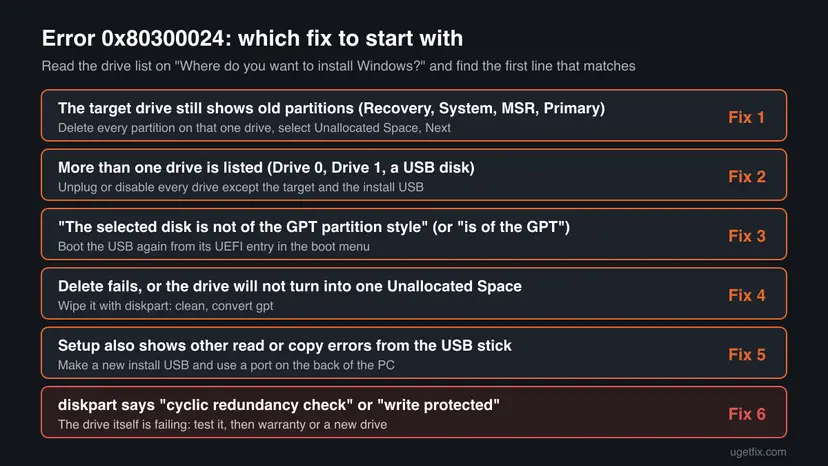
Fix 1 and Fix 2 solve most cases in a few minutes, but Fix 1 erases the target drive, so save your files first. Fix 3 and Fix 4 deal with UEFI and the GPT partition style. Fix 5 replaces the install stick, and Fix 6 tells you when the drive is failing.
| What you see or have | Start with |
|---|---|
| The target drive shows several partitions from an old Windows. | Fix 1 |
| Two or more drives are listed, or a USB disk is plugged in. | Fix 2 |
| Setup says the selected disk is or is not of the GPT partition style. | Fix 3 |
| Delete fails, or the drive will not become one Unallocated Space. | Fix 4 |
| The stick was made with a third-party tool or gives other read errors. | Fix 5 |
| diskpart shows a cyclic redundancy check error or write protected. | Fix 6 |
Fix 1. Delete the old partitions and install to the Unallocated Space
5 minutesRead the warningYou are reinstalling on a drive that held Windows before, and you picked one of its partitions.
Microsoft's instructions for Setup are to delete each partition on the target drive and select the unallocated space. Setup then lays the drive out itself in the style that matches how the PC was started. On Ten Forums this was the step that cleared 0x80300024.
Delete removes the partition and everything on it, including the old Windows and your files. Copy what you need to another drive or the cloud before you start Setup: Back up your files (Windows Backup, File History, Time Machine). If the PC has several drives, check the drive number and size twice, as Microsoft warns.
- Boot from the Windows install USB stick and go through Setup until Which type of installation do you want?. Select Custom: Install Windows only (advanced).
- On Where do you want to install Windows?, find the drive you want Windows on by its size, for example Drive 0.
- Select its first partition and select Delete, then OK. Repeat for every partition of that same drive.
- When the drive shows one line, Drive 0 Unallocated Space, select that line.
- Select Next. Do not select New or Format: Setup creates the partitions it needs.
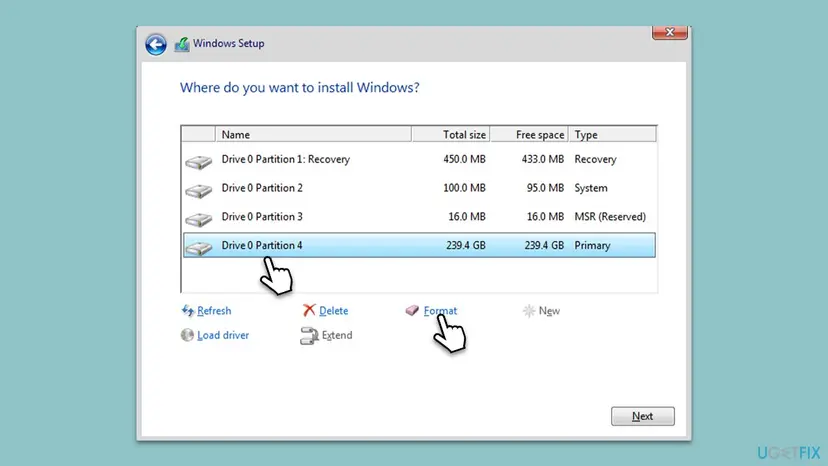
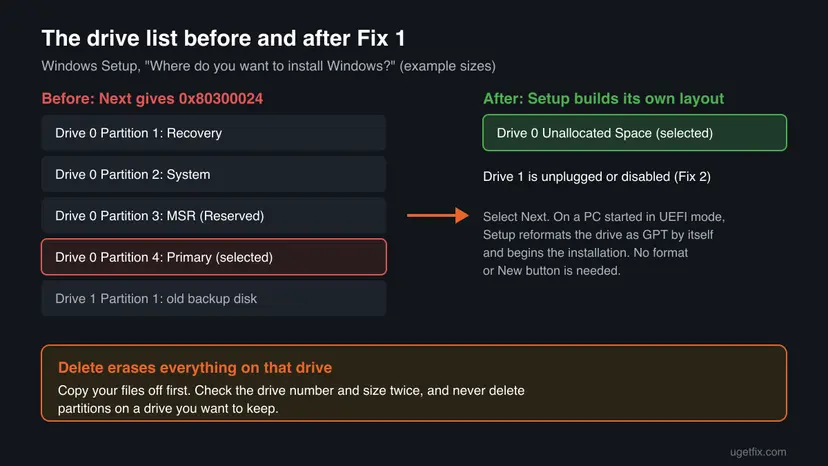
It worked if: Setup accepts the Unallocated Space and moves on to Installing Windows with the copy progress.
If not: If 0x80300024 comes back, unplug the other drives with Fix 2. If Delete fails, go to Fix 4.
Fix 2. Unplug every drive except the target and the install stick
5 to 15 minutesLow riskThe drive list shows more than one drive, or a USB hard drive or card reader is connected.
With several drives, Setup may want to put its boot files on a drive you did not choose. On Ten Forums the person who asked solved it only after disabling the other drive in the firmware, and Microsoft warns to delete partitions only on the right drive.
- Shut down the PC fully and unplug USB hard drives, SD cards and phones. Leave only the install stick, the keyboard and the mouse.
- On a desktop, unplug the data cable of each internal drive you are not installing to, with the power off and the power cord out.
- If the cables are hard to reach, open the firmware setup at start (often Del, F2 or F10) and disable the other drives or their ports instead.
- Boot from the install stick again. The list on Where do you want to install Windows? should now show only the target drive.
- Repeat Fix 1 on that drive and select Next.
- Reconnect the other drives after Windows has finished its first start.
The drive number alone does not decide it. A Ten Forums member points out that Windows installs to Drive 1 or Drive 2 just as well. Unplugging the extras removes the doubt about which drive gets the boot files.
It worked if: Only one drive appears in the list, and Setup starts copying after Next.
If not: If Setup now names the GPT partition style, go to Fix 3. If the error stays with one drive, go to Fix 4.
Fix 3. Start the install stick in UEFI mode so the partition style matches
10 minutesLow riskSetup says the selected disk is or is not of the GPT partition style, or the stick appears twice in the boot menu.
Microsoft explains that the drive's partition style must match the mode the PC started in: GPT for UEFI, MBR for legacy BIOS. Windows 11 needs UEFI, so start the stick in UEFI mode and let Setup convert the empty drive to GPT.
- Plug in the install stick and restart the PC.
- Press the boot menu key shown on the start screen or in your PC maker's manual.
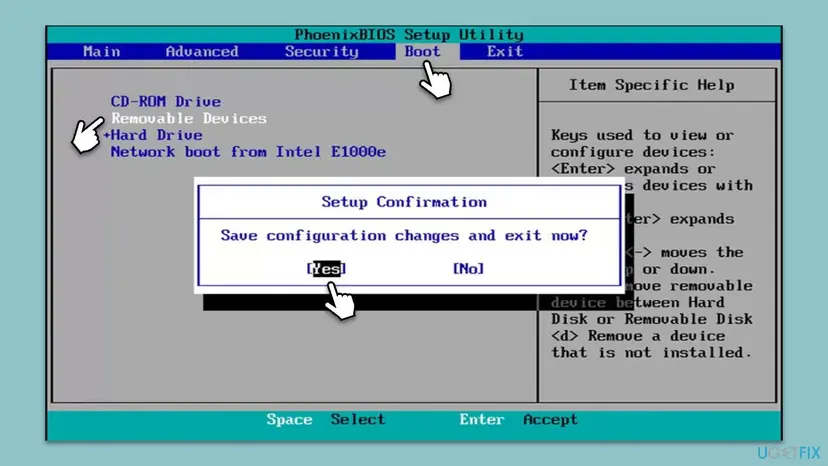
- If the stick is listed twice, pick the entry that starts with UEFI:. To change the order for good, use the Boot tab of the firmware setup instead.
- In Setup, choose Custom, delete the partitions of the target drive as in Fix 1 and select the Unallocated Space.
- Select Next. Microsoft states that Setup detects UEFI mode and reformats the drive as GPT by itself.
Want to keep an MBR drive with its data? Microsoft's other option is to start in legacy BIOS mode. That route does not work for Windows 11, which requires UEFI. Converting with MBR2GPT keeps data but runs from Windows, not from this screen.
It worked if: The GPT message is gone, and Next on the Unallocated Space starts the copy.
If not: If you cannot delete the partitions or the GPT message stays, wipe the drive with diskpart in Fix 4.
Fix 4. Wipe the drive and convert it to GPT with diskpart
10 minutesRead the warningDelete fails, the drive keeps odd partitions, or the GPT message survives Fix 3.
The diskpart clean command removes the whole partition table, including hidden leftovers that the Setup screen cannot delete. Microsoft documents clean and convert gpt from Setup as the manual way to make a drive ready for UEFI.
There is no undo. Back up first with Back up your files (Windows Backup, File History, Time Machine). Pick the disk by its size in list disk, not by its number alone, and unplug other drives as in Fix 2 so you cannot wipe the wrong one.
- Boot the install stick in UEFI mode as in Fix 3. On the first Setup screen, press Shift + F10 to open a command prompt.
- Type
diskpartand press Enter. - Type
list diskand press Enter. Note the number of the target drive by its size. - Select that disk, wipe it, convert it and leave diskpart. Press Enter after each line and replace 0 with your disk number:
select disk 0 clean convert gpt exit - Close the command prompt and continue Setup. Choose Custom, select the Unallocated Space and select Next.
Older guides add create partition primary, active and format after clean. The active flag belongs to MBR drives in legacy BIOS mode and does not apply to GPT. Leave the space unallocated: Setup partitions and formats it.
It worked if: Each diskpart command ends with a success line and no error, and Setup shows one Unallocated Space that it accepts.
If not: If diskpart reports a data error, cyclic redundancy check or write protection, the drive is the problem: go to Fix 6. Otherwise try a new stick with Fix 5.
Fix 5. Make a new install stick with Microsoft's tool and use another USB port
30 to 45 minutesLow riskThe stick was made with a third-party tool, is old, or Setup also shows copy or read errors.
The message asks you to check your media drive. A stick with read errors or a layout that starts only in legacy mode can make Setup misjudge the target drive, so a fresh one from Microsoft rules this out.
- On a working PC, open Microsoft's Download Windows 11 page and download the Media Creation Tool.
- Plug in an empty USB stick. Everything on it will be erased.
- Run the tool, accept the license, choose language and edition, then USB flash drive and your stick.
- On the PC that fails, plug the new stick into a USB port on the back of the PC, directly on the motherboard, not a hub or front panel.
- Boot from it as in Fix 3 and repeat Fix 1.
It worked if: Setup starts from the new stick and the Unallocated Space installs without 0x80300024.
If not: If the same code appears with a new stick and one empty drive, test the drive with Fix 6.
Fix 6. Check the drive's cable and health
20 to 40 minutesLow riskdiskpart shows CRC data errors or write protection, Setup cannot create a partition (0x80070017), or nothing else helped.
In a Microsoft Q&A case with 0x80300024, diskpart failed with a cyclic redundancy check error and the drive reported write protection. The accepted answer pointed to a physical fault of the SSD and to the warranty. No partition fix works on a failing drive.
- Turn the PC off and unplug it. On a desktop, reseat the drive's data and power cables, or move the SSD to another M.2 or SATA slot.
- Boot Setup again. If the drive is still listed with errors, take it out and connect it to another Windows PC with a USB adapter or enclosure.
- On that PC, look at the drive in Disk Management and run a disk check on it: Check a disk for errors (chkdsk).
- Run the drive maker's own test tool on the second PC, if the maker has one.
- If the drive shows errors, write protection or disappears, stop using it. Ask for a warranty replacement or install to a new drive.
It worked if: Either the drive passes and installs after a cable change, or you know it is failing and will not waste more time on partitions.
If not: If the drive passes on another PC but fails in this one, the slot, cable or firmware settings of this PC are next: read the section below.
If Windows Setup still can't install in the location you chose
Setup does not write the reason for 0x80300024 on screen. The most useful clue is the output of diskpart from Fix 4. Run list disk and look at the Status and Gpt columns, then detail disk for the selected disk. A drive that shows Offline, a wrong size or read errors is not a partition problem.
| What you find | What to do |
|---|---|
| diskpart: Data error (cyclic redundancy check) | The drive has unreadable areas. Back up what you can and replace the drive. |
| The disk is write protected, or chkdsk cannot run because it is write protected | The accepted Microsoft Q&A answer read this as a physical fault of the SSD. Contact the maker for a warranty claim. |
| We couldn't create a new partition. [Error: 0x80070017] | In the Microsoft Q&A case it came together with CRC data errors. Treat it as a drive fault, as in Fix 6. |
| The target drive is not listed at all | Setup lacks a storage driver, or the drive is off in the firmware. Check the firmware's storage settings and the PC maker's support page. |
| The drive passes every test on another PC | Try a different slot or cable in this PC and update its firmware from the PC maker. |
- What to send to support: the full message with the code, the PC model, the drive model and size, and the output of
list disk. - Say whether the PC started the stick in UEFI or legacy mode, and how many drives were connected.
- List the fixes you tried and what changed after each one.
Suspect the hardware when the same drive fails with a new stick, with every other drive unplugged and after clean. CRC errors, write protection and a drive that drops out of list disk are the signs. A new install stick will not change that.
How to avoid 0x80300024 on the next clean install
- Back up your files before you boot the install stick.
- Unplug all drives except the target before a clean install.
- Start the stick from its UEFI: entry and install to the Unallocated Space.
- Make the stick with Microsoft's Media Creation Tool.
- Do not install to an old Primary partition while the old Recovery and System partitions stay.
- Do not use Format to clear a drive Setup refused: use Delete.
- Do not add
activeor MBR steps on a PC that starts in UEFI mode. - Do not keep reinstalling on a drive that shows CRC errors.
Windows 10 left support on 14 October 2025. If you are reinstalling anyway and the PC meets the Windows 11 requirements, install Windows 11 from a UEFI started stick. That also gives the GPT layout this error tends to trip over.
If you only want a fresh Windows and your current one still starts, you can avoid this screen altogether. Reinstall from inside Windows and keep your files: Reinstall Windows without losing files. If the in-place tool fails instead, see our guide to the Installation Assistant's "Can't create files" error.
Frequently asked questions
What does "We couldn't install Windows in the location you chose" mean?
It means Windows Setup refused the partition or drive you selected on the Where do you want to install Windows? screen during a clean install. The code 0x80300024 is how Setup reports that refusal. Microsoft does not publish a text for the code, but users tie it to old partitions on the target drive, other drives in the PC, a UEFI and MBR mismatch, and sometimes a failing drive. Nothing has been installed or erased when you see it.
Why does it say "Please check your media drive" if my USB stick is fine?
Because Setup adds that hint to several errors on the drive selection screen, whatever the cause. In most reported cases the stick works, and the problem is the target drive: old partitions, a second drive, or a partition style that does not match how the PC started. Try Fix 1 and Fix 2 before you remake the stick. Replace it with Fix 5 only when Setup also shows read or copy errors.
Will deleting the partitions erase my files?
Yes. Delete on the Where do you want to install Windows? screen removes the partition and everything in it, and diskpart clean wipes the whole selected disk. Neither can be undone from Setup. Copy your files to another drive or a cloud service before you boot the install stick. If the old Windows no longer starts, connect the drive to another PC to copy files first. Delete only partitions on the drive you install to.
Do I have to install Windows on Drive 0?
No. Windows can be installed on Drive 1, Drive 2 or any other number, as a Ten Forums member who answers many install questions points out. The number is not the problem. A second drive can still confuse Setup about where to put its boot files, and one user only got past 0x80300024 after disabling the other drive in the firmware. Unplugging every drive except the target removes that doubt.
What is the difference between GPT and MBR, and which one do I need?
They are two ways to lay out partitions on a drive. Microsoft explains that a PC started in UEFI mode needs a GPT drive, and a PC started in legacy BIOS mode needs MBR. MBR is limited in size and in the number of partitions. Windows 11 requires UEFI, so use GPT. Setup converts an empty drive to GPT by itself when the stick was started in UEFI mode.
Can I fix 0x80300024 without losing data?
Sometimes. Unplugging other drives (Fix 2), starting the stick in the right mode (Fix 3) and making a new stick (Fix 5) erase nothing. Microsoft's MBR2GPT tool can convert a drive to GPT and keep its data, but it runs from a working Windows. If Windows still starts, a reinstall that keeps your files avoids this screen entirely. Deleting partitions or clean always erases the drive.
What do 0x80300001, 0x80300002 and 0x8030002c mean?
They appear with the same sentence on the same Setup screen, and people search for them together with 0x80300024. Microsoft does not describe these codes either, so we cannot give an official meaning for each. In practice they come from the drive selection step, and the same order of fixes applies: delete the old partitions, unplug other drives, check UEFI and GPT, wipe with diskpart, then check the drive itself.
Is 0x80300024 a sign that my SSD is dying?
Usually not, but it can be. Most cases end with Fix 1 or Fix 2. Suspect the drive when diskpart reports Data error (cyclic redundancy check), when the disk is write protected, or when Setup cannot create a partition with error 0x80070017. In a Microsoft Q&A case with exactly those signs, the accepted answer was a physical SSD fault and a warranty claim. Test the drive on another PC to be sure.
I see the message in German, Russian or Polish. Is it the same error?
Yes. "Windows kann nicht am ausgewählten Speicherort installiert werden", "Нам не удалось установить Windows в выбранное расположение" and "Nie można zainstalować systemu Windows w wybranej lokalizacji" are the same Setup message in other languages, with the same codes. The menu names on the drive screen are translated, but the fixes are the same. The message "Could not retrieve installation folder" is different: we could not tie it to Windows Setup, and it is not covered here.
Setup still fails after every fix. What now?
Stop changing partitions and look at the drive. If it fails with a new stick, with no other drive connected and after diskpart clean, test it on another PC with chkdsk and the maker's tool. Check that the firmware sees the drive and update the PC's firmware from its maker. If the drive passes elsewhere, try another slot or cable. Send the PC maker or a repair shop the full message and the output of list disk.
Sources
- Microsoft Learn: Windows Setup, installing using the MBR or GPT partition style (UEFI and legacy modes, deleting partitions, diskpart clean and convert gpt) (learn.microsoft.com)
- Microsoft Q&A: We couldn't install Windows in the location you chose, 0x80300024 (CRC data error, write protected SSD, 0x80070017) (learn.microsoft.com)
- Ten Forums: We couldn't install Windows in the location you chose: 0x80300024 (user reports: deleting the partition, disabling the second drive) (tenforums.com)
Did this fix work?
One click, no account. It tells the next reader which guides are worth their time.
Questions and experiences: fix "We couldn't install Windows in the location you chose" 0x80300024 error
Still broken, or found a fix we did not cover? Ask here: members and our editors answer. Reading is open; writing needs a free account.
…