
How to fix Windows login error 0x80090011

Prefer to fix it yourself? The manual steps follow.
- 7methods
- 5 to 30 minutes
- Medium
Applies to Windows 11 and Windows 10 PCs that sign in with a Windows Hello PIN, home PCs and work or school PCs joined to Microsoft Entra ID
7 methods in this guide
Hi, I have a big problem: I can't log in to Windows because I get error 0x80090011 every time. I have been using the same PIN for over a year with no problems, and now I suddenly can't log in. Please help.
Error 0x80090011 means Windows could not find the key container that your Windows Hello PIN unlocks, so the PIN stops working at sign-in, in administrator prompts or when you set it up. Sign in with your account password, remove the PIN, restart and add a new one first.
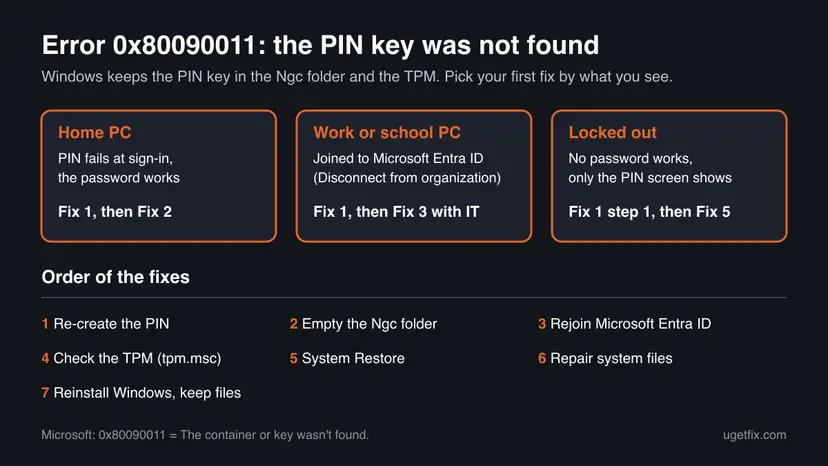
0x80090011 means the key behind your PIN was not found. On the sign-in screen choose Sign-in options, select the key icon and sign in with your account password, or select I forgot my PIN. Then remove the PIN in Settings > Accounts > Sign-in options, restart and set a new one (Fix 1). If that fails, empty the Ngc folder (Fix 2). On a work PC, Microsoft's fix is to rejoin Microsoft Entra ID (Fix 3).
| Error | Something went wrong and your PIN isn't available (code: 0x80090011). Microsoft's meaning: The container or key wasn't found. |
|---|---|
| Where it appears | On the Windows sign-in screen under the PIN box, in the Create a PIN step of Windows Hello setup, and in User Account Control prompts that ask for the PIN when you install an app or run one as administrator. |
| Main cause | The Windows Hello PIN data in the Ngc folder is damaged or no longer matches its key, so Windows cannot find the key the PIN should unlock. |
| Fastest fix | Sign in with the password, remove the PIN, restart and set up a new PIN (Fix 1). |
| Also written as | 0x80090011, 80090011, code: 0x80090011, 2148073489 (decimal), -2146893807 (signed), NTE_NOT_FOUND. |
| Affects | Windows 11 and Windows 10. Windows 10 left support on 14 October 2025, so a Windows 10 PC gets no further fixes for Windows Hello. |
| Microsoft's status | Listed in Microsoft's table of Windows Hello PIN creation errors with one mitigation: unjoin the device from Microsoft Entra ID and rejoin (checked 15 October 2026). No Windows update is named as a fix. |
| Time to fix | 5 minutes for a new PIN, 15 minutes for the Ngc folder, longer for a Microsoft Entra rejoin or a repair from the recovery screen. |
Facts checked on 15 October 2026. Steps written for Windows 11 (25H2 and 26H2) and Windows 10 22H2 with a Windows Hello PIN, read against Microsoft's Windows Hello PIN error table.
What error 0x80090011 means and where you see it
A Windows Hello PIN is not checked like a password. The PIN unlocks a secret key that Windows created for your account and stored on this PC, usually protected by the TPM security chip. Windows keeps the setup of that key for every account in a system folder named Ngc. Error 0x80090011 is the cryptographic code Microsoft describes as The container or key wasn't found: Windows looked for your key container and it was not there or could not be read.
That is why the PIN fails while your account and its password are fine. A Microsoft support moderator describes the code the same way: the PIN credential data is corrupted, and Windows cannot use the PIN for sign-in, administrator approval or app installation, even when Settings still shows the PIN as set up.
| Spelling | Where you see it |
|---|---|
| Something went wrong and your PIN isn't available (code: 0x80090011). | Windows sign-in screen, under the PIN box |
0x80090011 or 80090011 | Windows Hello Create a PIN window, User Account Control prompts, Event Viewer |
2148073489 | The same code in decimal, in some app and sign-in logs |
-2146893807 | The same code as a signed number, in scripts and server logs |
NTE_NOT_FOUND | The code's name in Windows developer headers and logs |
Some videos call 0x80090011 a Windows Update or upgrade error. Microsoft documents the code only for Windows Hello PIN errors, and we found no Microsoft page that ties it to Windows Update. If you see it during an update, the steps below for system files and a repair reinstall (Fix 6 and Fix 7) are the ones that apply.
What causes error 0x80090011, from the most common
The ranking is our reading of Microsoft's PIN error table, Microsoft's support answers and the reports behind the old version of this guide, not a statistic. The key question is whether you can still sign in with a password: if you can, the fix is quick.
| How often | Cause | Typical sign | Fix |
|---|---|---|---|
| Most often | The PIN data in the Ngc folder is damaged, for example after an update, a crash during a PIN change or a cleanup tool | The PIN fails but the password works | Fix 1, then Fix 2 |
| Often | Removing the PIN in Settings did not clear the broken container | You removed and re-added the PIN and still get 0x80090011 | Fix 2 |
| Often on work PCs | The device's Microsoft Entra ID registration no longer matches the Windows Hello for Business key | Work or school account, the error appears in Create a PIN | Fix 3 |
| Less often | The TPM that holds the key is off, reset or not ready | tpm.msc does not say The TPM is ready for use | Fix 4 |
| Rarely | Damaged Windows system files or a bad recent change | Other sign-in or security features also fail | Fix 5, Fix 6, Fix 7 |
The code comes from Windows' own key storage on this PC. Your Microsoft account, its password and your files are not damaged, which is why the password still signs you in.
How to fix error 0x80090011
All fixes start from a password sign-in, so make sure you know your account password or can reset it at account.microsoft.com from another device. The fixes go from the quickest and safest to the slowest. You are done when Windows accepts a new PIN and signs in with it after a restart.
| Your situation | Start with | Then |
|---|---|---|
| Home PC, the PIN fails at sign-in, the password works | Fix 1 | Fix 2 |
| You already removed and re-added the PIN and still get the code | Fix 2 | Fix 4 |
| Work or school PC, the error shows in Create a PIN | Fix 1 | Fix 3 with IT |
| The code appears in an administrator prompt when you install an app | Fix 1 | Fix 2 |
| You cannot sign in at all, not even with a password | Fix 1, steps 1 and 2 | Fix 5 |
| Other sign-in and security features also fail | Fix 4 | Fix 6 |
Fix 1. Sign in with the password, remove the PIN and set up a new one
5 minutesLow riskEveryone who can sign in with the account password or reset the PIN from the sign-in screen.
Removing the PIN makes Windows drop the PIN's key setup, and adding one creates a new key container. Microsoft's own first steps for PIN creation errors are the same: try again, sign out and in, restart, then create the PIN again.
- On the sign-in screen select Sign-in options, select the key icon and sign in with your account password.
- If you only see the PIN box, select I forgot my PIN below it, confirm your Microsoft account password and follow the prompts to set a new PIN. If that works, you are done.
- Once signed in, open Settings > Accounts > Sign-in options and expand PIN (Windows Hello).
- Select Remove and confirm with your password.
- If Remove is grey, under Additional settings turn off For improved security, only allow Windows Hello sign-in for Microsoft accounts on this device. On Windows 10 it is Require Windows Hello sign-in for Microsoft accounts.
- Restart the PC and sign in with the password again.
- In Sign-in options, select PIN (Windows Hello) > Set up and choose a new PIN.
- Lock the PC with Win + L and sign in with the new PIN.
Windows Hello face and fingerprint sign-in depend on the PIN. They stop working when you remove it, and you may have to set them up again after the new PIN.
It worked if: Windows saves the new PIN without an error and accepts it after a restart.
If not: If Set up shows 0x80090011 again, or the PIN fails after a restart, the old container is still there: empty the Ngc folder with Fix 2.
Fix 2. Take ownership of the Ngc folder, empty it and add a new PIN
15 minutesRead the warningFix 1 did not help, or Settings shows the PIN as set up but every use fails with 0x80090011. You must be able to sign in with a password.
This is the fix a Microsoft support moderator gives for 0x80090011: it deletes the damaged PIN data, so Windows builds a fresh key container the next time you add a PIN. It removes what Fix 1 cannot reach.
The Ngc folder holds the PIN, face and fingerprint setup of all accounts on the PC. Each user must sign in with a password afterwards and set Windows Hello up again. Know your password before you start. On a work PC that uses Windows Hello for Business, ask IT first.
- Sign in with your password to an administrator account.
- Open File Explorer and go to
C:\Windows\ServiceProfiles\LocalService\AppData\Local\Microsoft. Confirm the access prompt if one appears. - Right-click the Ngc folder and select Properties > Security > Advanced.
- Next to Owner select Change, type your user name, select Check Names and OK.
- Tick Replace owner on subcontainers and objects, then select Apply and OK.
- Open the Ngc folder, select everything in it and delete it. Keep the empty Ngc folder itself.
- Restart the PC, sign in with the password and add a new PIN in Settings > Accounts > Sign-in options.
We cover the same folder in more detail, including a permission reset with icacls, in our guide to The device that is required by this cryptographic provider is not ready for use.
It worked if: Windows asks you to set up a PIN as if for the first time, and the new PIN works after a restart.
If not: On a work or school PC, go to Fix 3. On a home PC, check the TPM with Fix 4.
Fix 3. Disconnect from Microsoft Entra ID and join again (work or school PC)
15 to 30 minutesRead the warningThe PC is joined to a work or school organization and the error shows when you create the PIN. Do this with your IT administrator.
This is the one mitigation Microsoft lists for 0x80090011 in its Windows Hello PIN error table. Rejoining gives the device a new registration, so Windows Hello for Business can create a new key container that matches it.
After you disconnect, your work account can no longer sign in to this PC until it is joined again. Make sure you know the password of a local administrator account on the PC, and that IT allows you to rejoin. Company apps and policies may need to be set up again.
- Sign in with your password.
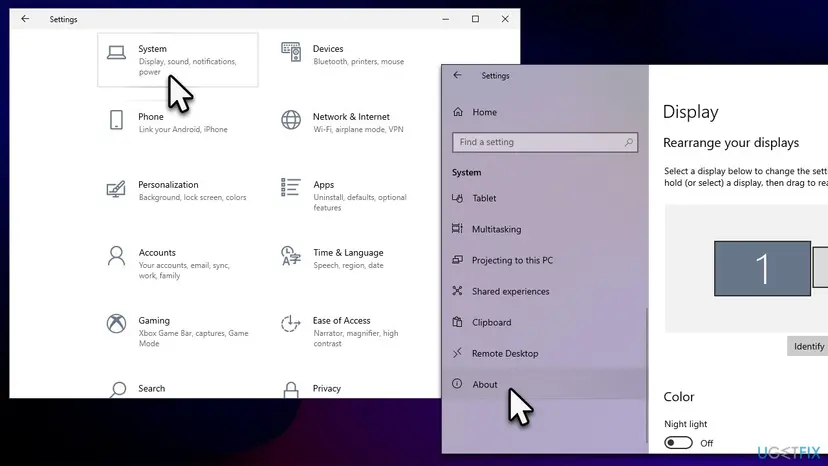
- Open Settings > System > About. On Windows 10 it is Settings > System > About as well, with the link under Related settings.
- Select Disconnect from organization and confirm with Continue.
- Restart and sign in with a local administrator account.
- Join the PC again in Settings > Accounts > Access work or school > Connect, as IT tells you.
- Sign in with the work account and set up the PIN in Settings > Accounts > Sign-in options.
It worked if: The PC shows as connected under Access work or school and the new PIN saves.
If not: Ask IT to check the device and Windows Hello for Business on their side, and read the still broken section below.
Fix 4. Check that the TPM is ready in tpm.msc
5 minutesLow riskFix 1 and Fix 2 did not help, or you changed BIOS or TPM settings recently.
The key the PIN unlocks usually lives in the TPM. If the TPM was turned off, cleared or is not ready, Windows cannot find the key, and a new PIN fails too.
- Press Win + R, type
tpm.mscand press Enter. - Under Status, look for The TPM is ready for use.
- If it says that no compatible TPM is found, open the PC's firmware settings and check that the TPM (often called PTT on Intel or fTPM on AMD) is turned on.
- If the console reports another state, follow our TPM guide from its Fix 2.
- When the TPM is ready, set up the PIN again as in Fix 1.
It worked if: tpm.msc shows The TPM is ready for use and a new PIN saves.
If not: If the TPM is ready and the PIN still fails, the fault is in Windows itself: go to Fix 5 or Fix 6.
Fix 5. Use System Restore or Startup Repair from the recovery screen
15 to 45 minutesLow riskYou cannot sign in at all, or the error started right after an update, a driver or a cleanup tool.
System Restore returns Windows settings, drivers and programs to a restore point from before the PIN broke, without touching your files. It works from the recovery screen, so you do not need to sign in first.
- On the sign-in screen, hold Shift and select Power > Restart.
- Select Troubleshoot > Advanced options > System Restore and pick a restore point from before the error started.
- If there is no restore point, select Startup Repair on the same screen instead.
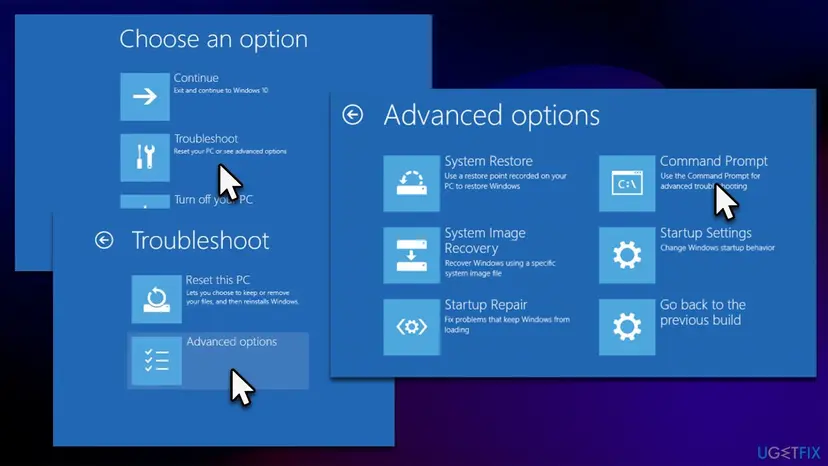
- Choose a restore point and finish. Select a restore point from before the problem, optionally Scan for affected programs, then select Next and Finish.
- Restart. When the restore is done, select Restart.
These steps were written for Windows 11 and Windows 10, from the Windows Recovery Environment. The full page with the other versions and what each result means: Undo recent changes with System Restore
If the drive is encrypted, the recovery screen asks for the 48-digit BitLocker recovery key. A personal PC's key is saved in your Microsoft account; on a work PC, ask IT.
It worked if: Windows restarts, says the restore finished, and the PIN works or can be set up again.
If not: If the restore fails or there is no restore point, repair the system files with Fix 6.
Fix 6. Repair Windows system files with DISM and SFC
20 minutesLow riskOther sign-in or security features fail as well, or Fix 1 to Fix 5 did not help.
Windows Hello depends on system components. If one of them is damaged, Windows can lose track of the key container; DISM and SFC replace damaged files with good copies.
If you can sign in with the password, run the scan from Windows. If you cannot, use the recovery variant of the procedure: there the commands must point at your Windows drive, because the recovery screen runs its own copy of Windows. Step by step: Run DISM and SFC to repair Windows system files.
- Open an elevated command window. Right-click Start and select Terminal (Admin), or type cmd in the search box, right-click Command Prompt and select Run as administrator. Select Yes when Windows asks for permission.

Search for cmd and choose Run as administrator. Screenshot: Windows 11 26H2. - Run DISM first. Type the command below and press Enter. DISM downloads clean copies of damaged components from Windows Update, so it can take several minutes. Wait until it says The operation completed successfully.
DISM.exe /Online /Cleanup-Image /RestoreHealth
DISM /RestoreHealth running. Screenshot: Windows 11 26H2. - Run System File Checker. In the same window, type the command below and press Enter. Do not close the window until the verification reaches 100%.
sfc /scannow
sfc /scannow at 100%. Screenshot: Windows 11 26H2. - Read the result and restart. Compare the last message with the table below this guide, then restart the PC so that repaired files are loaded.

The result line tells you what SFC did. Screenshot: Windows 11 26H2.
These steps were written for Windows 11 24H2 and 25H2. The full page with the other versions and what each result means: Run DISM and SFC to repair Windows system files
It worked if: SFC reports that it found and repaired damaged files, or found no integrity violations. After a restart a new PIN saves.
If not: If the files are fine and the PIN still fails, reinstall Windows with your files kept (Fix 7).
Fix 7. Reinstall Windows and keep your files
1 to 2 hoursRead the warningNothing above helped and you can sign in with a password, or you are locked out and System Restore failed.
A reinstall that keeps your files replaces every Windows component, including the Windows Hello parts, while your documents stay where they are.
Reset this PC with Keep my files removes installed apps, and any reinstall can fail halfway. Copy your documents, photos and other files to an external drive or OneDrive first. Step by step: Back up your files (Windows Backup, File History, Time Machine).
- Open Recovery in Settings. Open Settings > System > Recovery. Next to Fix problems using Windows Update, select Reinstall now. This keeps your apps, files and settings.

Fix problems using Windows Update reinstalls the current version and keeps apps, files and settings. Screenshot: Windows 11 26H2. - Start the reinstall. Choose whether the PC may restart on its own 15 minutes after the installation, then select OK.
- Wait and restart. Windows Update downloads and installs a repair copy of your current Windows version. Keep the PC plugged in and online, and restart it when asked.
- If that did not help: Reset PC. Back in Settings > System > Recovery, next to Reset this PC, select Reset PC. This keeps your personal files but removes installed apps and settings.
- Choose Keep my files. Select Keep my files. Do not select Remove everything.
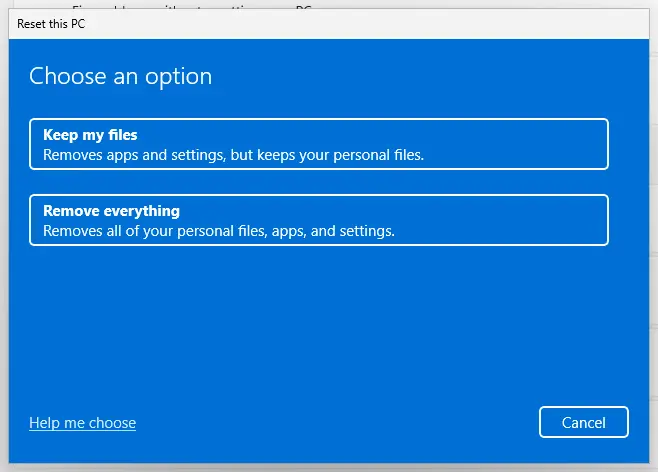
Keep my files removes apps and settings but keeps personal files. Screenshot: Windows 11 26H2. - Choose where Windows comes from. Select Cloud download to download a fresh copy of Windows, or Local reinstall to use the files already on the PC (faster, but may not include the latest updates).
- Reset. Review the summary and select Reset. The PC restarts several times.
These steps were written for Windows 11 22H2 and later. The full page with the other versions and what each result means: Reinstall Windows without losing files
It worked if: Windows starts with your files in place, and a new PIN saves on the first try.
If not: If the error survives a reinstall, read the still broken section: the TPM or the work account is the likely cause.
If error 0x80090011 is still there
As long as the password works, you are not locked out: you can keep using the PC without a PIN. Before you try anything bigger, collect what Microsoft Support, the PC maker or IT will ask for.
- The exact message and where it appeared: sign-in screen, Create a PIN, or an administrator prompt.
- Event Viewer: open Applications and Services Logs > Microsoft > Windows > HelloForBusiness > Operational and note the errors from the time of the failure.
- The TPM status: a picture of
tpm.mscwith its Status box, or of Windows Security > Device security > Security processor details. - Work or school PC: run
dsregcmd /statusin Command Prompt and send the output to IT. It shows whether the device is joined to Microsoft Entra ID. - Hardware: if a new PIN fails even after a reinstall and the TPM is not ready, contact the PC maker. A TPM fault is a warranty case, not a Windows setting.
For Windows Hello PIN errors that its steps do not fix, Microsoft says to contact Microsoft Support. Mention the code 0x80090011 and what you already tried.
How to keep error 0x80090011 from coming back
- Know your account password. It is the way back in whenever the PIN fails. Keep the setting that allows a password sign-in on.
- Change or remove the PIN only in Settings, never by deleting files, and let Windows finish before you restart.
- Do not let cleanup or tweaking tools touch
C:\Windows\ServiceProfiles. The PIN data lives there. - Keep the TPM settings unchanged in the firmware unless the PC maker tells you otherwise, and keep the BitLocker recovery key at hand.
- Keep a restore point: System Restore is the fastest way back when you are locked out.
Frequently asked questions
What is error code 0x80090011?
0x80090011 is a Windows cryptographic error that Microsoft describes as The container or key wasn't found. You see it when a Windows Hello PIN cannot be used or created, usually because the PIN data in the Ngc folder is damaged. Sign in with your password, remove the PIN, restart and set a new one. If that fails, empty the Ngc folder, and on a work PC rejoin Microsoft Entra ID.
What does "Something went wrong and your PIN isn't available" mean?
It means Windows could not use the key that your PIN unlocks, and code 0x80090011 says the key was not found. Your PIN itself is not wrong and your account is fine. Choose Sign-in options on the sign-in screen and use your password, or select I forgot my PIN. After you sign in, set up a new PIN as in Fix 1.
Why does 0x80090011 show when I install an app or run something as administrator?
On many PCs the User Account Control prompt asks for your Windows Hello PIN to approve administrator actions. If the PIN data is broken, that prompt fails with 0x80090011 too, so installs stop. In the prompt choose more choices and use your password, then rebuild the PIN with Fix 1 or Fix 2. A Microsoft support moderator points to the Ngc folder for exactly this case.
I removed the PIN and set it up again, but 0x80090011 is still there. What now?
Removing the PIN in Settings does not always delete the damaged key container. Take ownership of the Ngc folder in C:\Windows\ServiceProfiles\LocalService\AppData\Local\Microsoft, delete what is inside, restart and add the PIN again (Fix 2). On a work or school PC, the next step is to disconnect from the organization and join again with IT (Fix 3).
How do I fix 0x80090011 on Windows 11?
The fixes are the same on Windows 11 and Windows 10. Sign in with the password through Sign-in options, remove the PIN in Settings > Accounts > Sign-in options, restart and set a new PIN. If the error returns, empty the Ngc folder. On Windows 11, Disconnect from organization is under Settings > System > About when the PC belongs to a work or school account.
Can I get past the PIN screen without the PIN?
Yes, with your account password. Select Sign-in options under the PIN box and choose the key icon. If only the PIN box shows, select I forgot my PIN and confirm your Microsoft account. If you do not know the password of a Microsoft account, reset it at account.microsoft.com from another device. There is no safe way around both the PIN and the password, by design.
Will deleting the Ngc folder delete my files?
No. The Ngc folder holds Windows Hello data only: the PIN, face and fingerprint setup of the accounts on the PC. Your documents, apps and saved browser passwords are not stored there. After you empty it, each user signs in with a password and sets up a PIN again. Delete only what is inside the folder, not the folder itself.
Is 0x80090011 the same as 0x80090010 or 0x80090030?
No, they are neighbouring codes from the same family. Microsoft lists 0x80090010 as NTE_PERM, a permission error with no documented mitigation. The code 0x80090030 means the security device, usually the TPM, is not ready. We cover it in our guide to the cryptographic provider error. The code 0x80090011 means the key container was not found, and the fixes on this page start with the PIN data.
Does 0x80090011 mean my TPM is broken?
Usually not. In most cases the PIN data is damaged and a new PIN or an empty Ngc folder fixes it. The TPM becomes the suspect only when a new PIN fails every time, tpm.msc does not say The TPM is ready for use, or the error started after a BIOS change. Then check the TPM as in Fix 4 and contact the PC maker if it stays not ready.
Sources
- Microsoft Learn: Windows Hello errors during PIN creation (0x80090011, The container or key wasn't found, unjoin and rejoin Microsoft Entra ID; 0x80090010 NTE_PERM) (learn.microsoft.com)
- Microsoft Q&A: Windows 11 error code 0x80090011 when trying to put PIN (Microsoft support moderator: rebuild the Ngc folder, then disconnect from organization) (learn.microsoft.com)
- Microsoft Support: Windows Hello common issues and troubleshooting tips (PIN failures) (support.microsoft.com)
Did this fix work?
One click, no account. It tells the next reader which guides are worth their time.
Questions and experiences: fix Windows login error 0x80090011
Still broken, or found a fix we did not cover? Ask here: members and our editors answer. Reading is open; writing needs a free account.
…