
How to fix KB5057056 fails to install in Windows 10?

Prefer to fix it yourself? The manual steps follow.
- 6methods
- 10 to 45 minutes
- Intermediate
Applies to Windows 10 version 22H2 with .NET Framework 3.5, 4.8 or 4.8.1, and the .NET Framework updates that replaced KB5057056
6 methods in this guide
- What KB5057056 is
- Why it fails
- Windows 10 end of support
- Where the cause is written
- The fixes
- 1. Install the newest .NET update
- 2. Install the package by hand
- 3. Repair .NET Framework
- 4. Reset update components
- 5. Repair system files
- 6. Free disk space
- If it still fails
- Uninstall the update
- Keep it from coming back
- FAQ
Today I woke up and saw the message in the corner: there's a new update. OK, nothing unusual, but when I tried to install it, it failed. The update number is KB5057056, and it does not give any reason why it failed. I would be grateful for some help here.
KB5057056 is an optional preview update of 22 April 2025 for .NET Framework 3.5, 4.8 and 4.8.1 on Windows 10 version 22H2. It brought no new security fixes, and every later .NET Framework update contains it. Restart the PC and install the newest .NET update Windows Update offers instead.
You do not need KB5057056 by name. It is an optional .NET Framework preview with no new security fixes, and later .NET updates include it. Restart, open Settings > Update & Security > Windows Update, select Check for updates and install the newest .NET Framework update (Fix 1). If .NET updates keep failing, install the package by hand (Fix 2) or run the .NET Framework Repair Tool (Fix 3).
| Error | 2025-04 Cumulative Update Preview for .NET Framework 3.5, 4.8 and 4.8.1 for Windows 10 Version 22H2 for x64 (KB5057056) fails to install, often with no reason shown. |
|---|---|
| Where it appears | Settings > Update & Security > Windows Update and View update history, usually as an optional update you chose to install. |
| Main cause | A damaged download in the update cache or a damaged .NET Framework install on the PC. Microsoft lists no known issues for this update. |
| Fastest fix | Restart and install the newest .NET Framework update instead of the old preview (Fix 1). |
| Also written as | KB 5057056, the April 2025 .NET preview. Its two parts are KB5056577 (.NET 3.5 and 4.8) and KB5056578 (.NET 3.5 and 4.8.1). |
| Affects | Windows 10 version 22H2 only, x64, x86 and ARM64. Not Windows 11, and not the monthly Windows 10 cumulative update. |
| Microsoft's status | Released 22 April 2025 as a preview. Microsoft says it is not aware of any issues. It was not offered through Windows Update for Business or WSUS. |
| Newest .NET update | KB5128925 of 13 October 2026 is the newest .NET Framework update Microsoft lists for Windows 10 22H2. Before the end of support it was KB5066747 of 14 October 2025. |
| Download size | 151.8 MB for x64 and 47.7 MB for ARM64 in the Microsoft Update Catalog, by our 2025 screenshot. |
| Time to fix | 10 minutes for Fix 1, up to 45 minutes when the system files need a repair. |
Facts checked on 15 October 2026. Steps written for Windows 10 22H2.
What Windows 10 update KB5057056 is
KB5057056 is not a Windows update in the usual sense. It updates .NET Framework, the runtime many Windows programs are built on. Microsoft released it on 22 April 2025 as a Cumulative Update Preview for .NET Framework 3.5, 4.8 and 4.8.1 on Windows 10 version 22H2.
Microsoft's page says there are no new security improvements in this release. It carries the earlier security fixes plus quality and reliability fixes. It is made of two packages: KB5056577 for PCs with .NET 3.5 and 4.8, and KB5056578 for PCs with .NET 3.5 and 4.8.1.
| What you see | Where | What it tells you |
|---|---|---|
| 2025-04 Cumulative Update Preview for .NET Framework 3.5, 4.8 and 4.8.1 for Windows 10 Version 22H2 for x64 (KB5057056) | Windows Update, as an optional update | The update itself on a 64-bit PC. The word Preview means it is optional. |
| The same name ending in for ARM64 (KB5057056) | Windows Update on an ARM PC | The ARM64 package, listed for .NET Framework 3.5 and 4.8. |
| A failed entry with a date and an error code | View update history | The failed attempt. The time tells you where to look in CBS.log. |
| KB5056577 or KB5056578 | Logs and the update list | The .NET part of KB5057056 that matches the .NET version on your PC. |
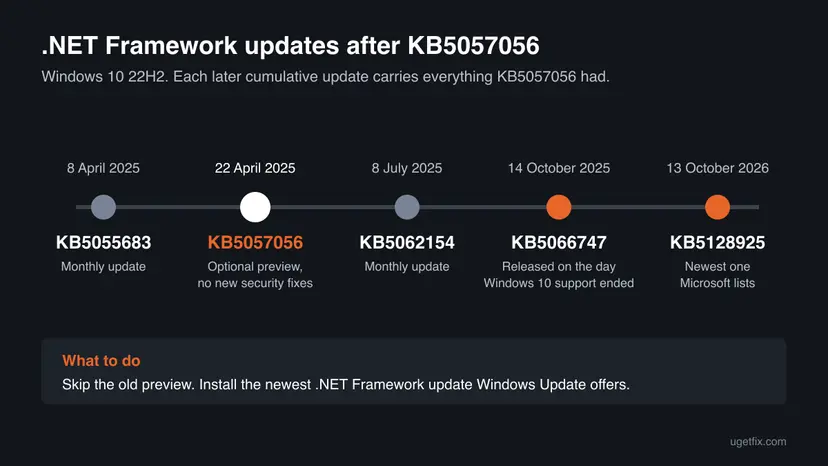
.NET Framework updates for Windows 10 are cumulative. A newer one such as KB5066747 or KB5128925 contains the fixes of KB5057056, so a newer update that installs well closes the gap.
Why KB5057056 fails to install
Microsoft says it is not aware of any issues in this update. So the cause sits on the PC, in Windows Update or in the installed .NET Framework. These are the usual causes, ordered by how likely they are.
| Cause | How often | How to tell | Fix |
|---|---|---|---|
| A newer .NET update replaced it, or the PC waits for a restart | Often | The PC has not been restarted for days, or a newer .NET entry is already in Update history. | Fix 1 |
| Windows Update picks the wrong package or keeps failing on the download | Sometimes | The download stops at the same point every time. | Fix 2, Fix 4 |
| The installed .NET Framework is damaged | Sometimes | Programs built on .NET also show errors, or every .NET update fails. | Fix 3 |
| Damaged system files or component store | Less often | DISM reports damage, or CBS.log names missing files. | Fix 5 |
| Too little free space on drive C: | Rarely | Drive C: shows only a few hundred megabytes free. | Fix 6 |
| A managed PC that gets updates from WSUS | Only on company PCs | The preview is never offered. Microsoft did not publish it to WSUS or Windows Update for Business. | Ask the administrator |
KB5057056 after the end of Windows 10 support
Support for Windows 10 ended on 14 October 2025. The last .NET Framework update Microsoft released for Windows 10 22H2 before that date is KB5066747. Microsoft's list then continues with .NET updates from April 2026 to KB5128925 of 13 October 2026.
| Your PC | What to install | Note |
|---|---|---|
| Windows 10 22H2 offered a 2026 .NET update | The newest one offered, for example KB5128925 | It contains KB5057056 and later security fixes. |
| Windows 10 22H2 offered nothing newer than October 2025 | KB5066747 of 14 October 2025 | It contains KB5057056. We could not confirm which PCs outside Extended Security Updates get the 2026 .NET updates. |
| Windows 11 | Not KB5057056 | Windows 11 gets its own .NET updates with other KB numbers. |
How to check whether the .NET update is installed and where it failed
Before you repair anything, check what the PC already has. A failed KB5057056 entry can stay in the history after a newer .NET update installed well.
- Open Settings > Update & Security > Windows Update > View update history.
- Open the group of .NET Framework updates and look for a newer entry than KB5057056 that says Successfully installed. If you find one, nothing from KB5057056 is missing.
- Note the date, time and code of the failed KB5057056 attempt.
- Press Win + R, type
%windir%\Logs\CBSand press Enter. CopyCBS.logto the Desktop and open the copy in Notepad. - Press Ctrl + F and search for
KB5056578orKB5056577. The lines with error or failed near the time of the attempt name the step that broke.
How to fix KB5057056 failing to install
Fix 1 solves most cases, because the update you need today is a newer .NET Framework update. Fix 2 installs the package by hand. Fix 3 repairs .NET Framework itself. Fix 4 to Fix 6 repair Windows Update, the system files and free space.
| What you see or have | Start with |
|---|---|
| KB5057056 failed and you have not checked for updates since | Fix 1 |
| Windows Update fails on the download, or offers nothing | Fix 2 |
| Every .NET update fails, or .NET programs show errors too | Fix 3 |
| All updates fail, not only .NET | Fix 4, then Fix 5 |
| Drive C: is almost full | Fix 6 |
| Update history shows a newer .NET update as successfully installed | Nothing to fix |
Fix 1. Restart and install the newest .NET Framework update instead
10 minutesNo riskEveryone, first. Above all if KB5057056 still shows as failed in Update history.
KB5057056 is an optional preview, and every later .NET Framework update for Windows 10 22H2 is cumulative. Installing the newest one gives the PC the same fixes plus the security fixes the preview never had.
- Save your work and select Start > Power > Restart. Use Restart, not Shut down.
- Open Settings > Update & Security > Windows Update and select Check for updates.
- Install the .NET Framework update offered, and any Windows update waiting with it. Do not search for KB5057056 again.
- Restart when Windows asks.
- Open View update history and check that the new .NET Framework entry says Successfully installed.
The newest .NET update Microsoft lists for Windows 10 22H2 is KB5128925 of 13 October 2026. If your PC is offered an older one, such as KB5066747 of 14 October 2025, it still contains KB5057056.
It worked if: The newest .NET Framework update installs and shows as successfully installed in Update history.
If not: Install the package by hand with Fix 2.
Fix 2. Install the right .NET package by hand from the Microsoft Update Catalog
15 minutesLow riskWindows Update fails on the download, stops at the same point, or offers no .NET update at all.
The catalog file is the complete standalone package, so a damaged download in the update cache is no longer used. The catalog lists one file per architecture, and the wrong one will not install.
- Press Win + R, type
winverand press Enter. Check that it says Version 22H2. - Open Settings > System > About and read System type: 64-bit (x64), 32-bit (x86) or ARM-based (ARM64).
- Go to
https://www.catalog.update.microsoft.comand search for the newest .NET update,KB5128925. Search forKB5057056only if you need exactly that package. - Select Download on the line for Windows 10 Version 22H2 that ends in your architecture, for example for x64.
- Run the downloaded file and select Yes when Windows asks for permission.
- Restart the PC when the installer finishes.
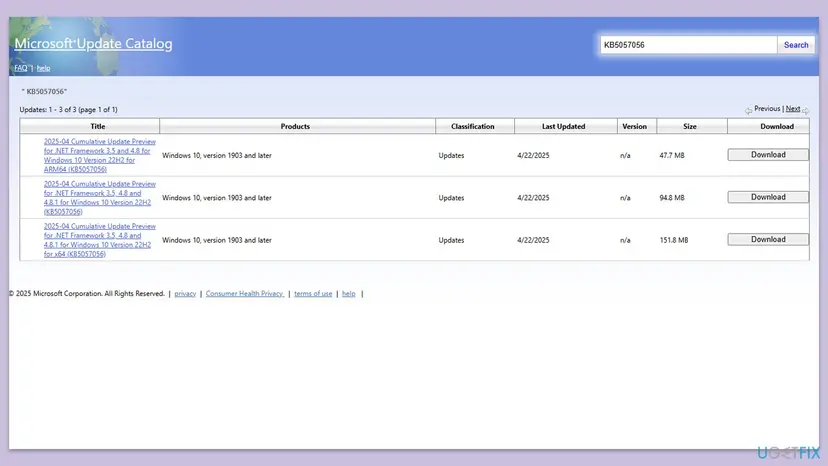
Step by step, with screenshots of the catalog: Install an update from the Microsoft Update Catalog.
It worked if: The installer ends without an error, and after a restart the update shows in Update history.
If not: If the installer says the update does not apply, a newer .NET update is already there. If it fails, repair .NET Framework with Fix 3.
Fix 3. Repair .NET Framework with the Microsoft .NET Framework Repair Tool
15 minutesLow riskEvery .NET Framework update fails, or programs built on .NET show errors as well.
KB5057056 patches the .NET Framework already on the PC. When that install is damaged, the patch has nothing sound to build on. The Repair Tool looks for known setup problems and repairs the installed .NET Framework.
- Run the .NET Framework Repair Tool. Download the Microsoft .NET Framework Repair Tool and run NetFxRepairTool.exe. The wizard looks for setup problems, asks for your consent before it applies fixes, then repairs the installed .NET Framework versions. The tool is in English only.
- Turn on .NET Framework 3.5 if a program asks for it. Select Start, search for Windows Features and open it. In Turn Windows features on or off, select the .NET Framework 3.5 (includes .NET 2.0 and 3.0) check box and select OK. Windows downloads the files, so stay online.
- Restart and test. Restart the PC and start the program that showed the error.
These steps were written for Windows 11 25H2 and 26H2, Windows 10 22H2. The full page with the other versions and what each result means: How to repair Microsoft Visual C++ Redistributable and .NET Framework
It worked if: The Repair Tool reports that it applied its fixes, and after a restart the newest .NET update installs.
If not: Reset the Windows Update components with Fix 4.
Fix 4. Reset the Windows Update components
10 minutesLow riskAll updates fail, not only .NET, or the download fails again and again.
A damaged download in the SoftwareDistribution folder is used again at every retry. Stopping the update services and renaming the cache folders makes Windows download the .NET update from scratch.
- Open Command Prompt as administrator. Type cmd in the search box, right-click Command Prompt and select Run as administrator. Select Yes when Windows asks for permission.
- Stop the update services. Type the commands below and press Enter after each one. If Windows says that other services depend on Cryptographic Services, it stops them too. A message that a service is not started is fine.
net stop wuauserv net stop bits net stop cryptsvc - Delete the download queue files. This clears the list of downloads that the Background Intelligent Transfer Service keeps. If Windows says it cannot find the files, continue.
del "%ALLUSERSPROFILE%\Application Data\Microsoft\Network\Downloader\qmgr*.dat" - Rename the update cache folders. Renaming keeps a copy in case you need it; Windows creates new, empty folders when the services start again. If you get Access is denied, a service is still running: repeat the previous step.
ren %systemroot%\SoftwareDistribution SoftwareDistribution.old ren %systemroot%\System32\catroot2 catroot2.old - Start the services again. Type the commands below and press Enter after each one. The requested service has already been started is fine: Windows started it on its own.
net start cryptsvc net start bits net start wuauserv - Restart and check for updates. Restart the PC. Then select Start > Settings > Windows Update > Check for updates. The first check can take longer than usual because everything is downloaded again.
These steps were written for Windows 11 and Windows 10 (the steps are the same). The full page with the other versions and what each result means: Reset Windows Update components
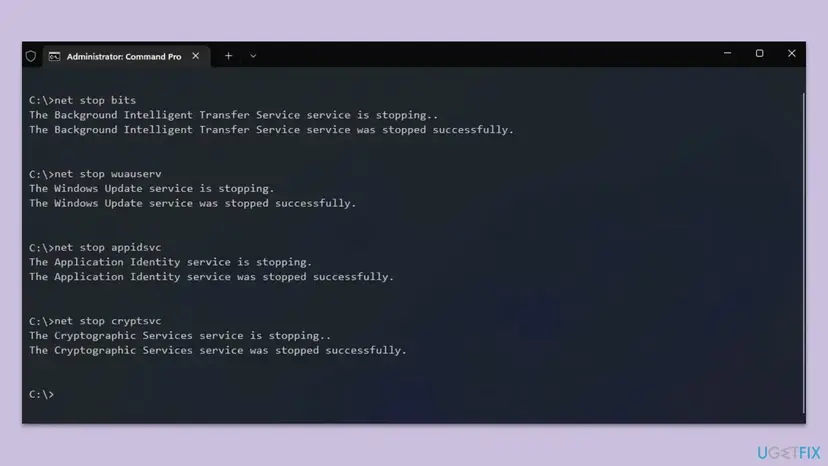
It worked if: Windows Update downloads the .NET update again from zero and installs it.
If not: Repair the system files with Fix 5.
Fix 5. Repair the system files with DISM and SFC
15 to 40 minutesNo riskCBS.log names missing or damaged files, or the fixes above did not help.
When every update fails, not only .NET, the damage is often in Windows itself. DISM downloads clean copies of damaged components, and SFC then repairs the system files in use.
- Open Command Prompt as administrator. Type cmd in the search box on the taskbar, right-click Command Prompt and select Run as administrator. Select Yes when Windows asks for permission.
- Run DISM first. Type the command below and press Enter. Wait until it says The operation completed successfully.
DISM.exe /Online /Cleanup-Image /RestoreHealth - Run System File Checker. Type the command below and press Enter. Do not close the window until the verification reaches 100%.
sfc /scannow - Read the result and restart. Compare the last message with the table below this guide, then restart the PC.
These steps were written for Windows 10 22H2. The full page with the other versions and what each result means: Run DISM and SFC to repair Windows system files
It worked if: DISM ends with The operation completed successfully., SFC reports that it repaired files or found no integrity violations, and the update installs after a restart.
If not: Free space with Fix 6, then read the section "If KB5057056 still fails" below.
Fix 6. Free space on drive C: with Disk Cleanup
10 minutesLow riskDrive C: is almost full.
The x64 package is 151.8 MB, and Windows needs more room than that to unpack it and keep old files until it finishes. Windows Update Cleanup removes old update files no longer needed.
- Type Disk Cleanup in the search box on the taskbar and press Enter.
- Select drive C: and select OK.
- Select Clean up system files, then select drive C: and OK again.
- Tick Windows Update Cleanup, Temporary files and Delivery Optimization Files, and select OK.
- Restart the PC and check for updates again.
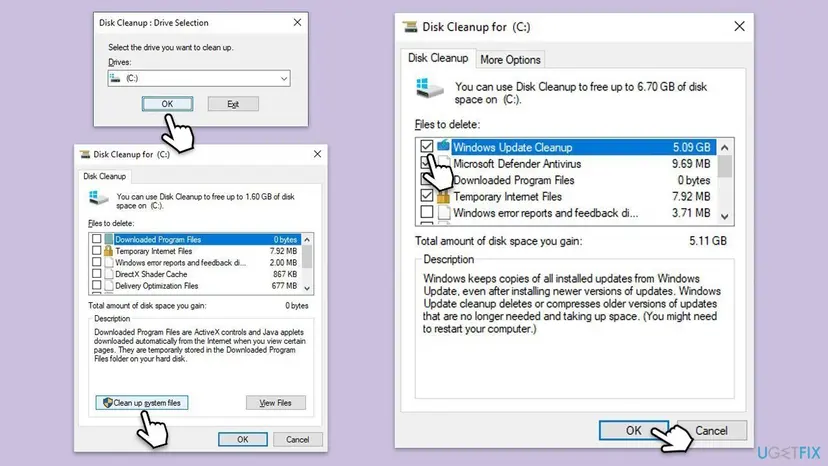
More ways to free space: Free up disk space and delete temporary files.
It worked if: Disk Cleanup frees space, and after a restart the .NET update installs.
If not: Read the section "If KB5057056 still fails" below.
If KB5057056 still fails
If all six fixes failed, first ask whether you need KB5057056 at all. A newer .NET update that installed well makes the failed preview harmless.
| Situation | What to do |
|---|---|
| A newer .NET update is installed | Nothing is missing. The failed KB5057056 entry is only a record of the attempt. |
| Only .NET updates fail, Windows updates install | Run the Repair Tool again and keep its log. Then send the log and CBS.log to Microsoft support. |
| All updates fail and DISM cannot repair the store | Reinstall Windows 10 over itself, as in the repair upgrade of our KB5060533 guide. |
| Work or school PC | Ask the administrator. Microsoft did not offer this preview through WSUS or Windows Update for Business. |
- What to send to support: the KB number, the error code and time from Update history,
CBS.log, and your .NET version (4.8 or 4.8.1). - Which fixes you already ran, and whether other Windows updates install.
How to uninstall KB5057056
If KB5057056 did install and a .NET program broke after it, you can remove it while it is the newest .NET update. Microsoft lists no known issues, so check the program's own updates first.
- Open Windows Update. Select Start > Settings > Update & Security > Windows Update.
- Open the update history. Select View update history. Note the KB number and the date of the update you suspect.
- Open the list of removable updates. Select Uninstall updates.
- Uninstall the update. Select the update you want to remove in the list, then select Uninstall.
These steps were written for Windows 10 22H2. The full page with the other versions and what each result means: How to uninstall a Windows update
In the list of installed updates the .NET part may appear as KB5056578 or KB5056577 instead of KB5057056. If a newer .NET update is installed on top, remove that one or leave both in place.
How to keep .NET Framework updates from failing again
- Restart when Windows Update asks, before you install the next update.
- Install the monthly .NET update. Optional previews can wait for the next monthly one.
- Keep at least a few gigabytes free on drive C:.
- Plan the move to Windows 11, or join Extended Security Updates, so the PC keeps getting security fixes.
- Do not switch the PC off while updates are being installed.
- Do not download .NET installers or update files from sites other than Microsoft's.
- Do not remove .NET Framework to get an update in: programs that need it stop working.
- Do not turn off your antivirus or firewall for good. Pause it for one test at most: Turn off Microsoft Defender protection for a moment.
Frequently asked questions
Do I need KB5057056?
No, not by name. KB5057056 is an optional preview, and Microsoft says it has no new security improvements. Every later .NET Framework update for Windows 10 22H2 contains its fixes. If View update history shows a newer .NET update as successfully installed, nothing from KB5057056 is missing. A failed KB5057056 entry is then only a record of the attempt, and you can ignore it.
Is KB5057056 a security update?
No. Microsoft's page says there are no new security improvements in this release. It contains the security fixes released before it, plus quality and reliability fixes. In the Microsoft Update Catalog it was listed under the classification Updates, not Security Updates. The monthly .NET updates before and after it, such as KB5055683 and KB5062154, are the ones that carry new security fixes.
What are KB5056577 and KB5056578?
They are the two parts of KB5057056. KB5056577 updates PCs with .NET Framework 3.5 and 4.8. KB5056578 updates PCs with .NET Framework 3.5 and 4.8.1. Windows installs only the one that matches the .NET version on your PC, so you may see that number in logs or in the list of installed updates instead of KB5057056.
What are the known issues of KB5057056?
Microsoft lists none. Its page says Microsoft is not currently aware of any issues in this update. A failure on your PC therefore points to the PC itself: a damaged download in the update cache, a damaged .NET Framework install or damaged system files. Fix 2, Fix 3 and Fix 5 cover these in that order.
Which .NET update should I install instead?
The newest one Windows Update offers. The newest .NET Framework update Microsoft lists for Windows 10 22H2 is KB5128925 of 13 October 2026. Before Windows 10 support ended, the last one was KB5066747 of 14 October 2025. Both contain KB5057056. We could not confirm which PCs outside Extended Security Updates get the 2026 .NET updates, so install whichever newer one your PC is offered.
Why does Windows Update not offer KB5057056 on my work PC?
Because Microsoft did not publish it to those channels. Its page says the preview was not available through Windows Update for Business and not synced to WSUS automatically. An administrator could import it into WSUS by hand. Most companies skip previews and wait for the next monthly .NET update, which contains the same fixes.
Does turning off the antivirus or firewall help KB5057056 install?
No source ties security software to this failure. The old version of this guide suggested turning off the firewall, and we removed that advice, because it leaves the PC open and the firewall does not block Windows Update downloads in a normal setup. If you suspect your third party antivirus, pause it for one test install and turn it back on at once: Turn off Microsoft Defender protection for a moment.
Is KB5057056 for Windows 11?
No. KB5057056 applies only to Windows 10 version 22H2. Windows 11 gets its own .NET Framework updates with other KB numbers. If Windows Update offers another number on your PC, follow that one. To see which Windows you have, press Win + R, type winver and read the version and build.
How do I know which .NET Framework version my PC has?
You do not need to know it to fix KB5057056. Microsoft built the update for PCs with .NET 3.5 and 4.8 and for PCs with .NET 3.5 and 4.8.1. Windows Update and the x64 catalog package pick the right part themselves: KB5056577 for 4.8 or KB5056578 for 4.8.1. The x86 and ARM64 packages are separate files in the catalog.
Sources
- Microsoft Support: April 22, 2025, KB5057056 Cumulative Update for .NET Framework 3.5, 4.8 and 4.8.1 for Windows 10 Version 22H2 (support.microsoft.com)
- Microsoft Support: October 13, 2026, KB5128925 Cumulative Update for .NET Framework 3.5, 4.8 and 4.8.1 for Windows 10 Version 22H2, with the list of .NET updates for 22H2 (support.microsoft.com)
Did this fix work?
One click, no account. It tells the next reader which guides are worth their time.
Questions and experiences: fix KB5057056 fails to install in Windows 10
Still broken, or found a fix we did not cover? Ask here: members and our editors answer. Reading is open; writing needs a free account.
…