
How to fix Blue Screen error 0xc00002e3 in Windows 10?

Prefer to fix it yourself? The manual steps follow.
- 8methods
- 20 to 90 minutes
- Advanced
Applies to Windows 10 and Windows 11 PCs, and Windows Server domain controllers, that stop with Security Accounts Manager initialization failed or code 0xc00002e3
8 methods in this guide
I have an issue with this Blue Screen of Death error. I have a Windows 10 computer, and the error 0xc00002e3 appears out of nowhere. I don't know why this is occurring. I installed Windows a while ago. The machine reboots okay, but I can't get any results from the troubleshooting. Can you explain this problem to me and offer any solutions?
Error 0xc00002e3 means the Security Accounts Manager, the part of Windows that holds local accounts and passwords, could not start. Windows then cannot sign anyone in, so it shuts down or restarts in a loop. Run Startup Repair from the recovery screen first, then check the disk.
0xc00002e3 is Microsoft's STATUS_SAM_INIT_FAILURE: the Security Accounts Manager failed to start, most often because its registry file or the disk under it is damaged. Read the reason after "because of the following error", then run Startup Repair from the recovery screen (Fix 1), check the disk with CHKDSK (Fix 2) and use System Restore (Fix 3).
| Error | Security Accounts Manager initialization failed because of the following error: a reason, then Error Status: and a second code. Windows shuts down when you click OK. |
|---|---|
| Where it appears | During start, before or at the sign-in screen, in a window titled lsass.exe - System Error. Users report it as a blue screen or a restart loop. |
| Main cause | The SAM registry file in C:\Windows\System32\config is damaged or cannot be read: a power loss, a forced shutdown, a failing disk, or a broken update. |
| Fastest fix | Startup Repair from Troubleshoot > Advanced options (Fix 1), then CHKDSK from the recovery Command Prompt (Fix 2). |
| What the code means | 0xC00002E3 is STATUS_SAM_INIT_FAILURE in Microsoft's list of NTSTATUS values: "Security Accounts Manager initialization failed". |
| Also written as | 0xC00002E3, c00002e3, Status sam init failure, SAM initialization failed, lsass.exe System Error. |
| Related codes | 0xc00002e1 (Directory Services cannot start) and 0xc00002e2 on domain controllers. They appear as the Error Status inside the same message. |
| Affects | Windows 10, Windows 11 and Windows Server. Windows 10 left support on 14 October 2025. |
| Vendor status | Not a known issue of any Windows update. Microsoft documents the code and, for domain controllers, a recovery article (KB 258062). |
| Time to fix | 20 to 40 minutes for Fixes 1 to 4. An hour or more when the disk is checked in full or Windows is reset. |
Facts checked on 16 October 2026. Steps written for Windows 11 (25H2 and 26H2) and Windows 10 22H2.
What error 0xc00002e3 means
0xc00002e3 is the NTSTATUS code STATUS_SAM_INIT_FAILURE. Microsoft's text for it reads: "Security Accounts Manager initialization failed because of the following error: %hs Error Status: 0x%x. Please click OK to shutdown this system and reboot into Safe Mode, check the event log for more detailed information." The %hs and 0x%x are filled in with the real reason and a second code.
The Security Accounts Manager (SAM) runs inside lsass.exe, the process that signs users in. On a home or office PC it keeps local accounts and password hashes in the registry file C:\Windows\System32\config\SAM. On a domain controller it also needs the Active Directory database. If SAM cannot start, Windows cannot let anyone sign in, so it asks to shut down.
0xc00002e3 only says that SAM failed. The words after because of the following error and the code after Error Status say why. Write both down or take a photo before you click OK.
| Code | Microsoft's name | What it points to |
|---|---|---|
0xc00002e3 | STATUS_SAM_INIT_FAILURE | The Security Accounts Manager failed to start |
0xc00002e1 | Directory Services cannot start | A domain controller cannot open its Active Directory database |
| Any other Error Status | Shown in the message | Usually a damaged SAM file or a disk Windows cannot read |
Why the Security Accounts Manager fails: the causes, most common first
The error looks like it comes out of nowhere, but something changed at the last shutdown or start. The SAM file is written to often, so a cut in power or a forced shutdown can leave it half written. Updates and newly installed programs that change system files can do the same.
| How often | Cause | Sign | Fix |
|---|---|---|---|
| Most often | The SAM registry file or other system files are damaged | The PC froze, lost power or was turned off with the power button | Fix 1, Fix 3 |
| Often | The disk has file system errors or bad sectors | The reason reads "A device attached to the system is not functioning", or the PC was slow before | Fix 2 |
| Less often | An update or a program left files installed only in part | It began right after Windows Update or a new program | Fix 4, Fix 5 |
| Servers only | The Active Directory database of a domain controller is damaged or cannot be reached | The reason reads "Directory Services cannot start" | Fix 7 |
| Rarely | The disk is failing | CHKDSK finds bad sectors, or the disk sometimes vanishes from the BIOS | Fix 2, Fix 8 |
Where the cause is written
The message itself asks you to check the event log. These are the places that hold the reason:
- The message: the text after because of the following error and the code after Error Status.
C:\Windows\System32\Logfiles\Srt\SrtTrail.txt: the log that Startup Repair writes in Fix 1. It names what it found, for example a damaged registry file or a disk error.- Event Viewer > Windows Logs > System: once Windows starts again, look for Disk, Ntfs and Kernel-Power events around the first failed start.
- On a domain controller, Directory Service events such as 1168 and 1103, which Microsoft lists for a damaged database.
How to fix error 0xc00002e3
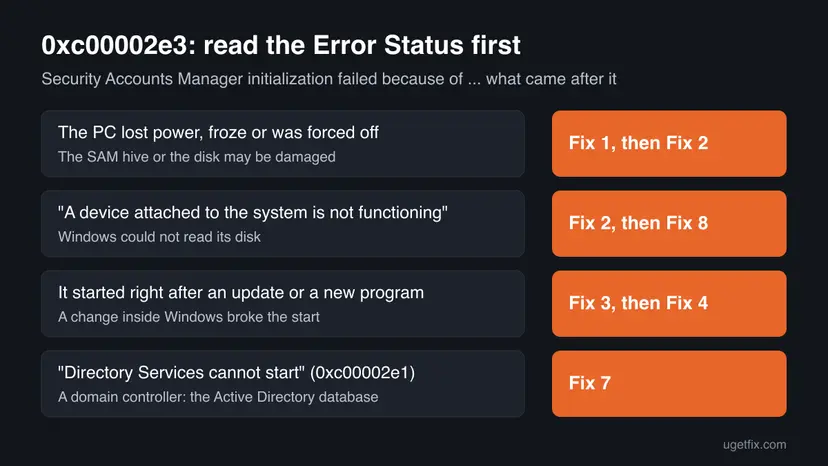
Fixes 1 to 4 run from the Windows recovery screen, because the PC usually cannot reach the desktop. Start with Fix 1 and Fix 2: they touch no personal files. Fix 7 is only for domain controllers, and Fix 8 is the last resort.
| What you see or what happened | Start with | Then |
|---|---|---|
| The PC froze, lost power or was forced off before the error | Fix 1 | Fix 2 |
| The reason reads A device attached to the system is not functioning | Fix 2 | Fix 8 |
| It started right after an update or a new program | Fix 3 | Fix 4 |
| Windows starts in Safe Mode but not normally | Fix 6 | Fix 5 |
| The reason reads Directory Services cannot start (a server) | Fix 7 | Fix 8 |
Fix 1. Run Startup Repair from the recovery screen or a Windows USB drive
20 minutesLow riskEveryone, first. The PC shows the message at every start or loops back to it.
Startup Repair runs from the recovery environment, which does not need the SAM file that failed. It checks the registry files, the boot files and the disk, and repairs what it can.
- Turn the PC on and, when the logo appears, hold the power button until it turns off. Do this twice; the third start opens Automatic Repair.
- If the recovery screen never appears, make a Windows 11 USB drive with the Media Creation Tool on another PC and plug it in.
- Start from the USB drive with the boot menu key. It depends on the maker, often F12, F11, F8 or Esc.
- Press any key when asked, pick your language and keyboard layout, select Next, then Repair your computer in the lower left corner.
- On the Choose an option screen, select Troubleshoot, then Advanced options, then Startup Repair. Step by step: Run Startup Repair
- Wait until it finishes and restart the PC.
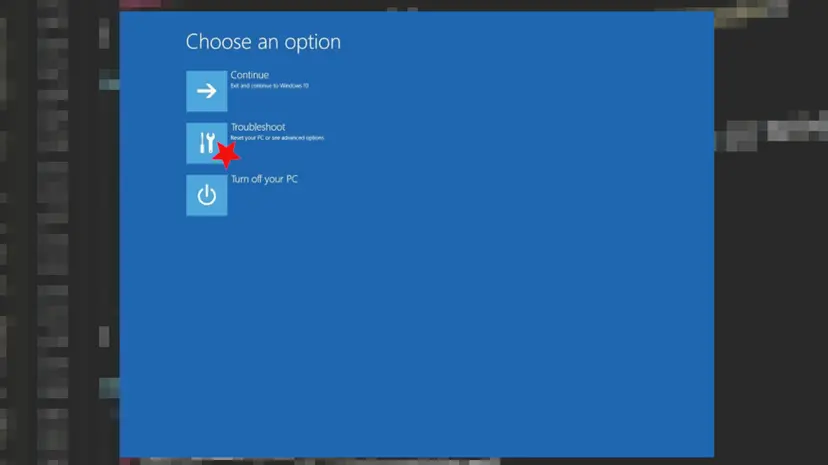
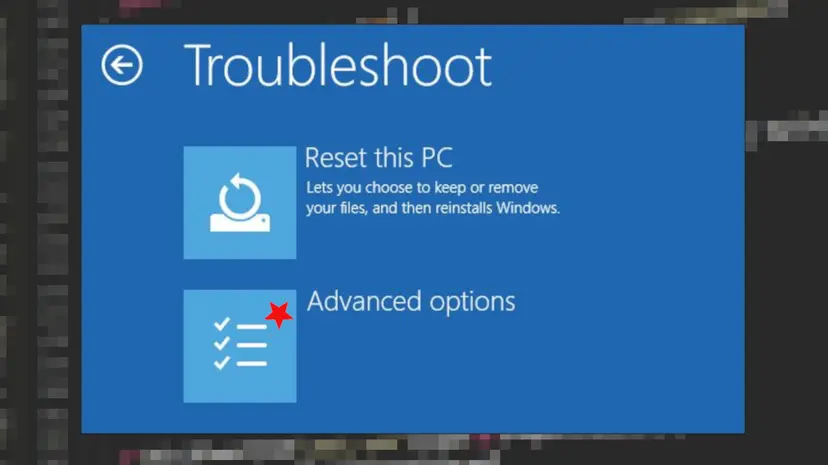
The recovery screen may ask for a BitLocker recovery key. With a Microsoft account, the key is listed at account.microsoft.com/devices/recoverykey. Look it up on a phone or another PC.
It worked if: Startup Repair reports that it repaired the PC, and the next start reaches the sign-in screen without the message.
If not: If it says it could not repair the PC, read SrtTrail.txt and check the disk in Fix 2.
Fix 2. Check the system disk for errors with CHKDSK
30 to 90 minutesLow riskThe PC lost power, the reason names a device that is not functioning, or Startup Repair failed.
SAM fails when Windows cannot read its registry file from the disk. CHKDSK repairs file system damage left by a hard shutdown and, with /r, finds bad sectors.
- Open the recovery screen as in Fix 1 and select Troubleshoot > Advanced options > Command Prompt.
- Find the Windows drive letter: type
dir C:\Windows, thendir D:\Windows, until one lists the folder. In recovery it is often notC:. - Run
chkdsk C: /f /rwith that letter. The/rpass can take an hour or more on a large disk. - Read the result, type
exitand select Continue. Step by step: Check a disk for errors (chkdsk)
In the recovery Command Prompt (replace C: with your Windows drive):
dir C:\Windows
chkdsk C: /f /r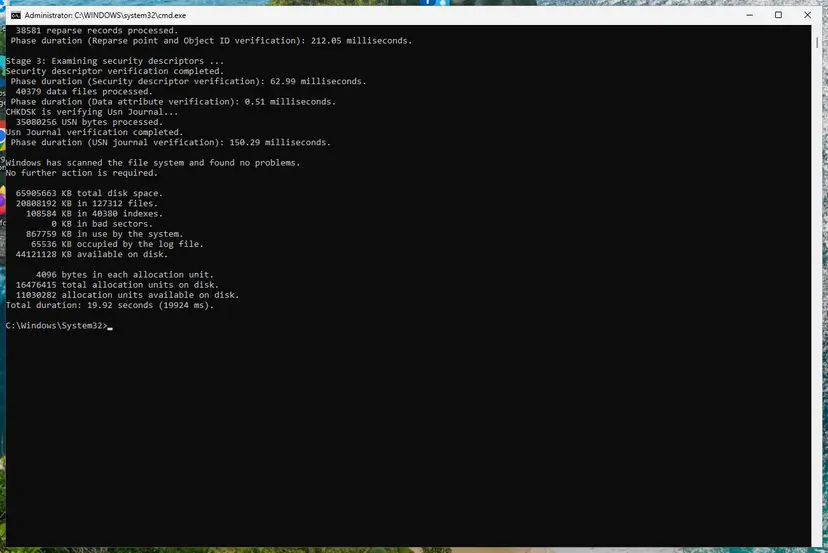
It worked if: CHKDSK reports that it made corrections or found no problems, and the next start reaches Windows.
If not: If CHKDSK reports bad sectors, copy your files off the disk and plan to replace it. If it is clean, go to Fix 3.
Fix 3. Bring the registry back with System Restore
20 minutesRead the warningFixes 1 and 2 did not help, or the error began after an update, a driver or a new program. System Protection must have been on.
A restore point holds a copy of the registry, the SAM file included. Going back puts a working copy in place of the damaged one.
System Restore does not touch your documents and photos. It removes apps, drivers and updates installed after the restore point, and a password you changed after that date goes back to the old one. Note what you installed so you can add it again.
- Open the recovery screen and select Troubleshoot > Advanced options > System Restore.
- Pick your account and enter its password if asked.
- Select a restore point dated before the first failed start, then Next and Finish.
- Do not turn the PC off while it restores. Step by step: Undo recent changes with System Restore
It worked if: Windows reports that System Restore completed successfully and starts to the sign-in screen.
If not: If there is no restore point, or the restore fails, remove the last update in Fix 4.
Fix 4. Uninstall the latest Windows update from recovery
10 minutesLow riskThe message first appeared right after Windows installed an update.
An update that was cut off can leave system files installed only in part. Removing it from recovery takes Windows back to the build that started.
- Open the recovery screen and select Troubleshoot > Advanced options > Uninstall Updates.
- Choose Uninstall latest quality update first. If that does not help, come back and choose Uninstall latest feature update.
- Pick your account if asked, confirm and restart. Step by step: How to uninstall a Windows update
It worked if: The PC starts to the sign-in screen with the previous update level.
If not: If the message stays, repair the system files in Fix 5.
Fix 5. Repair the system files with SFC and DISM
20 minutesNo riskStartup Repair found nothing, or files were damaged by an update or a program.
SFC compares Windows files with a clean copy and replaces damaged ones, including the files lsass.exe loads. From recovery it runs offline against the Windows folder on the disk.
From the recovery Command Prompt, point SFC at the Windows drive you found in Fix 2. Recovery itself runs from X:.
In the recovery Command Prompt (replace C: with your Windows drive):
sfc /scannow /offbootdir=C:\ /offwindir=C:\WindowsIf Windows starts in Safe Mode or normally again, run the full check from the desktop. Step by step: Run DISM and SFC to repair Windows system files
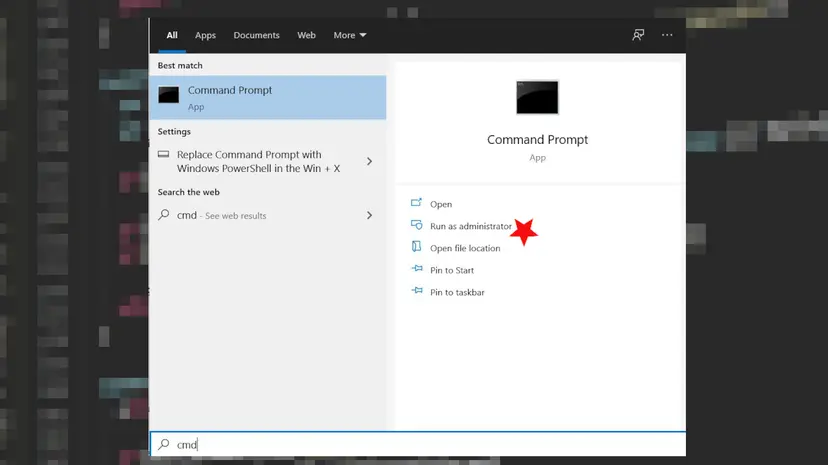
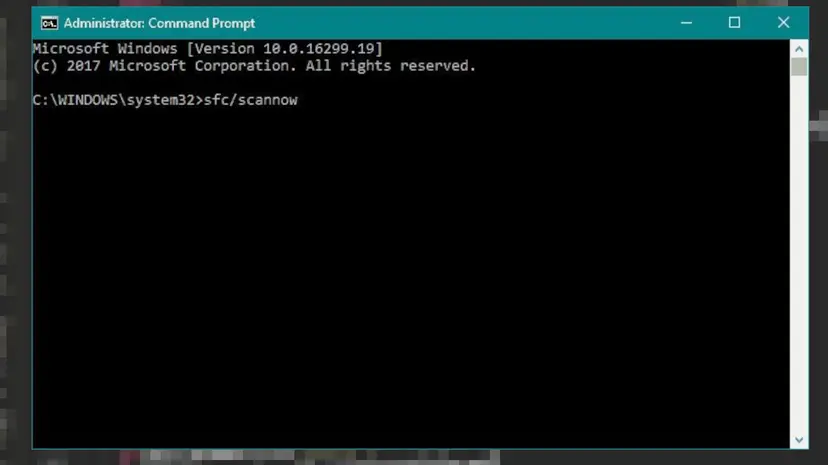
It worked if: SFC reports that it found corrupt files and repaired them, or that it did not find any integrity violations.
If not: If SFC cannot repair the files, try Safe Mode in Fix 6 or reset Windows in Fix 8.
Fix 6. Start in Safe Mode, read the event log and install updates
20 minutesLow riskThe message asks you to reboot into Safe Mode, or Windows starts in Safe Mode but not normally.
Safe Mode loads only basic drivers and services. If SAM starts there, the cause is a driver or program that loads in a normal start, and the event log names it.
- On the recovery screen, select Troubleshoot > Advanced options > Startup Settings > Restart, then press 4 for Safe Mode. Step by step: Start Windows or a Mac in Safe Mode
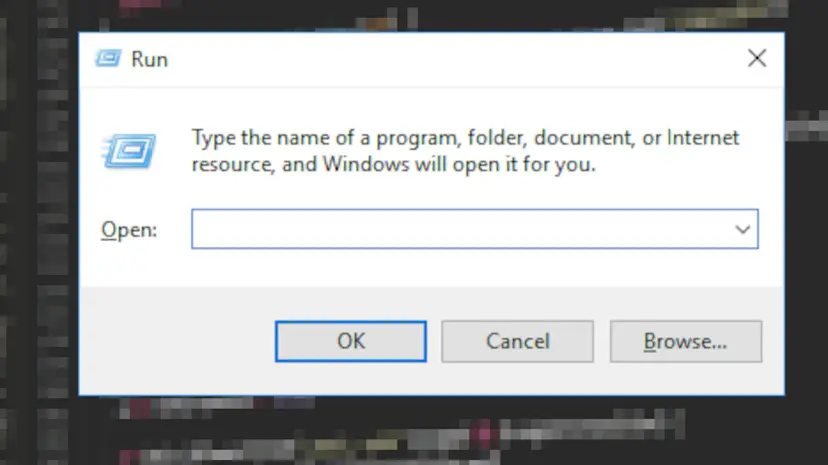
- If you can sign in, press Win + R, type
eventvwr.mscand press Enter. - Open Windows Logs > System and look for errors at the time of the failed starts.
- Uninstall a program or driver that was added just before the error.
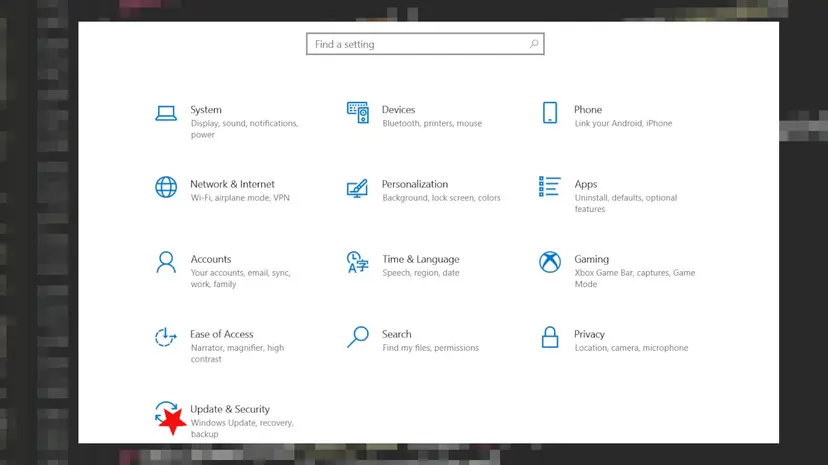
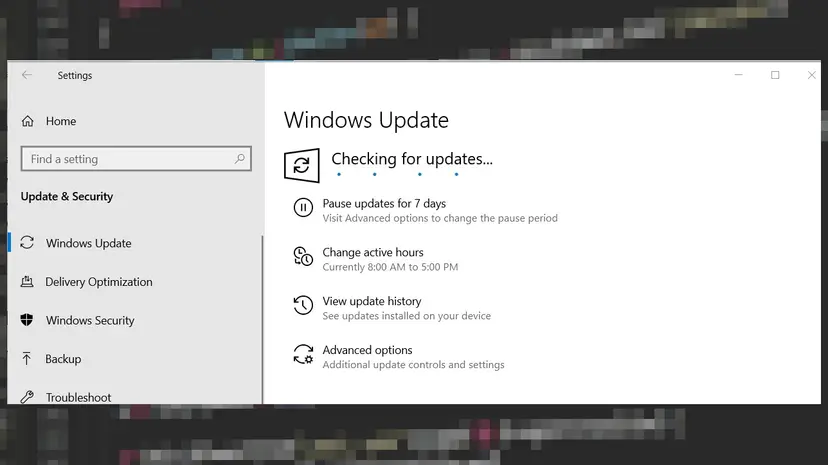
- Restart normally. When Windows starts, open Settings > Windows Update on Windows 11, or Settings > Update & Security > Windows Update on Windows 10.
- Select Check for updates, then Download and install or Install all, and restart when asked.
It worked if: Windows starts normally and no new SAM or lsass error appears in the System log.
If not: If Safe Mode shows the same message, the SAM file itself is damaged: go back to Fix 3 or reset Windows in Fix 8.
Fix 7. On a domain controller, start in Directory Services Restore Mode
30 minutes or moreRead the warningA Windows Server domain controller, and the reason reads Directory Services cannot start.
On a domain controller SAM needs the Active Directory database ntds.dit. Microsoft names its causes: too strict NTFS permissions on the drive or the NTDS folder, a changed drive letter, a compressed NTDS folder or a damaged database.
A lossy repair of the database deletes data, and Microsoft does not support a domain controller after it. Restore a system state backup or rebuild from another healthy domain controller first, and contact Microsoft Support before any lossy repair.
- Restart the server and choose Directory Services Restore Mode from the advanced start options.
- Sign in with the Directory Services Restore Mode password.
- Open a Command Prompt and run
ntdsutil files infoto see where the database and logs are. - Check that those files exist, that the drive letter did not change and that the NTDS folder is not compressed.
- Check that System and Administrators have Full Control on the NTDS folder, and that System has it on the drive root and
%WINDIR%. - Run
ntdsutil files integrity. With no errors, restart in normal mode.
It worked if: The integrity check passes and the domain controller starts in normal mode.
If not: If the check fails, follow the semantic analysis and offline defragmentation steps in Microsoft's KB 258062, or restore a system state backup.
Fix 8. Reset Windows and keep your files
60 to 90 minutesRead the warningEvery fix above failed and the disk is healthy.
A reset writes a new Windows with a new SAM file. It is the sure way past a SAM file that cannot be repaired.
Reset this PC with Keep my files keeps documents, pictures and the desktop, but removes installed apps. Local accounts are created again, so note their names. If Windows does not start, copy your files first from a Windows USB drive or another PC: Back up your files (Windows Backup, File History, Time Machine)
- On the recovery screen, select Troubleshoot > Reset this PC > Keep my files.
- Choose Cloud download for fresh files from Microsoft, or Local reinstall.
- If the reset cannot start, boot from the Windows USB drive from Fix 1 and install Windows from there.
- Sign in and install your apps again. Full method: Reinstall Windows without losing files
It worked if: Windows starts to a fresh desktop with your files in place, and the message does not come back.
If not: If the message returns on a fresh Windows, the disk or the hardware is at fault: see the next section.
Still getting 0xc00002e3: what to collect and whom to ask
Support can help only with the reason behind the code. Collect these once:
- A photo of the full message, with the reason and the Error Status code.
- What happened before the first failure: a freeze, a power cut, an update, a new program or driver.
- The text of
SrtTrail.txtfrom Fix 1 and the CHKDSK result from Fix 2. - Whether Safe Mode starts, and any System log errors you saw there.
- Your Windows version and, for a server, whether it is a domain controller.
| Where to ask | When |
|---|---|
| Your disk's maker or a repair shop | CHKDSK reports bad sectors, or the error comes back on a fresh Windows |
| Microsoft Support | The disk is healthy and only the installed Windows fails, or a domain controller needs a lossy repair |
| Your PC maker | The disk is sometimes missing in the BIOS, or the PC is under warranty |
How to keep error 0xc00002e3 from coming back
- Shut Windows down from the Start menu, and let updates finish before you turn the PC off.
- Keep System Protection on for the system drive, so a restore point with the registry exists.
- Use a UPS on a desktop or server where power cuts are common.
- Keep a backup of your files, and daily system state backups on a domain controller.
- Hold the power button while Windows is installing updates.
- Edit or replace files in
C:\Windows\System32\configby hand. - Ignore a disk that is suddenly slow or reports errors.
- Run a lossy Active Directory repair before every other option.
Windows 10 left support on 14 October 2025. A Windows 10 PC gets fixes only through Extended Security Updates, so moving to Windows 11 keeps them coming.
Frequently asked questions
What is error 0xc00002e3?
It is the Windows status code STATUS_SAM_INIT_FAILURE: the Security Accounts Manager could not start. SAM runs inside lsass.exe and holds local accounts and their passwords, so without it Windows cannot sign anyone in. The message asks you to click OK, shut down and start in Safe Mode, and to check the event log. The reason and a second code in the same message tell you why SAM failed.
Is 0xc00002e3 a Blue Screen of Death?
Not always. The message comes from lsass.exe as a System Error window, and Windows shuts down when you click OK. Because lsass.exe is needed to run Windows, users report a blue screen or a restart loop instead. We could not confirm which stop code a blue screen shows in that case. The fixes on this page are the same either way.
What does Status sam init failure mean?
It is the name of the same code, STATUS_SAM_INIT_FAILURE, written in plain words. SAM stands for Security Accounts Manager and init for initialization. It means the part of Windows that checks accounts and passwords failed to start, most often because its registry file in C:\Windows\System32\config is damaged or the disk under it cannot be read.
Why did the error appear out of nowhere?
It rarely comes out of nowhere; something changed at the last shutdown or start. A power cut, a freeze followed by a forced shutdown, an update that was cut off, a new program or a disk that began to fail can each damage the SAM file. Think about what happened just before the first failed start, then use the chooser table above to pick the first fix.
Will I lose my files?
Usually not. The error stops the sign-in, not the disk, so your documents and photos are normally still there. Fixes 1, 2, 4, 5 and 6 do not touch personal files. System Restore removes only apps and drivers installed after the restore point, and Reset this PC with Keep my files keeps personal files. If CHKDSK finds bad sectors, copy your files off the disk before anything else.
Can I fix 0xc00002e3 by editing the registry?
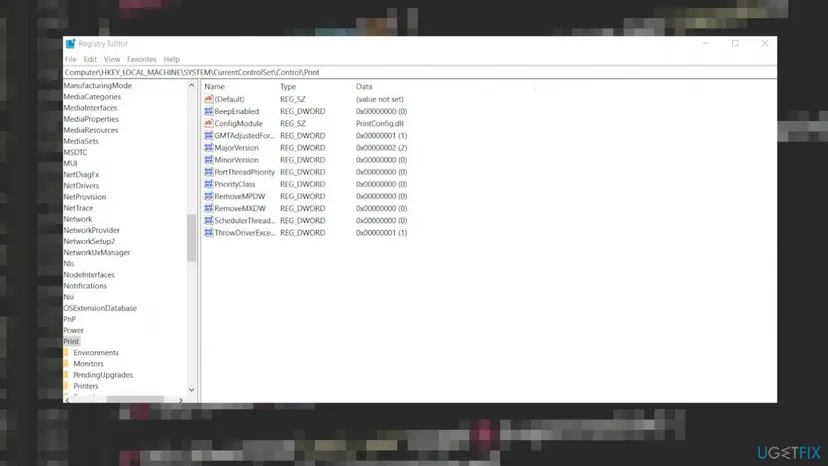
No. The old advice to delete the WUServer and WIStatusServer values belongs to Windows Update settings and has nothing to do with SAM. The SAM file is locked even for administrators, and editing it by hand can lock you out of every local account. Use Startup Repair, System Restore or a reset, which replace the file in a safe way.
What does Error Status 0xc00002e1 mean in this message?
It means Directory Services cannot start. It appears on Windows Server domain controllers, where SAM needs the Active Directory database. Microsoft lists the causes: too strict NTFS permissions on the drive or the NTDS folder, a changed drive letter, a compressed NTDS folder or a damaged ntds.dit database. Start in Directory Services Restore Mode and follow Fix 7.
Does Safe Mode help with 0xc00002e3?
Sometimes. Safe Mode loads fewer drivers and programs, so if one of them stopped SAM, Windows may start there and you can remove it and read the event log. If the SAM file itself is damaged, Safe Mode needs it too and shows the same message. Then go back to System Restore (Fix 3) or reset Windows (Fix 8).
Does this error happen on Windows 11?
Yes. Windows 11 uses the same Security Accounts Manager and the same status code, so the message and the fixes are the same. Only the Settings paths differ: Windows Update is in the left column of Settings on Windows 11 and under Update & Security on Windows 10. The recovery screens with Startup Repair and System Restore look the same on both.
Sources
Did this fix work?
One click, no account. It tells the next reader which guides are worth their time.
Questions and experiences: fix Blue Screen error 0xc00002e3 in Windows 10
Still broken, or found a fix we did not cover? Ask here: members and our editors answer. Reading is open; writing needs a free account.
…