
How to fix State Repository Service high CPU usage in Windows?

Prefer to fix it yourself? The manual steps follow.
- 9methods
- 5 minutes to check and restart the service, 20 to 40 minutes for updates and repairs
- Intermediate
Applies to The State Repository Service (StateRepository) on Windows 11 and Windows 10
9 methods in this guide
Hello. I noticed that the State Repository Service or the "appmodel" process is using a lot of CPU on my Windows PC. Is there a way to fix that?
State Repository Service (StateRepository) is the built-in Windows service that Microsoft says provides required infrastructure support for the application model, the system behind Store apps, Start and other packaged apps. Short bursts are normal; constant high CPU means an app, an update or a damaged app registration keeps it busy. Find what triggers it first, then restart the service.
Do not disable the State Repository Service: Microsoft calls it required infrastructure for the app model, which Start, Settings and Store apps use. Check in Task Manager what makes it busy (Fix 1), let a fresh Windows update finish and install the latest one (Fix 2), then restart the service in services.msc (Fix 3). If one app keeps it busy, repair or reset that app (Fix 4).
| Error | No error message. Task Manager shows Service Host: State Repository Service high in the CPU column, often with File Explorer, fans running and the PC lagging. |
|---|---|
| Where it appears | Task Manager on Windows 11 and Windows 10. The Services tab and services.msc name it StateRepository. |
| Main cause | Packaged apps that start, install, update or change state again and again: Store apps, Edge, Xbox Game Bar captures, or app registrations left half done by an update. |
| Fastest fix | Let a pending update finish and install the latest Windows update (Fix 2), then restart the service (Fix 3). |
| Also written as | StateRepository, staterepository service, Service Host: State Repository Service, appmodel, state repository. In Spanish Task Manager: Host de servicio: State Repository Service. |
| Microsoft's status | Microsoft Learn lists it as Always installed, startup type Manual, description "Provides required infrastructure support for the application model." We found no Microsoft known issue note for high CPU. |
| Safe to disable? | No. Microsoft gives no guidance to disable it, and it serves the app model that Start, Settings, the Store and built-in apps use. |
| Time to fix | 5 minutes for a check and a restart of the service, 20 to 40 minutes with updates and app repairs. |
Facts checked on 15 October 2026. Steps written for Windows 11 (25H2 and 26H2) and Windows 10 22H2, with the service details read from Microsoft Learn's system services guidelines.
What the State Repository Service is and why it uses CPU
State Repository Service is a built-in Windows service. Its service name is StateRepository, it is always installed and its startup type is Manual, so Windows starts it when something needs it. Microsoft describes it in one line: "Provides required infrastructure support for the application model." The application model is the way Windows installs, registers and runs packaged apps: Microsoft Store apps, Settings, the Start menu, Photos, Xbox Game Bar and many more.
It runs inside a shared Service Host (svchost.exe) process, which is why Task Manager shows it as Service Host: State Repository Service. The reader's question above calls it the "appmodel" process, a name close to Microsoft's description; we could not confirm the exact svchost group name from a Microsoft page today.
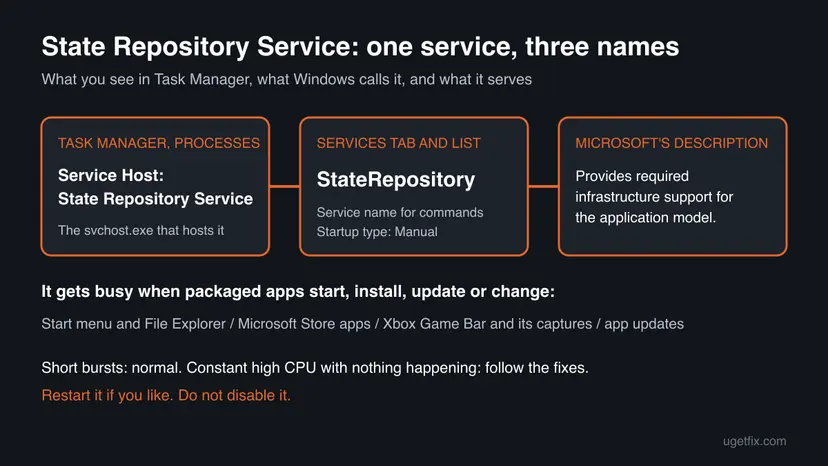
| What you see | Where | What it is |
|---|---|---|
| Service Host: State Repository Service | Task Manager, Processes tab | The svchost.exe process that hosts the service. The CPU column you are worried about. |
StateRepository | Task Manager Services tab, sc and net commands | The short service name that commands use. |
| State Repository Service | services.msc | The display name, with the description about the application model. |
| Host de servicio: State Repository Service and other translations | Task Manager in another Windows language | The same service. Only the Service Host part is translated. |
When you open Start, install or update a Store app, or open a folder in File Explorer, the service records the change and the CPU line jumps for a few seconds. That is the service doing its job. Constant load for minutes with nothing happening is not.
Why State Repository Service uses so much CPU, from most to least common
Microsoft publishes no statistics and no known issue note for this service, so this order comes from Microsoft's description of what the service does and the user reports we read. Most often the load follows a Windows update or one app that keeps changing state. Less often app registrations are damaged. Rarely the cause is the user profile or malware hiding behind a svchost.exe name.
| Cause | How often | How to tell | Fix |
|---|---|---|---|
| A Windows update or feature update that is still re-registering apps, or that brought a bug the next update fixed. A Microsoft Q&A user saw the load after a 1809 feature update and reported that moving to 1903 fixed it. | Most often | The load started right after an update, and File Explorer is busy at the same time. | Fix 2 |
| A service that is stuck after sleep or an update. | Often | The spike started today and a restart of the service calms it. | Fix 3 |
| One Store app or Edge that keeps changing state. The same Q&A user reported less CPU after removing Store apps. | Often | The load starts with one app and stops when you close it. | Fix 4 |
| Xbox Game Bar and a large captures folder. Users on Tom's Hardware report the load dropped after they sorted old clips or removed Game Bar. | Sometimes, on gaming PCs | You record clips and the Captures folder holds many files. | Fix 5 |
| Damaged app registrations or system files. | Less often | Start, Settings or several Store apps also open slowly or fail. | Fix 6, Fix 7 |
| A damaged user profile. | Rarely | Another account on the same PC does not have the load. | Fix 8 |
| Malware using the svchost.exe name. | Rarely | The file is not in C:\Windows\System32. | Fix 9 |
The old version of this page said the service stores snapshots of Microsoft Edge browsing sessions. Microsoft's own description says nothing about Edge, so we dropped that. Edge is one packaged app among many that can keep the service busy, not its purpose.
How to fix State Repository Service high CPU usage
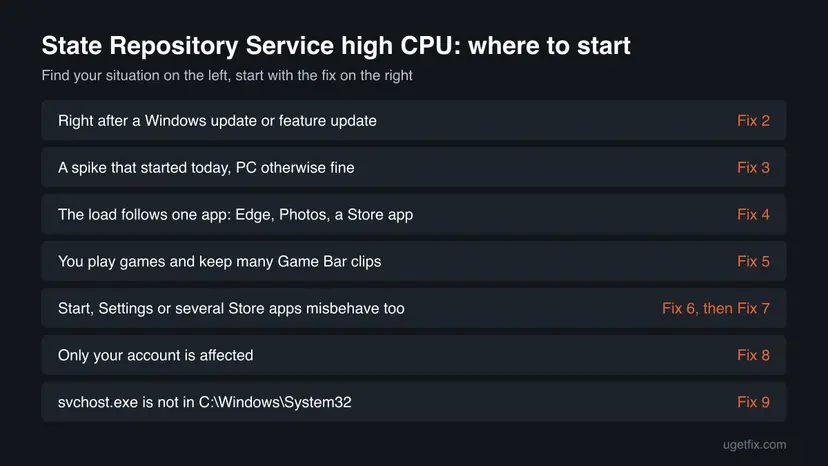
Fix 1 takes three minutes and tells you what keeps the service busy. Fix 2 and Fix 3 solve most cases. Fix 4 and Fix 5 deal with one app or Game Bar. Fix 6 to Fix 9 are deeper repairs for when Start and Store apps misbehave too.
| What you see or have | Start with |
|---|---|
| The load started right after a Windows update or feature update. | Fix 2 |
| A spike that started today, the PC is otherwise fine. | Fix 3 |
| The load starts with one app, such as Edge, Photos or another Store app. | Fix 4 |
| You play games and keep many Xbox Game Bar clips. | Fix 5 |
| Start, Settings or several Store apps open slowly or fail too. | Fix 6, then Fix 7 |
| Only your account has the problem. | Fix 8 |
The svchost.exe behind it is not in C:\Windows\System32. | Fix 9 |
Fix 1. Confirm it is StateRepository and see what keeps it busy
3 minutesNo riskEveryone, before changing anything. It also tells you whether one app is behind the load.
A Service Host line in Task Manager can hold more than one service, and StateRepository works only when packaged apps change state. Seeing which app runs or updates at the same time tells you whether to update Windows or deal with that app.
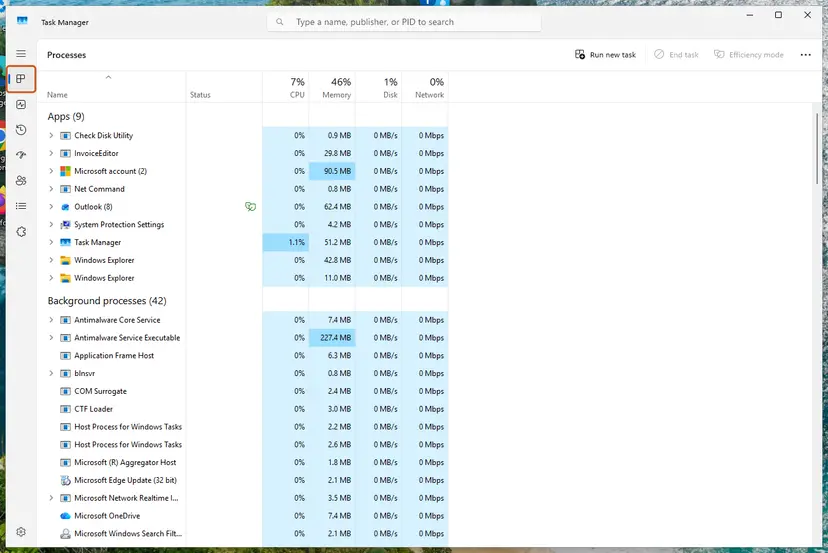
- Press Ctrl + Shift + Esc to open Task Manager. On Windows 10, select More details if you see a short list.
- On the Processes tab, select the CPU column header so the busiest process is on top.
- Expand Service Host: State Repository Service and check that the service inside is State Repository Service.
- Open the Services tab, find
StateRepositoryand note its PID. Right-click it and select Go to details. - Back on Processes, look at what else is busy: Windows Explorer, a Store app, Edge, Microsoft Store downloads or Xbox Game Bar.
- Close that app and watch the CPU column for two minutes.
| What you see | Go to |
|---|---|
| Busy right after a Windows update, Explorer busy too | Fix 2 |
| Stops when you close one app | Fix 4 |
| Busy while Game Bar or a game runs | Fix 5 |
| Busy with nothing open, for many minutes | Fix 3, then Fix 6 |
svchost.exe opens from a folder other than C:\Windows\System32 | Fix 9 |
It worked if: You know whether the service is busy because of an update, one app, Game Bar, or on its own with nothing running.
If not: If no line named State Repository Service is busy, the load comes from another service in a different Service Host. Note its name and search for that one.
Fix 2. Let a fresh update finish, then install the latest Windows update
20 to 40 minutesLow riskThe load started after a Windows update, a feature update or a large batch of Store app updates.
After an update Windows registers apps again, and the service records every change, so a busy period is expected. When the update itself carried a bug, the next update fixes it: a Microsoft Q&A user reported the load from a 1809 update ended only after moving to version 1903.
- If the update was installed in the last hour, leave the PC on and plugged in for 30 minutes and do not force a shutdown.
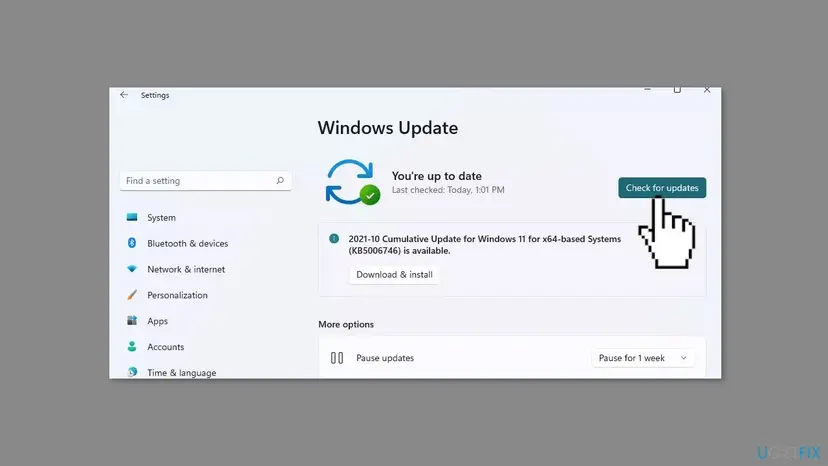
- Press Win + I and select Windows Update (Windows 10: Update & Security > Windows Update).
- Select Check for updates and install everything offered, including the latest cumulative update.
- Open Microsoft Store, select Library (older versions: Downloads) and select Get updates, so apps stop updating one by one in the background.
- Restart the PC when Windows asks, then open Task Manager again as in Fix 1.
Windows 10 22H2 left mainstream support on 14 October 2025. Only PCs enrolled in Extended Security Updates still get monthly fixes, so a bug in a Windows 10 build may never be fixed there. Install every update offered and use the other fixes.
It worked if: After the restart the service drops to near 0% CPU within a few minutes when you are not opening or updating apps.
If not: If an update fails to install, use Run the Windows Update troubleshooter. If updates are installed and the load stays, go to Fix 3.
Fix 3. Restart the State Repository Service
2 minutesLow riskThe load started recently, Windows is up to date, or you just closed the app that triggered it.
A restart ends a StateRepository session that is stuck after sleep or an update and makes it open its records again from a clean state. Its startup type is Manual, so Windows starts it again whenever an app needs it. Restarting is safe; disabling is not.
- Save your work and close Store apps and Edge.
- Press Win + R, type
services.mscand press Enter. - Find State Repository Service in the list. Its description reads Provides required infrastructure support for the application model.
- Right-click it and select Restart. If Windows asks to restart other services too, select Yes.
- Leave Startup type on Manual. Do not set it to Disabled.
- Open Task Manager and watch the CPU column for two minutes.
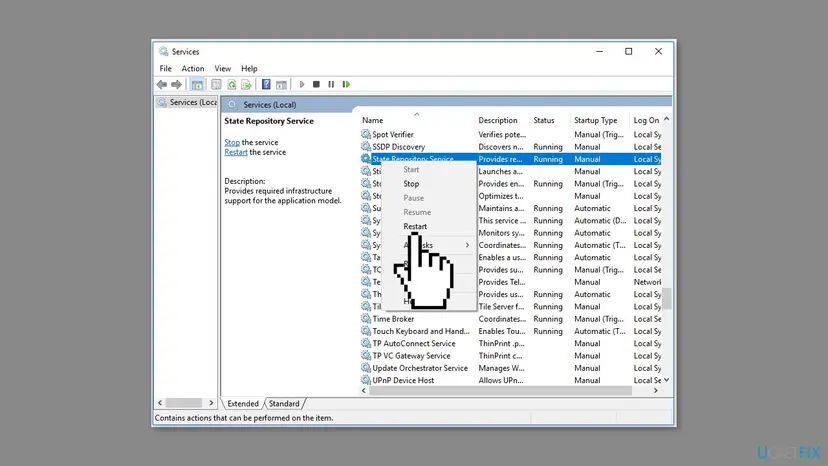
The Taskbar and Start can flicker for a moment while the service restarts. Step by step for any service: Check and restart Windows services.
It worked if: State Repository Service drops to near 0% CPU and Task Manager stays calm when you are not opening apps.
If not: If Restart is greyed out or the load returns within minutes, an app keeps triggering it (Fix 4 or Fix 5) or app registrations are damaged (Fix 6).
Fix 4. Repair or reset the Store app or Edge that triggers it
5 minutesRead the warningFix 1 showed the load starts with one app, such as Edge, Photos, Microsoft Store or another Store app.
The service writes a record each time a packaged app changes state. An app with damaged data can do that in a loop. Repair rebuilds the app's files, and Reset clears its data, so the loop stops at the source. A Microsoft Q&A user reported less CPU after removing Store apps.
Repair keeps the app's data. Reset deletes the app's local data, settings and sign-in. For Edge, Reset settings keeps favourites, history and passwords but turns off extensions; sign in with your Microsoft account first so your data syncs.
- Press Win + I and open Apps > Installed apps (Windows 10: Apps > Apps & features).
- Find the app that triggers the load, select the three dots next to it and select Advanced options.
- Select Terminate, then Repair. Open the app and watch Task Manager.
- If the load stays, go back and select Reset.
- For Edge, open Edge and go to Settings > Reset settings > Restore settings to their default values. Edge is repaired from Installed apps > Microsoft Edge > Modify > Repair.
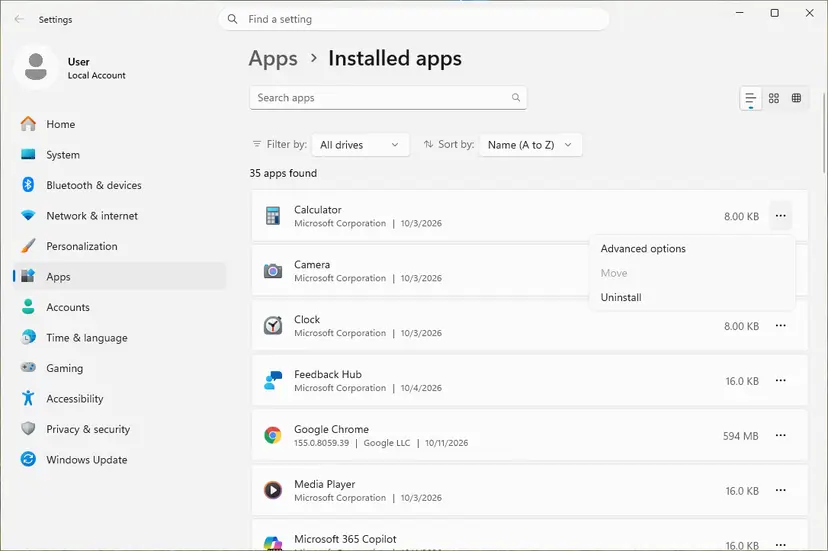
Full steps with Windows 10 paths: How to repair or reset an app in Windows. An app you do not use can simply be removed: Remove built-in Windows apps with PowerShell.
It worked if: With the app repaired or reset, the service stays quiet while that app is open.
If not: If no single app stands out, or every Store app is affected, go to Fix 6.
Fix 5. Tidy the Xbox Game Bar captures folder and stop background recording
10 minutesLow riskYou play games, the load appears with a game or Game Bar, and you keep many clips and screenshots.
Xbox Game Bar is a packaged app, so its activity runs through the app model. Users on Tom's Hardware report the State Repository load dropped after they moved old clips into sub-folders, and stopped for some only after Game Bar was removed.
- Press Win + I and open Gaming > Captures. Note the Captures location, by default the Captures folder inside Videos.
- Turn off Record what happened (Windows 10: Background recording) if you do not use it.
- Open the captures folder in File Explorer.
- Move old clips into sub-folders by year, or to another drive, so the folder itself holds few files.
- Restart the PC and play for a while with Task Manager open.
If you never use Game Bar, you can remove it. Users report this ended the load when nothing else did. Step by step: Remove built-in Windows apps with PowerShell. You can install it again from Microsoft Store.
It worked if: During games the service stays quiet, and Game Bar opens faster.
If not: If the load stays with Game Bar removed or idle, go to Fix 6.
Fix 6. Re-register the Microsoft Store apps
10 minutesLow riskStart, Settings or several Store apps open slowly or fail too, or the service is busy with nothing open.
The service keeps the records of every registered packaged app. When a registration is damaged, Windows can retry it again and again, and the service writes each retry. Re-registering reads each app's manifest again and repairs the registration without downloading anything.
- Open PowerShell. Select Start, type PowerShell and select Windows PowerShell. Open it the normal way, not as administrator: in an administrator window the app is registered to the administrator account instead of yours.
- Find the app's package. Type the command below with a part of the app's name between the asterisks and press Enter. If the app is installed, PowerShell prints its details, including Name and InstallLocation. If nothing is printed, the app is not installed for your account: see the section below.
Get-AppxPackage -Name '*WindowsCalculator*' - Re-register the app. Paste the three commands below, with the same name between the asterisks, and press Enter. They read the folder the app is installed in and register its manifest again. If no red text appears, it worked.
$InstallLocation = Get-AppxPackage -Name '*WindowsCalculator*' | Select-Object -ExpandProperty InstallLocation $ManifestPath = $InstallLocation + '\Appxmanifest.xml' Add-AppxPackage -Path $ManifestPath -Register -DisableDevelopmentMode - Open the app. Close PowerShell and start the app from Start. If it still fails, restart the PC and try once more.
These steps were written for Windows 11 25H2 and 26H2, Windows 10 22H2. The full page with the other versions and what each result means: How to re-register Microsoft Store apps with PowerShell
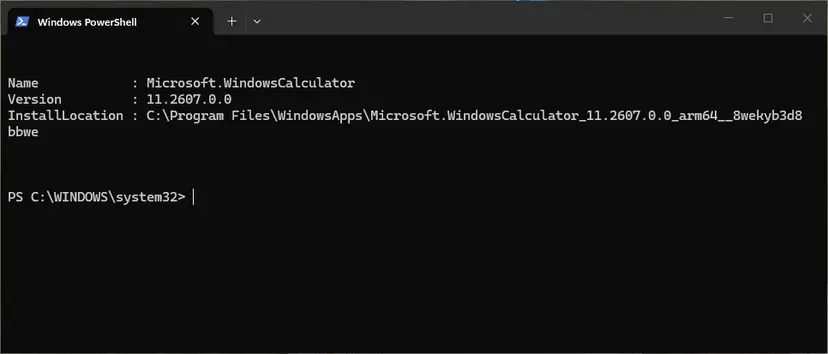
Start with the app that misbehaves. Re-registering every app at once shows many red errors for system apps that are in use; that is normal and does not mean the repair failed.
It worked if: Start, Settings and Store apps open normally and the service settles after a restart.
If not: If apps still fail to register, repair the Windows files they depend on in Fix 7.
Fix 7. Repair Windows system files with SFC and DISM
20 minutesNo riskWindows is up to date, the app fixes did not help, and Start or other services misbehave too.
StateRepository is part of Windows. If its files or the component store are damaged, the service can fail and retry in a loop, which shows up as steady CPU use. SFC and DISM replace damaged system files with good copies.
- Open an elevated command window. Right-click Start and select Terminal (Admin), or type cmd in the search box, right-click Command Prompt and select Run as administrator. Select Yes when Windows asks for permission.
- Run DISM first. Type the command below and press Enter. DISM downloads clean copies of damaged components from Windows Update, so it can take several minutes. Wait until it says The operation completed successfully.
DISM.exe /Online /Cleanup-Image /RestoreHealth - Run System File Checker. In the same window, type the command below and press Enter. Do not close the window until the verification reaches 100%.
sfc /scannow - Read the result and restart. Compare the last message with the table below this guide, then restart the PC so that repaired files are loaded.
These steps were written for Windows 11 24H2 and 25H2. The full page with the other versions and what each result means: Run DISM and SFC to repair Windows system files
It worked if: SFC reports that it repaired corrupt files or found no integrity violations, and the service settles after a restart.
If not: If SFC cannot repair some files even after DISM, test a new account in Fix 8, then read the still broken section.
Fix 8. Test with a new user account
15 minutesLow riskFixes 2 to 7 did not help, and you want to know whether your profile is the problem.
Packaged apps are registered per user, so a damaged profile can keep the service busy for one account only. Users on Tom's Hardware report the load was gone in a new local account. A new account tells you whether to repair the profile or Windows.
- Open Other users. Open Settings > Accounts > Other users. You can also press Windows key + R and run the command below.
ms-settings:otherusers - Add an account. Next to Add other user, select Add account.
- Skip the Microsoft account. Select I don't have this person's sign-in information.
- Choose a local account. Select Add a user without a Microsoft account.
- Name the account. Type a user name and, if you want one, a password. If you set a password, Windows also asks for answers to security questions. Select Next.
- Make it an administrator (optional). Back in Other users, select the new account, then Change account type next to Account options. Choose Administrator and select OK. For testing a problem, a standard account is usually enough.
- Sign in to the new account. Open Start, select your account picture and choose the new account. The first sign-in takes a few minutes while Windows sets up the profile.
These steps were written for Windows 11 24H2, 25H2 and 26H2. The full page with the other versions and what each result means: Create a new user account to test a problem
It worked if: In the new account the service stays quiet. Then the problem is in your old profile: move your files to the new account and use it.
If not: If the new account has the same load, the cause is in Windows. Go to Fix 9, then the still broken section.
Fix 9. Check the svchost.exe file and scan for malware
15 minutesNo riskGo to details shows a svchost.exe outside C:\Windows\System32, or the CPU stays high after every other fix.
Malware likes the svchost.exe name because many copies of it run on every PC. The real one is always in C:\Windows\System32. A Microsoft Defender scan rules out anything using that name.
- In Task Manager, open the Services tab, right-click
StateRepositoryand select Go to details. - Right-click the highlighted svchost.exe and select Open file location.
- Check that File Explorer opens
C:\Windows\System32. - Run a full scan with Microsoft Defender as in How to scan for malware with Microsoft Defender.
It worked if: The file is in System32 and Defender finds no threats, so the load is not malware.
If not: If the file is somewhere else or Defender finds a threat, remove it and run an offline scan before any other fix.
State Repository Service still uses high CPU: what to check next
If Windows is up to date, no app triggers it, apps are re-registered and the scan is clean, collect evidence before you reinstall anything. Microsoft has not documented a log for this service, so use what Windows records around it.
- Event Viewer: press Win + R, type
eventvwr.mscand open Applications and Services Logs > Microsoft > Windows > AppXDeploymentServer > Microsoft-Windows-AppXDeploymentServer/Operational. Many errors in a row name the app that fails to register. If AppX Deployment Service is busy at the same time, see AppX Deployment Service (AppXSVC) high CPU. - Reliability Monitor: type reliability in Start and open View reliability history. A red cross on the day the load began often names the update or app behind it.
- Feedback Hub: press Win + F and report it with your build number from
winverand the app that triggers it. - Repair install: as a last step, reinstall Windows over itself and keep your files and apps: Reinstall Windows without losing files.
This service is software only. High CPU from State Repository Service does not mean a failing processor. A very slow or nearly full system drive makes every write slower, so check free space and the drive's health if the PC is slow everywhere.
How to keep State Repository Service from flaring up again
- Keep Windows Update on and let updates finish before you shut down. Interrupted updates leave apps half registered.
- Update Store apps in one go from Microsoft Store > Library, not one by one while you work.
- Remove Store apps you never use, so fewer apps change state in the background.
- If you record games, sort clips into sub-folders and turn off background recording when you do not need it.
- Do not disable StateRepository or tweak its startup type to save resources. It breaks app features and gives no real gain.
Frequently asked questions
What is the State Repository Service?
It is a built-in Windows service, service name StateRepository, that Microsoft describes as providing required infrastructure support for the application model. The application model is how Windows installs, registers and runs packaged apps such as Microsoft Store apps, Settings, Start, Photos and Xbox Game Bar. It is always installed and starts manually when something needs it. Task Manager lists it as Service Host: State Repository Service because it runs inside a shared svchost.exe process. Searches for staterepository or state repository mean the same service.
Why does Service Host: State Repository Service use high CPU?
Because something keeps packaged apps changing state. Most often that is a Windows update or a batch of Store app updates still re-registering apps, or one app such as Edge, Photos or Xbox Game Bar that loops. Less often app registrations or system files are damaged, or one user profile is broken. Short bursts when you open Start or install an app are normal. Fix 1 shows which case is yours in three minutes, and the chooser table above points to the right fix.
Is it safe to disable the State Repository Service?
No. Microsoft lists it as always installed with Manual startup and gives no guidance to disable it, and its description calls it required infrastructure for the application model. Start, Settings, the Store and many built-in apps are packaged apps that depend on that model. Users who disabled it report features breaking. The old version of this guide did not suggest disabling it either. Restarting it is safe, as in Fix 3, and Windows starts it again whenever an app needs it.
Why is State Repository Service high on Windows 11?
The causes are the same as on Windows 10, but Windows 11 relies more on packaged apps: Settings, the Start menu, Photos, Snipping Tool and Game Bar all go through the app model. After a monthly update or a Store update wave the service is busy for a while. If the load lasts for hours, install the latest update (Fix 2), restart the service (Fix 3) and repair the app that triggers it (Fix 4). We found no Windows 11 known issue note from Microsoft for this service.
What is appmodel in Task Manager?
Some users see appmodel next to the State Repository Service when they look for the cause of high CPU, as in the question at the top of this page. It matches Microsoft's description of the service, which supports the application model, and is likely the name of the svchost group that hosts app model services. We could not confirm that from a Microsoft page today. Use the Services tab in Task Manager as in Fix 1: it shows StateRepository and its process ID directly.
Can a .NET or app update cause State Repository Service high CPU?
Yes, an update can start it. Each time an app or framework package is installed or updated, Windows registers it and the service records the change. A large update or a wave of Store updates can keep it busy for some time. Users on forums have blamed specific .NET updates; we could not confirm a Microsoft note for that. Let the updates finish, restart the PC and install the newest Windows update as in Fix 2. If one app keeps updating in a loop, repair it in Fix 4.
Does State Repository Service store Microsoft Edge sessions?
Many older pages, including the earlier version of this one, said the service saves snapshots of Edge browsing sessions. Microsoft's description does not say that: it says the service supports the application model for packaged apps in general. Edge can still be the app that keeps it busy, especially after an update. If the load starts with Edge, repair Edge from Installed apps or reset its settings as in Fix 4; your favourites, history and passwords stay.
What does Host de servicio: State Repository Service mean?
It is the same service in Spanish Windows. Task Manager translates the Service Host part, so Host de servicio, Host servizio in Italian and similar names in other languages all mean the svchost.exe that runs the State Repository Service. The service name StateRepository stays the same in every language, which is why the commands and the Services tab in Fix 1 and Fix 3 work everywhere. This page is in English, but every fix applies to any language of Windows 11 or Windows 10.
Why is CPU usage at 100% when nothing is running?
Windows does background work when you are idle: updates, Store app updates, indexing, Defender scans and app registration. The State Repository Service often shows up during that work for a few minutes. If it stays at the top of Task Manager for a long time with nothing open, it is stuck or looping, and the fixes on this page apply. If another process is at the top instead, note its name. A process that runs from outside C:\Windows\System32 under a system name needs a malware scan as in Fix 9.
Sources
- Microsoft Learn: Security guidelines for system services in Windows Server 2016 (State Repository Service) (learn.microsoft.com)
- Microsoft Q&A: Service state repository high cpu usage (user reports) (learn.microsoft.com)
- Tom's Hardware Forum: Service Host: State Repository Service, causes and fixes (user reports) (forums.tomshardware.com)
Did this fix work?
One click, no account. It tells the next reader which guides are worth their time.
Questions and experiences: fix State Repository Service high CPU usage in Windows
Still broken, or found a fix we did not cover? Ask here: members and our editors answer. Reading is open; writing needs a free account.
…