
How to fix Windows Update error 0x8007041D?

Prefer to fix it yourself? The manual steps follow.
- 7methods
- 5 to 60 minutes
- Intermediate
Applies to Windows 11 and Windows 10: Windows Update, the Microsoft Store, the Xbox app, Microsoft Defender updates and any service that fails to start with error 1053
7 methods in this guide
I'm trying to update Windows 10 to the latest version, but I just can't get rid of the 0x8007041D error. It shows up every time I try, and it's been going on for over a week. Please advise.
Error 0x8007041D is Windows error 1053: a service did not answer its start request in time, so Windows Update gave up. The update is fine; a service it needs, usually BITS, Windows Update or Cryptographic Services, starts too slowly. Restart, then test each service with net start to find the slow one.
0x8007041D means a service timed out while starting. Restart the PC, open an administrator command window and run net start bits, net start wuauserv and net start cryptsvc (Fix 1). The one that answers with error 1053 is the slow one. If a service times out, start Windows with a clean boot (Fix 2). If it hangs only during updates, reset the Windows Update components (Fix 3).
| Error | 0x8007041D, the Windows Update form of system error 1053, ERROR_SERVICE_REQUEST_TIMEOUT: "The service did not respond to the start or control request in a timely fashion." |
|---|---|
| Where it appears | Settings > Windows Update as Install error - 0x8007041d or Download error - 0x8007041d, in the older message that ends with "this may help: (0x8007041d)", and in the Microsoft Store, the Xbox app or Defender updates. |
| Main cause | A service that Windows Update calls (BITS, wuauserv, CryptSvc or TrustedInstaller) does not report that it is running before the Service Control Manager stops waiting. |
| Fastest fix | Restart once, then run net start for each update service in an administrator window to find the one that times out (Fix 1). |
| Also written as | 0x8007041d, 8007041D, (0x8007041d), error 1053, 0x41D, "Install error - 0x8007041d", "Download error - 0x8007041d". |
| Affects | Windows 11 and Windows 10 alike. The code is not tied to one update or one KB number: any service in Windows can time out this way. |
| Microsoft's status | Not a known bug of one update, so no patch removes it. Microsoft's workaround for slow services is a longer start timeout, with the advice to look for the real cause too. |
| Where the cause is logged | Event Viewer, Windows Logs > System, source Service Control Manager, events 7000, 7009 and 7011. They name the service that timed out. |
| Time to fix | 5 minutes to find the slow service. 15 to 30 minutes for a clean boot or an update reset. About an hour for a repair install. |
Facts checked on 15 October 2026. Steps written for Windows 11 (25H2 and 26H2) and Windows 10 22H2.
What error 0x8007041D means in Windows Update
0x8007041D is not a Windows Update code of its own. The first half, 0x8007, marks an ordinary Windows error wrapped in the format that update components use. The second half, 041D, is the number 1053 written in hexadecimal. Microsoft's list of system error codes names 1053 ERROR_SERVICE_REQUEST_TIMEOUT, with one sentence: "The service did not respond to the start or control request in a timely fashion."
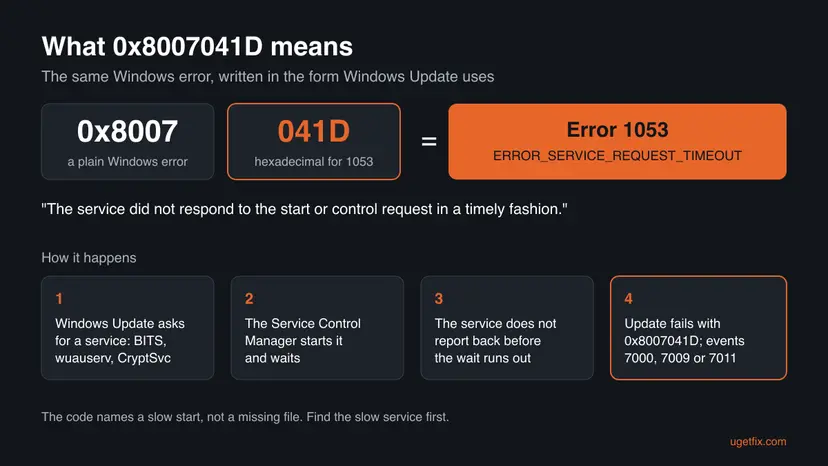
So the update file is rarely the problem. Windows Update depends on several services, and each one must tell the Service Control Manager that it is running. If one of them stays silent for too long, Windows stops waiting, records the timeout and reports 0x8007041D. You can print the same sentence yourself with net helpmsg 1053 in any command window.
| What you see | Where | Which service usually times out |
|---|---|---|
| Install error - 0x8007041d or Download error - 0x8007041d next to an update | Settings > Windows Update on Windows 11 | BITS, Windows Update (wuauserv), Windows Modules Installer |
| "There were some problems installing updates, but we'll try again later. If you keep seeing this and want to search the web or contact support for information, this may help: (0x8007041d)" | Settings > Update & Security > Windows Update on Windows 10 | The same update services |
| Error code 0x8007041D while an app or a game installs | Microsoft Store or the Xbox app | A service the Store or the Xbox app needs; we could not confirm which one from a Microsoft page |
| 0x8007041D while security intelligence updates | Windows Security or Defender updates | The Defender update path; an answer in Microsoft's Q&A forum suggests a manual definitions update |
| "System error 1053 has occurred" or "Error 1053" | Command Prompt after net start, or the Services window after Start | The service you just tried to start |
Most advice for this code is the general update checklist. The real meaning is narrower: one service was too slow to start. Find which one, and find what slows it down. The rest of this guide is ordered that way.
What causes 0x8007041D, from most to least likely
By definition there is one cause: a service did not answer in time. What differs is why it was slow. Microsoft's own article on slow services gives only the workaround of a longer wait and adds that the timeout may be "a symptom of another problem". The table ties each likely reason to the fix that addresses it.
| Reason | How to tell | Fix |
|---|---|---|
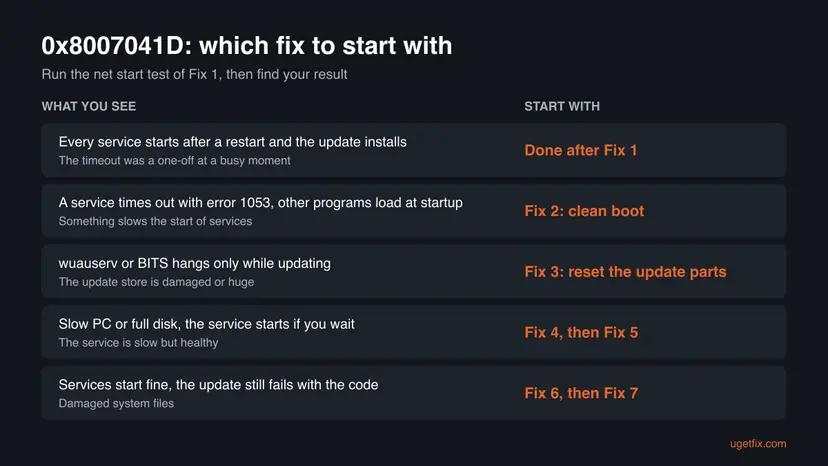
| A one-off timeout: the PC was busy just after start-up, or a service was stuck in a starting state. | The error came once or twice; after a restart every net start command works at once. | Fix 1 |
| Startup programs and third-party services compete with Windows services, or hook into their start (security suites, tuning tools, drivers of other vendors). | A service times out with error 1053 in normal start-up, but starts fine after a clean boot. | Fix 2 |
| The Windows Update data store or the BITS download queue is damaged or very large, so the service hangs while it reads it. | BITS or wuauserv starts but hangs or stops during Check for updates. | Fix 3 |
| The PC is simply slow to start services: an old hard drive, a nearly full disk, many services that start together. | The service starts if you run net start again a minute later; events 7009 or 7011 show the wait ran out. | Fix 4 and Fix 5 |
| Damaged system files behind one of the services. | Services start, the update still fails with the same code, or DISM finds corruption. | Fix 6, then Fix 7 |
Starting in Safe boot to install updates does not help: Windows Update does not install in Safe Mode. A clean boot is a normal start without third-party services, which is what Fix 2 does. Turning off the antivirus for good is never a fix either.
How to fix Windows Update error 0x8007041D
Fix 1 is the diagnosis, and everybody starts there: it takes five minutes and changes nothing. Its result tells you whether to go on with a clean boot (Fix 2), an update reset (Fix 3) or a longer timeout (Fix 4). Fixes 5 to 7 are the general repairs for a slow drive or damaged Windows files.
| What you see or have | Start with |
|---|---|
| Only the code 0x8007041D in Windows Update, and you do not know which service is slow. | Fix 1 |
net start answers "System error 1053 has occurred" for a service, and many programs open at sign-in. | Fix 2 |
| The services start, but BITS or Windows Update hangs during Check for updates. | Fix 3 |
| The service starts on the second try, events 7009 or 7011 show the wait ran out. | Fix 4, then Fix 5 |
| Every service starts and the update still fails with 0x8007041D. | Fix 6, then Fix 7 |
| The code appears in the Microsoft Store, the Xbox app or Defender updates. | Fix 1 with the same commands, then the FAQ below |
Fix 1. Restart, then find the service that times out
5 minutesNo riskAlways first: you see 0x8007041D and do not yet know which service is too slow.
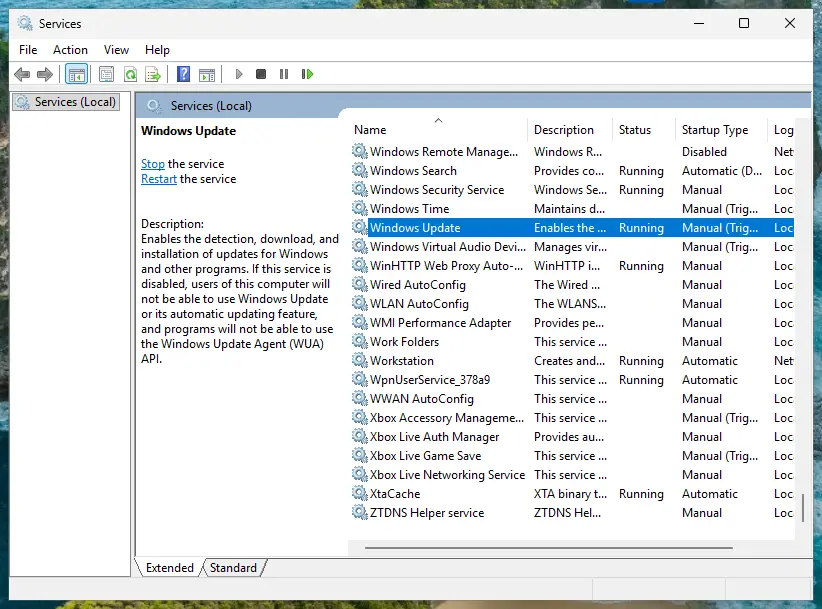
Error 1053 always belongs to one service. Starting each update service by hand shows which one stays silent, and a restart alone clears a service that was stuck in a starting state.
- Restart the PC with Start > Power > Restart, not Shut down. Try the update once more.
- If it fails again, on Windows 11 right-click Start and select Terminal (Admin). On Windows 10, type
cmdin the search box and select Run as administrator. - Start the update services one at a time. "The requested service has already been started" is a good answer.
net start bits net start wuauserv net start cryptsvc net start trustedinstaller - Note the one that answers with "System error 1053 has occurred" or takes very long. That is the slow service.
- Check its state. A line STATE with
2 START_PENDINGthat does not change means the service hangs while starting.sc.exe query bits - Open Settings > Windows Update and select Check for updates while the services are running.
- Read the event log too. Right-click Start, select Event Viewer, open Windows Logs > System and look for source Service Control Manager with event 7000, 7009 or 7011 at the time of the failed update. The event names the service.
- Event 7000 reads that the service "failed to start due to the following error: The service did not respond to the start or control request in a timely fashion."
- Events 7009 and 7011 report that a timeout was reached and print how many milliseconds Windows waited.
It worked if: Every net start command answers that the service started or was already running, and Windows Update installs the update.
If not: If a service answers with error 1053, go to Fix 2. If all start but the update hangs, go to Fix 3.
Fix 2. Start Windows with a clean boot and run the update
15 minutesLow riskA service times out in normal start-up, or many programs and third-party services load at sign-in.
A clean boot starts Windows with its own services only. If a third-party service or startup program slows the start of BITS or Windows Update, the update service answers in time and the update goes through.
- Open System Configuration. Select Search on the taskbar, type msconfig and select System Configuration from the results.
- Hide Microsoft services. On the Services tab, select the Hide all Microsoft services check box. Only services from other companies stay in the list.

With Hide all Microsoft services ticked, only third-party services stay in the list. Screenshot: Windows 11 26H2. - Disable the remaining services. Select Disable all, then select Apply.
- Open Task Manager. On the Startup tab of System Configuration, select Open Task Manager.

The Startup tab only links to Task Manager. Screenshot: Windows 11 26H2. - Disable the startup apps. On the Startup apps tab in Task Manager, select each item whose status is Enabled and select Disable. Write down or take a screenshot of the items you disable: you need the list to turn them back on.

Select an app, then Disable. Screenshot: Windows 11 26H2. - Confirm the changes. Close Task Manager. On the Startup tab of System Configuration, select OK.
- Restart and test. Restart the PC. Windows now starts in a clean boot environment: try again the thing that failed (run the app, install the update, uninstall the program).
These steps were written for Windows 11 25H2 and 26H2. The full page with the other versions and what each result means: How to perform a clean boot in Windows
- After the restart, open Settings > Windows Update and select Check for updates, or Retry next to the failed update.
- When the update is installed, switch the services and startup apps back on in groups and restart after each group. The group after which 0x8007041D returns holds the program that slows the services.
- Update or remove that program. Leave Hide all Microsoft services ticked whenever you change services in System Configuration.
Leave the Boot tab of System Configuration alone. Safe boot starts Windows in Safe Mode, where updates do not install. A clean boot keeps the normal start and only switches off services and apps of other companies.
It worked if: In the clean boot the update downloads and installs without 0x8007041D.
If not: If the update still fails in a clean boot, the slow part is Windows itself. Go to Fix 3.
Fix 3. Reset the Windows Update components
15 minutesLow riskThe services start, but BITS or Windows Update hangs or stops while it checks or downloads.
Windows Update and BITS read their download queue and data store when they start work. A damaged or oversized store can keep them busy past the timeout. The reset gives both a clean, empty store.
- Open Command Prompt as administrator. Type cmd in the search box, right-click Command Prompt and select Run as administrator. Select Yes when Windows asks for permission.
- Stop the update services. Type the commands below and press Enter after each one. If Windows says that other services depend on Cryptographic Services, it stops them too. A message that a service is not started is fine.
net stop wuauserv
net stop bits
net stop cryptsvc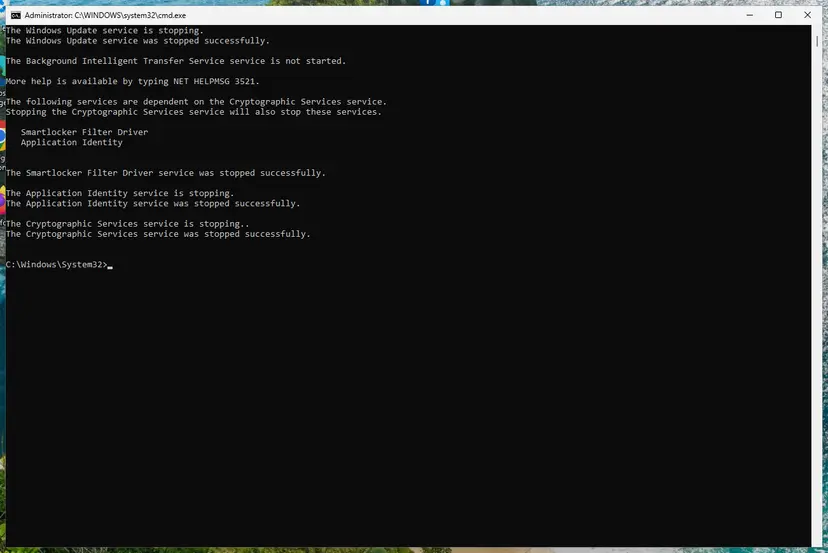
The update services are stopped. Screenshot: Windows 11 26H2. - Delete the download queue files. This clears the list of downloads that the Background Intelligent Transfer Service keeps. If Windows says it cannot find the files, continue.
del "%ALLUSERSPROFILE%\Application Data\Microsoft\Network\Downloader\qmgr*.dat" - Rename the update cache folders. Renaming keeps a copy in case you need it; Windows creates new, empty folders when the services start again. If you get Access is denied, a service is still running: repeat the previous step.
ren %systemroot%\SoftwareDistribution SoftwareDistribution.old
ren %systemroot%\System32\catroot2 catroot2.old
Both folders now end in .old. Screenshot: Windows 11 26H2. - Start the services again. Type the commands below and press Enter after each one. The requested service has already been started is fine: Windows started it on its own.
net start cryptsvc
net start bits
net start wuauserv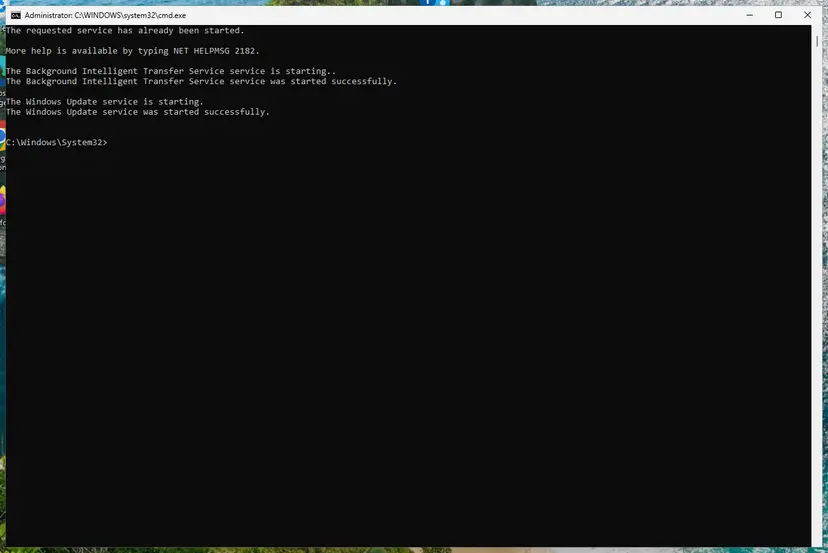
BITS and Windows Update are running again. Screenshot: Windows 11 26H2. - Restart and check for updates. Restart the PC. Then select Start > Settings > Windows Update > Check for updates. The first check can take longer than usual because everything is downloaded again.
These steps were written for Windows 11 and Windows 10 (the steps are the same). The full page with the other versions and what each result means: Reset Windows Update components
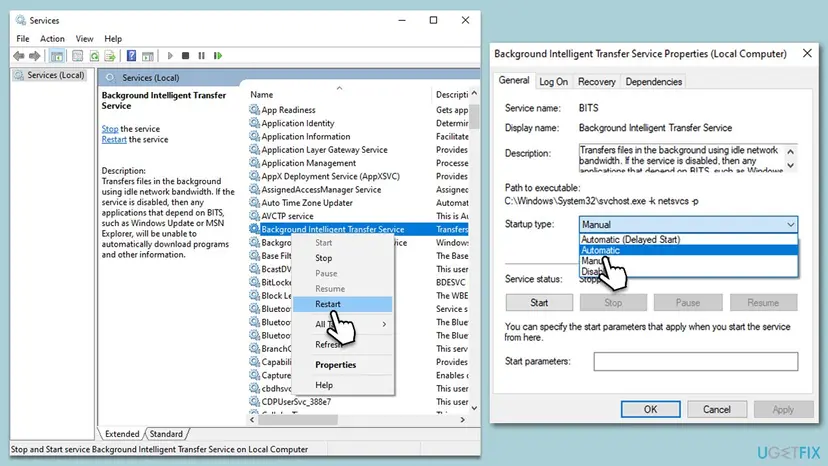
The net stop and net start commands of the reset are a test in themselves. If net start bits or net start wuauserv answers with "System error 1053 has occurred" even with an empty store, the service is slow for another reason: go to Fix 4.
It worked if: After the restart, Check for updates finds the update, the download starts and the install finishes without the code.
If not: If the error stays, give the services more time to start with Fix 4.
Fix 4. Give services more time to start with ServicesPipeTimeout
10 minutesRead the warningA service starts on the second try, or events 7009 or 7011 show that the wait ran out on a slow PC.
This is Microsoft's own workaround for a slow service that does not start in time. The registry value ServicesPipeTimeout sets how long the Service Control Manager waits before it logs a timeout.
A wrong value in this key affects how every service starts. Export HKEY_LOCAL_MACHINE\SYSTEM\CurrentControlSet\Control before you change it, and change only the one value below. Step by step: Back up the registry before editing it
- Press Win + R, type
regeditand press Enter. Select Yes in the User Account Control prompt. - Go to
HKEY_LOCAL_MACHINE\SYSTEM\CurrentControlSet\Control. - Look for ServicesPipeTimeout in the right pane. If it is not there, select Edit > New > DWORD (32-bit) Value and name it
ServicesPipeTimeout. - Right-click ServicesPipeTimeout and select Modify.
- Select Decimal, type
60000and select OK. The value is in milliseconds, so 60000 is 60 seconds. - Restart the PC and try the update again.
The same in an administrator command window
reg add "HKLM\SYSTEM\CurrentControlSet\Control" /v ServicesPipeTimeout /t REG_DWORD /d 60000 /f- Raise it in small steps. Microsoft recommends increasing the number a little at a time until the service can start, not setting a very large value.
- It is a workaround. Microsoft notes that the slow start may be a symptom of another problem. Keep looking for the cause with Fix 5 and Fix 6.
- To undo: delete the value with
reg delete "HKLM\SYSTEM\CurrentControlSet\Control" /v ServicesPipeTimeout /fand restart, or import your backup.
It worked if: After the restart the update services start within the longer wait and the update installs without 0x8007041D.
If not: If the service still times out after 60 seconds, it is not just slow. Check the drive with Fix 5.
Fix 5. Check the system drive for errors and free space
20 to 60 minutesLow riskThe PC starts slowly in general, the Windows drive is nearly full, or the disk is an older hard drive.
Every service loads its files from the Windows drive. A drive with file system errors or no free room answers slowly, which delays service starts and gives an update no space to unpack.
- Open File Explorer > This PC and look at the free space of the Windows drive, usually C:.
- If the bar is red or nearly full, free some space first: Free up disk space and delete temporary files
- Run a disk check on the Windows drive. Windows schedules it for the next restart because the drive is in use.
- Restart, let the check finish, then try the update.
- Open Command Prompt as administrator. Type cmd in the search box on the taskbar, right-click Command Prompt and select Run as administrator. Select Yes when Windows asks for permission.
- Scan the drive without changing anything. Type the command below and press Enter. Replace C: with another drive letter to check that drive. This scan only reports; it does not fix anything.
chkdsk C: - If errors were found, run the repair. Run chkdsk with /f to fix file system errors. On the Windows drive (C:) chkdsk cannot lock the drive while Windows is running, so it offers to check it at the next restart.
chkdsk C: /f - Schedule the check and restart. Type Y and press Enter, then restart the PC. chkdsk runs before Windows starts. Do not turn the PC off while it runs.
- Read the result after the restart. The report of a check made at startup is not shown on the desktop. Open PowerShell and run the command below to see it, or open Event Viewer (eventvwr.msc) > Windows Logs > Application and filter by the sources Chkdsk and Wininit.
Get-WinEvent -FilterHashtable @{LogName='Application'} | Where-Object { $_.ProviderName -match 'wininit' } | Select-Object -First 1 | Format-List TimeCreated, Message
These steps were written for Windows 11 and Windows 10 (the steps are the same). The full page with the other versions and what each result means: Check a disk for errors (chkdsk)
It worked if: The disk check reports no problems or fixes them, the drive has room again, and services start faster.
If not: If the drive is healthy and the error stays, repair the Windows files with Fix 6.
Fix 6. Repair Windows system files with DISM and SFC
20 to 40 minutesLow riskAll update services start, yet the update still fails with 0x8007041D.
A damaged system file behind one of the services can make it hang while starting. DISM repairs the store of Windows files, and System File Checker replaces damaged files from that store.
- Open an elevated command window. Right-click Start and select Terminal (Admin), or type cmd in the search box, right-click Command Prompt and select Run as administrator. Select Yes when Windows asks for permission.
- Run DISM first. Type the command below and press Enter. DISM downloads clean copies of damaged components from Windows Update, so it can take several minutes. Wait until it says The operation completed successfully.
DISM.exe /Online /Cleanup-Image /RestoreHealth - Run System File Checker. In the same window, type the command below and press Enter. Do not close the window until the verification reaches 100%.
sfc /scannow - Read the result and restart. Compare the last message with the table below this guide, then restart the PC so that repaired files are loaded.
These steps were written for Windows 11 24H2 and 25H2. The full page with the other versions and what each result means: Run DISM and SFC to repair Windows system files
Restart the PC after both scans, run the net start test from Fix 1 again and check for updates. Windows 11 also has its own update troubleshooter under Settings > System > Troubleshoot > Other troubleshooters. It is quick and worth one try here: Run the Windows Update troubleshooter
It worked if: DISM and SFC end without unrepaired files, and the update installs.
If not: If the scans cannot repair what they find, or the update still fails, go to Fix 7.
Fix 7. Reinstall the current version of Windows and keep your files and apps
1 to 2 hoursLow riskEvery other fix left the error in place, or DISM and SFC could not repair the files.
A repair install writes all Windows files and services again while it keeps your files, apps and settings. It also installs the newest build, which is what the failed update tried to do.
- Open Recovery in Settings. Open Settings > System > Recovery. Next to Fix problems using Windows Update, select Reinstall now. This keeps your apps, files and settings.

Fix problems using Windows Update reinstalls the current version and keeps apps, files and settings. Screenshot: Windows 11 26H2. - Start the reinstall. Choose whether the PC may restart on its own 15 minutes after the installation, then select OK.
- Wait and restart. Windows Update downloads and installs a repair copy of your current Windows version. Keep the PC plugged in and online, and restart it when asked.
- If that did not help: Reset PC. Back in Settings > System > Recovery, next to Reset this PC, select Reset PC. This keeps your personal files but removes installed apps and settings.
These steps were written for Windows 11 22H2 and later. The full page with the other versions and what each result means: Reinstall Windows without losing files
Both routes are made to keep your files, apps and settings. Copy important files to another drive before you start all the same, and keep the PC on mains power. Microsoft ended support for Windows 10 on 14 October 2025, so on Windows 10 updates now bring no free security fixes.
It worked if: Windows restarts on the newest build, and Windows Update checks and installs without 0x8007041D.
If not: If the error returns soon after, read the event log as the next section describes and collect the service name for support.
If 0x8007041D is still there: read what Windows logged
Windows writes down which service was too slow. The Service Control Manager records every start that timed out in the System log, and the event text names the service. With that name you can search the vendor of a third-party service or ask support a precise question.
| Log | Where | What to look for |
|---|---|---|
| System event log | Event Viewer, Windows Logs > System, source Service Control Manager | Events 7000, 7009 and 7011 at the time of the failed update, with the service name |
| Windows Update log | Run Get-WindowsUpdateLog in PowerShell; WindowsUpdate.log appears on the desktop | Lines with 8007041d and the time of the attempt |
| Servicing log | %windir%\Logs\CBS\CBS.log | What DISM and SFC could not repair in Fix 6 |
- What to send to support: the event 7000, 7009 or 7011 text, the output of
sc.exe queryfor that service, your Windows version from Settings > System > About and what you installed just before the error. - When it is not yours to fix: on a work or school PC, services and update settings can be held by policy. Report the event text to the administrator.
- When it is hardware: many services time out at once, the PC is slow from the start and the disk check finds bad sectors. That points to a failing drive. Back up your files first and replace the drive.
How to keep 0x8007041D from coming back
- Restart the PC now and then instead of only putting it to sleep, so stuck services start fresh.
- Keep at least several gigabytes free on the Windows drive for updates.
- Keep the number of startup apps small: Stop apps from opening at startup
- Keep third-party security and tuning tools up to date, or remove the ones you do not use.
- Note the service name from Event Viewer the first time the error appears.
- Do not disable update services to quieten Windows; pause updates in Settings instead.
- Do not set ServicesPipeTimeout to a huge value to hide a slow service.
- Do not use Safe boot to install updates.
- Do not turn off your antivirus for good to make an update pass.
Each point follows from what the code means. The error appears only when a service is slower than the wait allows, so anything that keeps service starts quick and the drive healthy keeps the code away.
Frequently asked questions
What does error 0x8007041D mean?
It means a Windows service did not respond to its start request in time. The code is system error 1053, named ERROR_SERVICE_REQUEST_TIMEOUT, in the notation Windows Update uses: 0x8007 marks a wrapped Windows error and 041D is 1053 in hexadecimal. Microsoft's text for it is "The service did not respond to the start or control request in a timely fashion." In Windows Update the slow service is usually BITS, Windows Update or Cryptographic Services. The update itself is rarely damaged.
How do I fix 0x8007041D on Windows 11?
Restart the PC first, then run net start bits, net start wuauserv and net start cryptsvc in Terminal (Admin). The service that answers with System error 1053 is the slow one. If one times out, try a clean boot and update from there. If the services start but the update hangs, reset the Windows Update components. On Windows 11 the failed update shows Install error - 0x8007041d or Download error - 0x8007041d in Settings > Windows Update, and Retry works after the fix.
Why do I see 0x8007041D in the Microsoft Store or the Xbox app?
The code means the same thing there: a service the app needs did not start in time. The Store and the Xbox app install apps and games through Windows services, so a slow or stuck service gives the same 1053 timeout. Restart the PC, then run the net start test from Fix 1 and look in Event Viewer for event 7000 or 7009 at the time of the error to see which service it was. We could not confirm from a Microsoft page which Store or Xbox service is affected most often.
Is 0x8007041D the same error in Windows Update in other languages?
Yes. The code stays the same in every language, only the sentence around it is translated. On a Russian Windows 10, for example, the message starts with "С установкой обновлений возникли некоторые проблемы" and ends with (0x8007041d). It is the same message as the English "There were some problems installing updates, but we'll try again later". The fixes on this page apply unchanged, and the commands such as net start bits are the same in every language version.
Is it safe to change ServicesPipeTimeout?
Yes, if you back up the key and change only that value. Microsoft documents it as a workaround for services that do not start in time, with 60000 milliseconds as the example. Microsoft also recommends raising the number in small steps and looking for the real cause, because a slow service may be a symptom of another problem. A very large value would make Windows wait a long time for a service that has really hung. To undo it, delete the value and restart.
Can antivirus software cause error 0x8007041D?
It can slow service starts, like any software that hooks into Windows at start-up, but we found no Microsoft page that names it as a cause of this code. The safe test is a clean boot, which stops third-party services without weakening Windows' own protection. If the update installs in a clean boot, bring the services back in groups to find the one that slows things down. Do not uninstall or disable your protection for good; update or replace the program instead.
Does a Windows Update troubleshooter fix 0x8007041D?
Sometimes, when the timeout came from a stuck service that the troubleshooter restarts or from a damaged update store it resets. It does not show you which service was slow, and it cannot change how long Windows waits for a service. That is why it sits late in this guide. Run the net start test first: it takes five minutes and tells you whether a clean boot, an update reset or a longer timeout is the next step.
Is 0x8007041D a sign of a hardware problem?
Usually not. One service that times out once points to software: a busy start-up, a third-party service or a damaged update store. Hardware becomes likely when many services time out together, the PC is slow from the moment it starts, and a disk check finds bad sectors. An old hard drive close to failing makes every service slow to load. In that case back up your files first, then check the drive with chkdsk and the maker's tool, and plan to replace it.
What is the difference between 0x8007041D and 0x80070422?
Both are service errors in Windows Update, but they mean different things. Code 0x8007041D is error 1053: the service exists and is allowed to start but did not answer in time. Code 0x80070422 is error 1058: the service is disabled, so Windows does not try to start it at all. For 1058 you set the start type back to Manual or Automatic. For 1053 you look for what makes the service slow. Running sc.exe query on the service shows which case you have.
Sources
- Microsoft Learn: System Error Codes (1000-1299), ERROR_SERVICE_REQUEST_TIMEOUT 1053 (0x41D) (learn.microsoft.com)
- Microsoft Learn: A slow service does not start due to time-out error in Windows (KB 922918, ServicesPipeTimeout) (learn.microsoft.com)
- Microsoft Q&A: Windows 10 Update error code 0x8007041d (learn.microsoft.com)
Did this fix work?
One click, no account. It tells the next reader which guides are worth their time.
Questions and experiences: fix Windows Update error 0x8007041D
Still broken, or found a fix we did not cover? Ask here: members and our editors answer. Reading is open; writing needs a free account.
…