
How to fix File System error (-2144927439) in Windows?

Prefer to fix it yourself? The manual steps follow.
- 5methods
- 10 to 90 minutes
- Intermediate
Applies to Windows 11 and Windows 10; Start menu, search, Settings and ms-settings: links, Microsoft Store, Calendar and other built-in apps
5 methods in this guide
Hello. The File System error (-2144927439) keeps popping up on my Windows PC. Is there a way to fix this?
File system error (-2144927439) appears when you open Start, Settings, an ms-settings: link, search or Microsoft Store and Windows cannot start the built-in app behind it. Your disk is fine. Register the built-in Windows apps again first.
File system error (-2144927439) is the Windows shell code 0x80270131. It shows when Start, Settings, an ms-settings: link or Microsoft Store will not open because their app registration is broken. It is not a disk fault. Register Settings, the shell and Store again in an administrator PowerShell (Fix 1). If that reports 0x80073CFE, repair Windows with DISM and SFC (Fix 2), then test a new account (Fix 3).
| Error | A box with File system error (-2144927439). and an OK button. The title bar shows what Windows tried to open, for example an ms-settings: address. |
|---|---|
| Where it appears | When you click Start, the search box or Settings, run an ms-settings: link from Win + R, or open Microsoft Store, Calendar or another built-in app. |
| Main cause | The registration of the built-in Windows apps (Settings, the Start and shell host, Store) is damaged, often after a blue screen, a forced shutdown or a failed update. |
| Fastest fix | Register Settings, the shell and Microsoft Store again with PowerShell as administrator, started from Task Manager (Fix 1). |
| Also written as | -2144927439, "file system error 2144927439", "ms-settings file system error", 0x80270131. Often seen together with 0x80073CFE. |
| Also shown | "This file does not have an app associated with it for performing this action" when Start or Settings is clicked. |
| Affects | Windows 10 and Windows 11. Most reports on Microsoft Q&A and Reddit come from Windows 10. |
| Microsoft's status | No Microsoft support page for this message. The code sits in the shell facility (0x27, 39); we could not confirm a symbol name for it. |
| Not the cause | A failing drive or NTFS damage, as long as your own files open and copy normally. |
| Time to fix | 10 to 15 minutes for Fix 1, up to 90 minutes for a repair install. |
Facts checked on 15 October 2026. Steps written for Windows 11 (25H2 and 26H2) and Windows 10 22H2.
What File system error (-2144927439) means
The box comes from the Windows shell, the part of Windows behind Start, the taskbar search, File Explorer and the links into Settings. You click Start or Settings, or type an address such as ms-settings: into Win + R, and instead of the app you get File system error (-2144927439). with one OK button. Some readers first see a second message: "This file does not have an app associated with it for performing this action."
Despite the words "file system", the number is a Windows error code printed as a negative decimal number. In hex, -2144927439 is 0x80270131. The 0x8027 part is facility 39, the Windows shell. We could not confirm a published symbol name or description for this exact code, so the page goes by what readers see and what Microsoft's helpers advise.
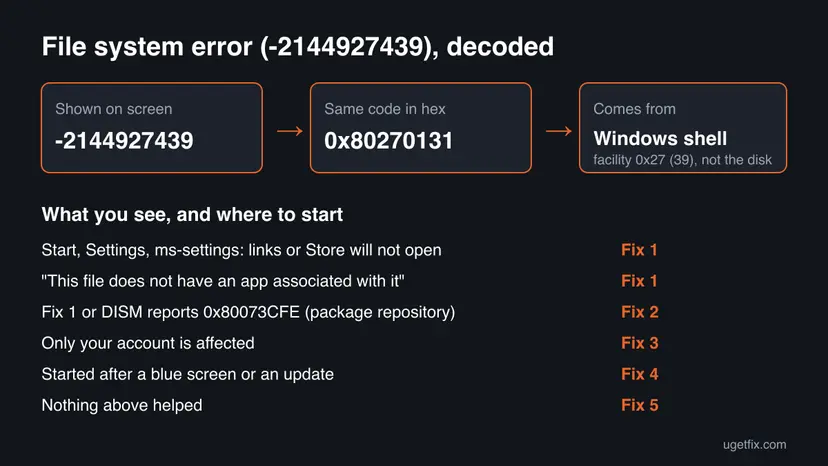
Your documents and your drive are almost certainly fine. Settings, Start and Microsoft Store are app packages that Windows registers for your account. When that registration breaks, the shell has nothing to start, and Windows reports it with this code. The fix is to register those apps again or repair Windows, not to scan the disk.
A close relative, File system error (-2144926975), is code 0x80270301 from the same shell facility. It usually follows a failed System Restore and blocks Control Panel and Recovery pages, so its fixes start elsewhere: File system error (-2144926975). With -2144927439, Start, Settings and Store are the parts that fail.
Why File system error -2144927439 appears
On Microsoft Q&A, readers with this code tell a similar story: Start, search, Settings, Calendar and Microsoft Store all stop at once, often right after a blue screen. One reader found that DISM and SFC reported a corrupted package repository, error 0x80073CFE. Rank the causes like this.
| Cause | How often | How to tell | Fix |
|---|---|---|---|
| The registration of Settings, the shell host or Store is damaged. | Most often | Start, Settings and Store fail, but File Explorer and your desktop programs work. | Fix 1 |
| Windows system files or the app package repository are damaged. | Often | Fix 1 prints red errors, or DISM and SFC report 0x80073CFE. | Fix 2 |
| Your user profile is damaged. | Sometimes | A new account opens Start and Settings without the error. | Fix 3 |
| A crash, forced shutdown or update left Windows half changed. | Sometimes | The error began right after a blue screen or an update. | Fix 4 |
| Windows is too damaged for repairs in place. | Rarely | Fixes 1 to 4 changed nothing. | Fix 5 |
How to fix File System error (-2144927439) in Windows
Fix 1 registers the built-in apps again and helps most readers. Fix 2 repairs the Windows files and package store behind them. Fix 3 tells you whether only your account is damaged. Fix 4 undoes a recent crash or update, and Fix 5 repairs Windows while keeping your files and apps.
| What you see or have | Start with |
|---|---|
| Start, search, Settings, ms-settings: links or Microsoft Store will not open. | Fix 1 |
| "This file does not have an app associated with it" when you click Start or Settings. | Fix 1 |
| Fix 1 prints red errors, or DISM reports 0x80073CFE. | Fix 2 |
| Fixes 1 and 2 ran cleanly but the error stays. | Fix 3 |
| The error began after a blue screen, a forced shutdown or an update. | Fix 4 |
| Nothing above helped. | Fix 5 |
Fix 1. Register Settings, the Windows shell and Microsoft Store again
10 to 15 minutesLow riskStart, search, Settings, ms-settings: links, Calendar or Microsoft Store show the error, and your desktop programs still work.
Settings, the Start and shell host and Microsoft Store are app packages registered to your account. When that registration breaks, the shell cannot start them and reports this code. Registering them again from their install folders repairs the link without downloading anything. It is the main advice given for this code on Microsoft Q&A.
- Press Ctrl + Shift + Esc to open Task Manager. You need it because Start and its right-click menu may not open.
- Select Run new task (Windows 11) or File > Run new task (Windows 10), type
powershell, tick Create this task with administrative privileges and select OK. - Paste the first command below and press Enter. It registers the Settings app (
windows.immersivecontrolpanel) for all users. - Paste the second command and press Enter. It registers the shell experience host behind Start, notifications and the taskbar.
- Paste the third command and press Enter. It registers Microsoft Store.
- If Start still fails, paste the fourth command. It registers every app of your account and takes a few minutes. Red lines for apps that are in use are normal.
- Restart Windows, then try Start, Settings and Win + R with
ms-settings:again.
Register Settings, the shell and Store (PowerShell as administrator)
Get-AppXPackage -AllUsers -Name windows.immersivecontrolpanel | Foreach {Add-AppxPackage -DisableDevelopmentMode -Register "$($_.InstallLocation)\AppXManifest.xml" -Verbose}
Get-AppxPackage Microsoft.Windows.ShellExperienceHost | Foreach {Add-AppxPackage -DisableDevelopmentMode -Register "$($_.InstallLocation)\appxmanifest.xml"}
Get-AppXPackage *WindowsStore* -AllUsers | Foreach {Add-AppxPackage -DisableDevelopmentMode -Register "$($_.InstallLocation)\AppXManifest.xml"}
Get-AppXPackage | Foreach {Add-AppxPackage -DisableDevelopmentMode -Register "$($_.InstallLocation)\AppXManifest.xml"}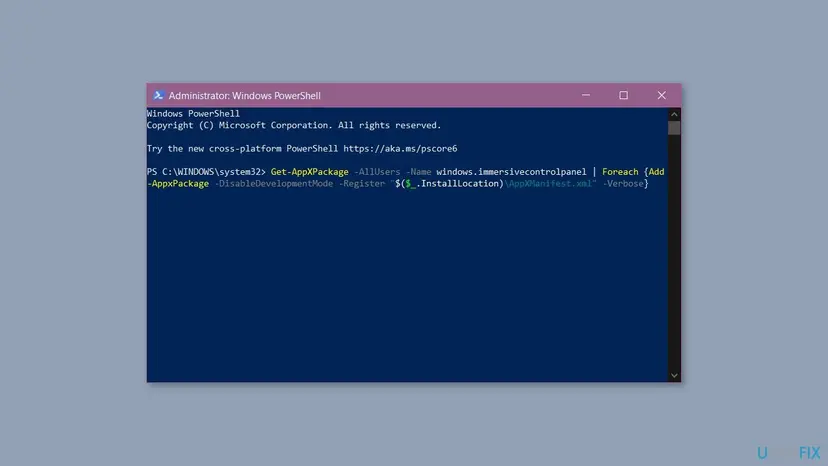
If the Start menu itself is frozen rather than missing, restart File Explorer from the same Task Manager first: Restart File Explorer How app registration works and how to register one app: How to re-register Microsoft Store apps with PowerShell
It worked if: The commands finish without red lines for Settings, the shell host and Store, and after the restart Start, search and Settings open normally.
If not: If a command ends with 0x80073CFE or other red errors for these three packages, go to Fix 2. If it ran cleanly but nothing changed, go to Fix 3.
Fix 2. Repair Windows and its app package store with DISM and SFC
30 minutesNo riskFix 1 printed red errors, DISM or SFC mention 0x80073CFE, or the error appears in every account.
Registering an app only works when the files and the package repository behind it are intact. A crash can damage both. DISM fetches clean copies of Windows' components and SFC puts damaged system files back, after which Fix 1 can succeed. On Microsoft Q&A, the reader whose scans reported 0x80073CFE was advised to run them from the recovery screen.
- Open Task Manager with Ctrl + Shift + Esc, select Run new task, type
cmd, tick Create this task with administrative privileges and select OK. - Run the DISM and SFC commands from the procedure below, DISM first.
- Restart Windows and run Fix 1 again.
- If Windows will not stay up long enough, or the scans stop with an error, run the offline scan from the recovery screen, as the procedure's recovery tab shows.
- Open an elevated command window. Right-click Start and select Terminal (Admin), or type cmd in the search box, right-click Command Prompt and select Run as administrator. Select Yes when Windows asks for permission.
- Run DISM first. Type the command below and press Enter. DISM downloads clean copies of damaged components from Windows Update, so it can take several minutes. Wait until it says The operation completed successfully.
DISM.exe /Online /Cleanup-Image /RestoreHealth - Run System File Checker. In the same window, type the command below and press Enter. Do not close the window until the verification reaches 100%.
sfc /scannow - Read the result and restart. Compare the last message with the table below this guide, then restart the PC so that repaired files are loaded.
These steps were written for Windows 11 24H2 and 25H2. The full page with the other versions and what each result means: Run DISM and SFC to repair Windows system files
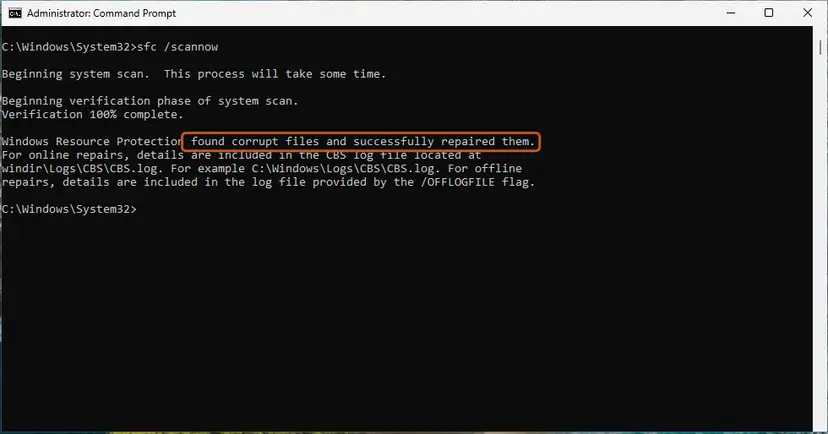
It worked if: DISM ends with "The restore operation completed successfully", SFC finds no problems or repairs them, and Fix 1 then runs without red lines for Settings and Store.
If not: If DISM still fails or Fix 1 still prints errors, go to Fix 3, then Fix 4.
Fix 3. Sign in with a new local administrator account
10 minutesLow riskFixes 1 and 2 ran without errors but Start or Settings still fails.
App registrations and shell settings are stored per user. A new account gets fresh ones, so it shows at once whether the damage is in your profile or in Windows itself. Microsoft's helpers suggest this for the code when repairs from inside Windows do not hold.
- Open an administrator PowerShell or Command Prompt from Task Manager, as in Fix 1. Settings is not needed.
- Run the first command below with a name and password of your choice. It creates a local account.
- Run the second command. It makes the new account an administrator.
- Sign out with Ctrl + Alt + Delete > Sign out and sign in to the new account.
- Click Start, open Settings and try
ms-settings:in Win + R.
Create a local administrator account (as administrator)
net user FixTest YourPassword1 /add
net localgroup administrators FixTest /add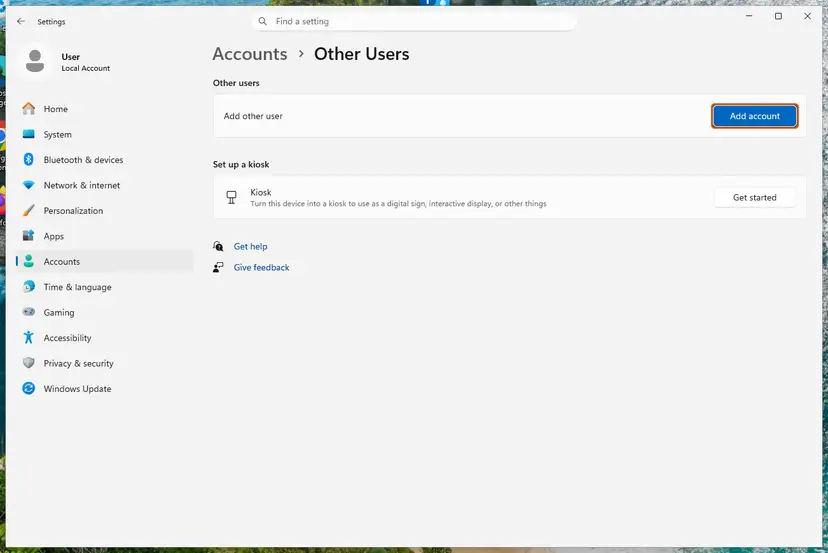
Settings route with screenshots: Create a new user account to test a problem
It worked if: In the new account, Start, search, Settings and Store open without File system error (-2144927439).
If not: If the new account works, copy your files from C:\Users\your name to it and keep using it. If it fails too, go to Fix 4.
Fix 4. Undo the last crash or update from the recovery screen
20 to 40 minutesRead the warningThe error started right after a blue screen, a forced shutdown or a Windows update, and Fixes 1 to 3 did not help.
When Settings itself fails, the Recovery page cannot be reached from Windows. The blue recovery screen has its own System Restore and Uninstall Updates, which put Windows back to a state before the damage. A Windows MVP on Microsoft Q&A gives this order for the code after a blue screen: System Restore first, then removing recent updates.
- Hold Shift and select Restart on the sign-in screen or in Ctrl + Alt + Delete > Power. If that fails, turn the PC off during start-up twice; the third start opens the recovery screen.
- Select Troubleshoot > Advanced options > System Restore, choose your account and enter its password.
- Pick a restore point dated before the first error and finish the wizard. Do not turn the PC off while it runs.
- If there is no restore point or it fails, go back to Advanced options and select Uninstall Updates > Uninstall latest quality update.
- Start Windows and try Start and Settings again.
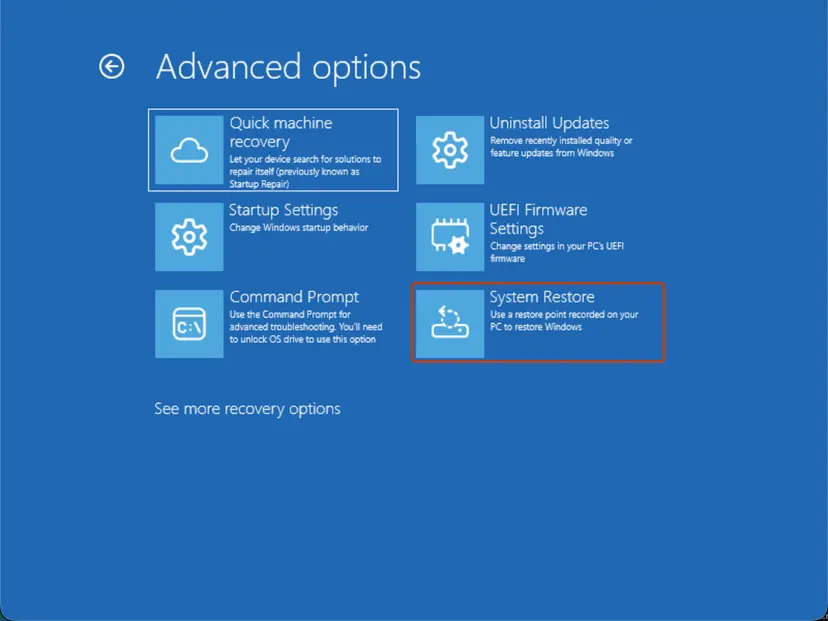
System Restore removes programs, drivers and updates installed after the restore point; your documents and pictures stay. Removing an update takes away its security fixes until it installs again. Note what you installed recently, and have your BitLocker recovery key from your Microsoft account ready before you start.
Both routes step by step: Undo recent changes with System Restore and How to uninstall a Windows update
It worked if: Windows starts with a message that the restore or removal completed, and Start and Settings open normally.
If not: If both fail or change nothing, go to Fix 5.
Fix 5. Repair Windows and keep your files and apps
60 to 90 minutesLow riskFixes 1 to 4 did not help, or Start, Settings and Store still fail in every account.
A repair install lays a complete, current copy of Windows over the damaged one, including the built-in app packages and their repository, while it keeps your files, settings and installed programs. It is the step before a reset when there is not enough of Windows left to repair from inside.
- Back up your important files first: Back up your files (Windows Backup, File History, Time Machine)
- On another working PC or in a browser, download the Windows installation media from Microsoft for your version, Windows 11 or Windows 10.
- On the broken PC, open the ISO or USB stick in File Explorer and run
setup.exe. - Choose Keep personal files and apps and let setup finish. The PC restarts several times.
- If Settings opens on Windows 11, you can use Settings > System > Recovery > Reinstall now instead.
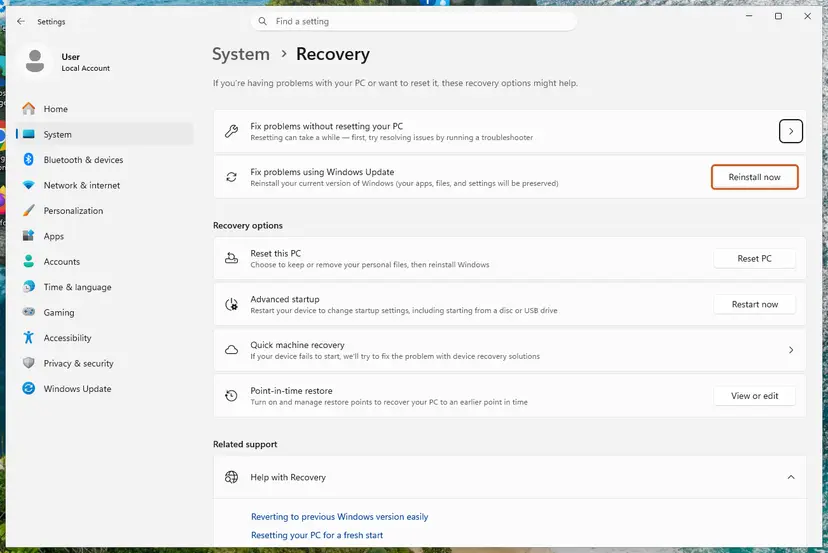
Both ways, step by step: Reinstall Windows without losing files
It worked if: Windows starts after the repair with your files and programs, and Start, Settings and Microsoft Store open without the error.
If not: Read "If File system error -2144927439 is still there" below.
If File system error -2144927439 is still there
The box itself writes nothing you can read. The app installer does keep a log, and it names the package that fails to register.
- Press Win + R, type
eventvwr.mscand press Enter. - Open Applications and Services Logs > Microsoft > Windows > AppXDeployment-Server > Microsoft-Windows-AppXDeploymentServer/Operational.
- Look for red Error entries at the time you ran Fix 1. Note the package name and the error code, such as
0x80073CFE. - Also check Windows Logs > Application for errors at the moment the box appeared.
- What to send to support: the code -2144927439, what you clicked when it appeared, the Windows version from winver, the AppX error from the log above and what Fixes 1 to 5 showed.
- Where to ask: Microsoft Support or Microsoft Q&A, since the error comes from Windows itself.
- When it is not software: repeated blue screens, disk read errors or a drive that disappears point to hardware. Back up first, then test the drive with Check a disk for errors (chkdsk) and the memory with How to test your RAM with Windows Memory Diagnostic.
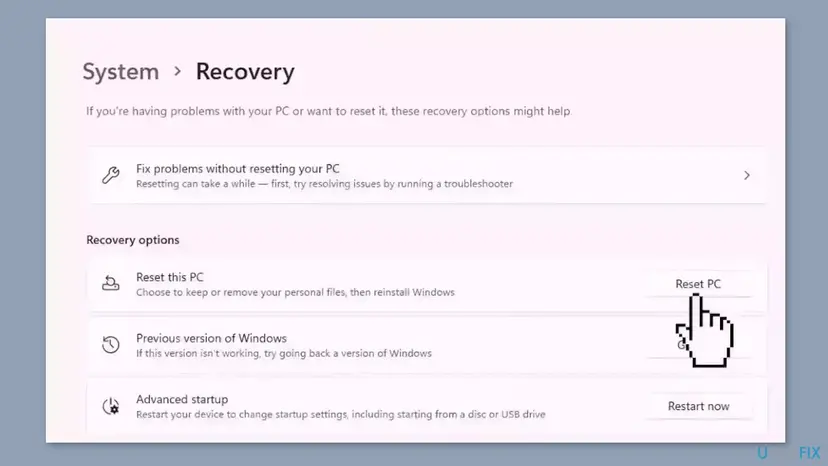
If even a repair install fails, Reset this PC with Keep my files reinstalls Windows but removes your installed programs. Back up first. When Settings will not open, start it from the recovery screen under Troubleshoot > Reset this PC.
How to keep the error from coming back
- Shut down from Start > Power and let updates finish, even when they take long.
- Keep System Protection on and create a restore point before big changes: Undo recent changes with System Restore
- Install Windows updates and restart afterwards, so the built-in apps stay on matching versions.
- Keep your BitLocker recovery key saved in your Microsoft account.
- Do not hold the power button during an update or while Windows is starting.
- Do not use debloat or tweak tools that remove built-in apps such as Settings, Store or the shell host.
- Do not delete folders under
C:\Program Files\WindowsAppsor change their permissions.
Windows 10 left support on 14 October 2025, so it gets no more fixes for shell and app problems. On Windows 10 22H2 the steps above work the same, but an upgrade to Windows 11 is the lasting route.
Frequently asked questions
What is File system error (-2144927439)?
It is the Windows code 0x80270131 written as a negative number. It comes from the Windows shell, the part behind Start, search and the links into Settings, not from your disk. You see it when Start, Settings, an ms-settings: link or Microsoft Store cannot be started because their app registration is broken. Start with Fix 1 and register those apps again in an administrator PowerShell.
Why does an ms-settings: link show a file system error?
Because ms-settings: addresses are opened by the Settings app, a built-in app package called windows.immersivecontrolpanel. When its registration is damaged, Windows has no app to hand the address to, so the shell shows File system error (-2144927439) instead. The first command in Fix 1 registers exactly that package again. If it fails with a red error, repair Windows with DISM and SFC (Fix 2) and run it once more.
How can I fix it when Start and Settings do not open at all?
Use Task Manager, which still works. Press Ctrl + Shift + Esc, select Run new task, type powershell, tick Create this task with administrative privileges and select OK. From that window you can run every command on this page: Fix 1 to register the apps, Fix 2 for DISM and SFC, and Fix 3 to create a test account. For System Restore, hold Shift while you select Restart on the sign-in screen.
What does 0x80073CFE mean together with this error?
0x80073CFE means the app package repository is corrupted: the store of records Windows keeps about installed app packages. A reader on Microsoft Q&A saw it in DISM and SFC results along with -2144927439. While the repository is damaged, registering Settings or Store fails. Run DISM and SFC (Fix 2), from the recovery screen if needed, then Fix 1 again. If that fails, a repair install (Fix 5) rebuilds it.
Is my hard drive or file system damaged?
Almost certainly not. The words "file system" are misleading: the code comes from the Windows shell. If your documents and pictures open and copy normally, the drive and its NTFS file system are fine. Check the disk only when files also fail to open, File Explorer shows read errors, or blue screens keep coming back. In that case, back up first and then run CHKDSK.
Will restarting File Explorer fix it?
Sometimes, for a short time. Restarting Windows Explorer in Task Manager reloads the taskbar and the shell, which can bring back a frozen Start menu. It does not repair a broken app registration, so the error usually returns after the next click on Settings or after a restart. Use it as a quick check, then do Fix 1 for a lasting repair.
Will these fixes delete my files or programs?
Fixes 1, 2, 3 and 5 keep your files and installed programs. Fix 4 keeps your files, but System Restore removes programs and drivers installed after the restore point, and removing an update takes away its fixes until it installs again. Only Reset this PC, the last step below the fixes, removes installed programs. Back up before Fix 4 or Fix 5.
What about file system error -2147219195?
That is a different code in the same kind of box: in hex it is 0x80040905. We did not research it for this page, so we give no fixes for it here. Readers usually meet that family of codes when Photos or another built-in app opens a picture. For a Photos or Media Player error, see the guide to File system error (-2147416359), which covers repairing and resetting those apps.
Does this error happen on Windows 10 and Windows 11?
Yes. Most reports on Microsoft Q&A and Reddit come from Windows 10, where Start and Settings stop together. The same fixes work on Windows 11; where a menu differs, the steps give both names. Windows 10 left support on 14 October 2025, so after you fix it, an upgrade to Windows 11 is the lasting route on that version.
I searched in another language, for example "не работает". Is this the same error?
Yes. The code -2144927439 is the same in every language of Windows, and so are the fixes; only menu names are translated. "Не работает" means "does not work", which is what readers say about Start and Settings with this error. This page is in English only, but the order is the same for everyone: register the built-in apps again first (Fix 1).
Sources
- Microsoft Q&A: file system error(-2144927439) (Start, Settings and Store do not open; restart Explorer, SFC and DISM, register built-in apps again with PowerShell) (learn.microsoft.com)
- Microsoft Q&A: How to fix file system error -2144927439 and 0x80073cfe (after a blue screen; ms-settings: fails, package repository corrupted; repairs from the recovery screen advised) (learn.microsoft.com)
Did this fix work?
One click, no account. It tells the next reader which guides are worth their time.
Questions and experiences: fix File System error (-2144927439) in Windows
Still broken, or found a fix we did not cover? Ask here: members and our editors answer. Reading is open; writing needs a free account.
…