
How to fix KernelBase.dll causes application crashes in Windows?

Prefer to fix it yourself? The manual steps follow.
- 9methods
- 5 minutes to 2 hours
- Intermediate
Applies to Windows 11 and Windows 10: programs and games that crash or close with "Faulting module name: KERNELBASE.dll" in Event Viewer, and the RegSvr32 message about KERNELBASE.dll
9 methods in this guide
- What the error means
- The regsvr32 message
- Causes, ranked
- The fixes
- 1. Read the crash log
- 2. Update or reinstall the app
- 3. Repair Visual C++ and .NET
- 4. Verify game files
- 5. Compatibility mode
- 6. Clean boot test
- 7. Repair system files
- 8. Test memory
- 9. Repair install of Windows
- Still crashing: what to send
- Prevent it
- FAQ
Hello. Every time I try to play almost any game from my Steam library, the games crash with the faulting module KERNELBASE.dll. I tried reinstalling the games in question, but to no avail: I still get constant crashes, sometimes even on launch. Any tips would be greatly appreciated.
When Event Viewer names KERNELBASE.dll as the faulting module, a program crashed while it was using this core Windows file, and the file itself is almost never broken. The fix is in the crashing program: its version, its Visual C++ or .NET runtime, its game files or something that hooks into it. Start by reading the faulting application and the exception code in Event Viewer.
KERNELBASE.dll is a core Windows file that almost every program uses, so it shows up in crash logs when the program itself fails. Open Event Viewer and read the faulting application and the exception code (Fix 1). Then update or cleanly reinstall that program (Fix 2) and repair its Visual C++ or .NET runtime (Fix 3). Games: verify the files (Fix 4). Do not download or re-register KERNELBASE.dll.
| Error | Event Viewer, Application Error: "Faulting module name: KERNELBASE.dll", with the path C:\Windows\System32\KERNELBASE.dll and an exception code such as 0xc0000005 or 0xe06d7363. |
|---|---|
| Where it appears | In Event Viewer > Windows Logs > Application, as an Error entry from the source Application Error, right after a program or game closes, freezes or fails to start. |
| Main cause | The crashing program: an outdated or damaged version, a missing Visual C++ or .NET runtime, damaged game files, or an add-on that hooks into it. Autodesk lists the Windows image, drivers, program prerequisites, certificates and virtualization. |
| Fastest fix | Read the faulting application and exception code (Fix 1), then update or reinstall that program (Fix 2). |
| Also written as | kernelbase.dll crash, appcrash kernelbase.dll, faulting module kernelbase.dll, faulty module kernelbase.dll, fault module name kernelbase dll, kernel base dll error, kernalbase dll |
| What the file is | A Windows system file added in Windows 7 and Windows Server 2008 R2. Microsoft moved functions from kernel32.dll and advapi32.dll into it, and those files now forward calls to it. |
| Affects | Every Windows version since Windows 7, including Windows 11 and Windows 10. Windows 10 left support on 14 October 2025. |
| Vendor status | Not one Windows bug. App makers such as Autodesk treat it as a crash of their own program and fix it with updates, prerequisite repairs and clean reinstalls. |
| Time to fix | 5 minutes to read the log. 10 to 30 minutes for a reinstall or runtime repair. 1 to 2 hours for a repair install of Windows. |
Facts checked on 15 October 2026. Steps written for Windows 11 (25H2 and 26H2) and Windows 10 22H2.
What "Faulting module name: KERNELBASE.dll" means
KERNELBASE.dll is part of Windows. Microsoft created it in Windows 7 and moved basic functions into it from kernel32.dll and advapi32.dll. Since then, almost every program calls it to open files, manage memory and report errors. When a program crashes, the last code that ran is often inside KERNELBASE.dll, so Windows names it as the faulting module.
That is why one Windows file can appear in crashes of games, Logitech Gaming Software, Autodesk Inventor, a video switcher app and a server service. The file is the place where the crash was reported, not the reason for it.
A real entry from a Windows 11 PC (Microsoft Q&A report)
Faulting application name: LCore.exe, version: 9.4.49.0
Faulting module name: KERNELBASE.dll, version: 10.0.22621.3085
Exception code: 0xc0000005
Fault offset: 0x0000000000026d9e
Faulting application path: C:\Program Files\Logitech Gaming Software\LCore.exe
Faulting module path: C:\Windows\System32\KERNELBASE.dll- File
KERNELBASE.dll, with a language filekernelbase.dll.muiin the language folder, for exampleC:\Windows\System32\en-US- Location
C:\Windows\System32\KERNELBASE.dll. 32-bit programs use the copy inC:\Windows\SysWOW64- Version
- Always the same as your Windows build, for example 10.0.22621.3085 on the Windows 11 PC above
- Fault offset
- A position inside the file, written as
KERNELBASE.dll+c1b6ain some crash tools. It tells developers where the crash was reported and does not identify a fix on its own
Why regsvr32 KERNELBASE.dll says the entry-point DllRegisterServer was not found
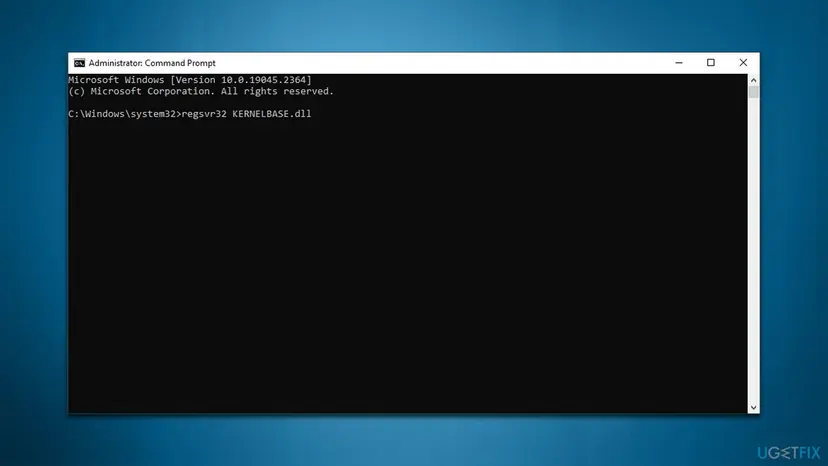
Many guides, including the old version of this one, tell you to run regsvr32 KERNELBASE.dll. It cannot work. Regsvr32 registers COM components, and KERNELBASE.dll is not one, so the RegSvr32 window always answers with the same message.
The RegSvr32 window
The module "KERNELBASE.dll" was loaded but the entry-point DllRegisterServer was not found.

Make sure that "KERNELBASE.dll" is a valid DLL or OCX file and then try again.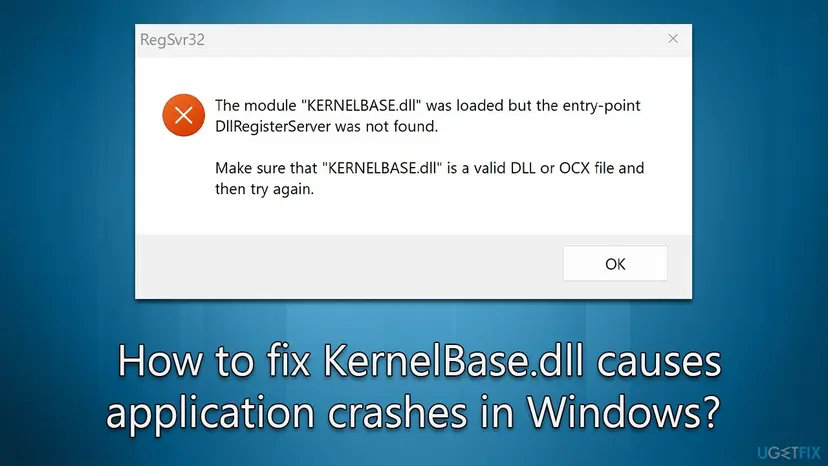
- What Microsoft's support specialist said: the message "typically indicates that you cannot manually register the kernelbase.dll file", which is "expected behavior for system DLLs like kernelbase.dll".
- Nothing changed. Regsvr32 stopped before writing anything, so you do not need to undo it.
- The same message for other Windows files. ExplorerFrame.dll gives the same answer, for the same reason: the ExplorerFrame.dll DllRegisterServer message.
What really causes KernelBase.dll crashes, ranked
Most often the crashing program is outdated, damaged or missing a runtime it needs. Less often another program hooks into it: an overlay, a mod or security software. Rarely the Windows copy of KERNELBASE.dll or the PC's memory is at fault, and then many unrelated programs crash, not one.
| Cause | How often | How to tell | Fix |
|---|---|---|---|
| The crashing program is outdated or its files are damaged | Most often | One program crashes, usually at start or on one action | Fix 2 |
| A missing or damaged Visual C++ or .NET runtime | Often | Exception code 0xe06d7363 or 0xe0434352; Autodesk lists program prerequisites as a cause | Fix 3 |
| Damaged game files, mods or a game launcher problem | Often, for games | The faulting application is a game .exe | Fix 4 |
| The program does not cope with your Windows version or needs more rights | Sometimes | An older program, or it works on another PC with older Windows | Fix 5 |
| An overlay, mod, injector or security tool hooks into the program | Sometimes | Exception code 0xc0000005 and the crash stops in a clean boot | Fix 6 |
| Damaged Windows system files | Rarely | Many programs crash and SFC reports repairs | Fix 7, Fix 9 |
| Unstable memory or overclock | Rarely | Random 0xc0000005 crashes in many programs, sometimes blue screens | Fix 8 |
How to fix KernelBase.dll application crashes
Fix 1 takes five minutes and tells you which program to fix. Fix 2 to Fix 4 solve most crashes of one program or game. Fix 5 to Fix 9 are for crashes that survive those, ordered from the cheapest to the last resort.
| What you see or what your PC has | Start with |
|---|---|
| You do not know which program crashed or what the code is | Fix 1 |
| One program crashes, any exception code | Fix 2 |
| Exception code 0xe06d7363 or 0xe0434352 | Fix 3 |
| A game from Steam, Epic Games or GOG crashes | Fix 4 |
| An older program crashes on Windows 11 | Fix 5 |
| Exception code 0xc0000005 and you use overlays, mods or tuning tools | Fix 6 |
| Many different programs crash | Fix 7, then Fix 8 |
| You ran regsvr32 KERNELBASE.dll and got the DllRegisterServer message | Nothing to fix: read the regsvr32 section, then Fix 1 |
Fix 1. Read the faulting application and the exception code in Event Viewer
5 minutesNo riskA program or game crashed and you found, or were told about, KERNELBASE.dll in a crash log.
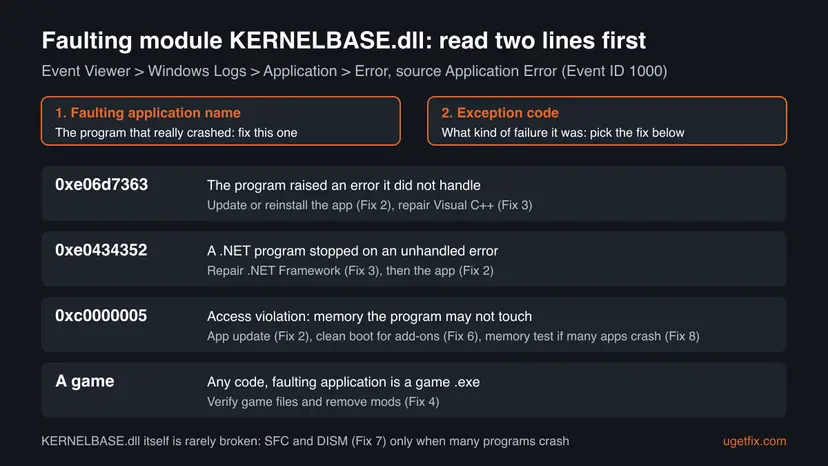
KERNELBASE.dll is only where the crash was reported. The same entry names the program that really failed and the type of failure, which decide every next step.
- Make the program crash once more, so the newest entry is the right one.
- Press Win + R, type
eventvwr.mscand press Enter. - Open Windows Logs > Application.
- Select the newest Error entry with the source Application Error at the time of the crash.
- Read Faulting application name and Faulting application path: this is the program to fix.
- Read Exception code and compare it with the chart in "What the error means".
- Copy the whole entry with Copy > Copy details as text and keep it for support.
| Exception code | What it means | Start with |
|---|---|---|
| 0xc0000005 | Access violation: the program used memory it may not use | Fix 2, Fix 6, Fix 8 |
| 0xe06d7363 | The program raised a C++ error and did not handle it | Fix 2, Fix 3 |
| 0xe0434352 | A .NET program stopped on an error it did not handle | Fix 3, Fix 2 |
It worked if: You know which program crashed, where it is installed and the exception code.
If not: If no Application Error entry appears, the program closed without crashing: check its own log folder or contact its maker. Otherwise continue with Fix 2.
Fix 2. Update the crashing program, then reinstall it cleanly
10 to 30 minutesLow riskEvent Viewer names one program, and other programs work.
A bug in one version or a damaged install file is the most common reason one program fails inside KERNELBASE.dll. App makers fix such crashes in updates, and Autodesk's own answer for Inventor is an update and a clean uninstall.
- Open the program's own update option, or download the newest version from its maker's site.
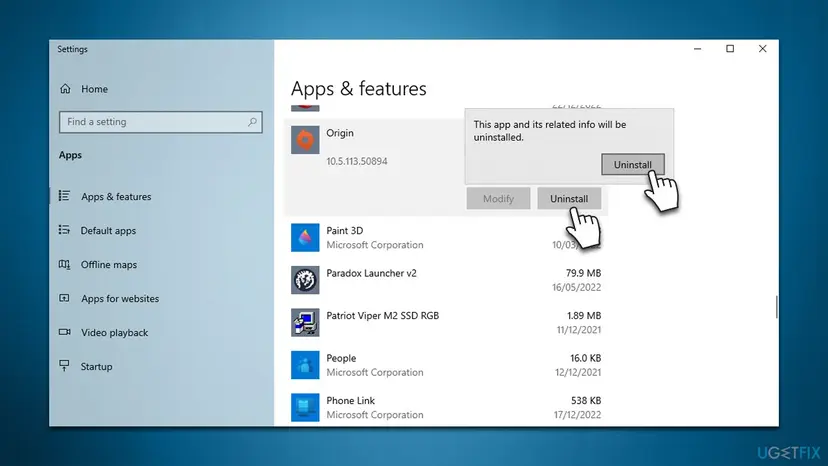
- If it still crashes, open Settings > Apps > Installed apps (Windows 11) or Settings > Apps > Apps & features (Windows 10).
- Select ... next to the program (Windows 11) or the program itself (Windows 10), then Uninstall.
- Restart the PC so no file of the program stays in use.
- Install the newest version from the maker's site and start it again.
For a Microsoft Store app, try Repair and then Reset in its advanced options first: How to repair or reset an app in Windows. Some makers publish a clean-uninstall guide that also removes settings folders; use it when a normal reinstall does not help.
It worked if: The program starts and the action that crashed it works, with no new Application Error entry.
If not: If the code was 0xe06d7363 or 0xe0434352, repair the runtimes in Fix 3. For a game, go to Fix 4.
Fix 3. Repair Microsoft Visual C++ and .NET Framework
15 to 30 minutesLow riskThe exception code is 0xe06d7363 or 0xe0434352, or several programs from different makers crash.
Most Windows programs are built on Visual C++ or .NET runtimes, and Autodesk lists program prerequisites as a source of KERNELBASE.dll crashes. A damaged or missing runtime makes the program fail before its own code can run.
- Open Programs and Features. Type control panel in the search box on the taskbar and select Control Panel. Select Programs > Programs and Features.
- Find the installed versions. Look for the entries that start with Microsoft Visual C++. Each one shows a year and an architecture, x64 or x86. Several entries side by side are normal: older versions stay installed next to newer ones.
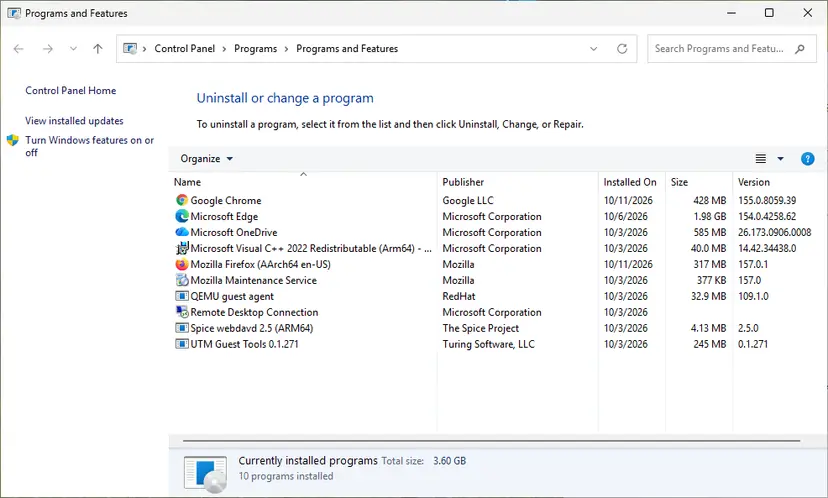
Each Visual C++ version is its own entry in Programs and Features. Screenshot: Windows 11 26H2. - Repair each Visual C++ entry. Right-click an entry and select Change, then select Repair in the window that opens. Do the same for every Microsoft Visual C++ entry.
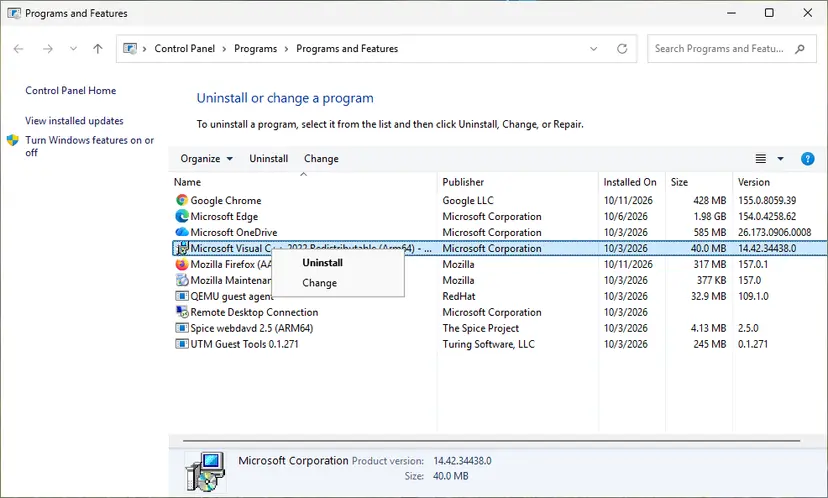
Right-click the entry and select Change to reach the repair option. Screenshot: Windows 11 26H2. - Install the latest supported version. Download the latest Visual C++ v14 Redistributable from Microsoft: Visual C++ Redistributable latest supported downloads and run it. On a 64-bit PC install both X64 and X86, because 32-bit programs need the x86 package. On an ARM64 PC install ARM64. This one version serves programs built with Visual Studio 2017 to 2026.
- Run the .NET Framework Repair Tool. Download the Microsoft .NET Framework Repair Tool and run NetFxRepairTool.exe. The wizard looks for setup problems, asks for your consent before it applies fixes, then repairs the installed .NET Framework versions. The tool is in English only.
- Turn on .NET Framework 3.5 if a program asks for it. Select Start, search for Windows Features and open it. In Turn Windows features on or off, select the .NET Framework 3.5 (includes .NET 2.0 and 3.0) check box and select OK. Windows downloads the files, so stay online.
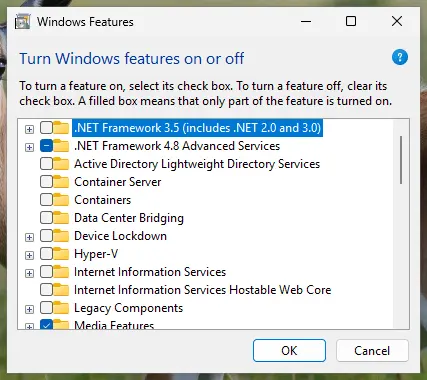
.NET Framework 3.5 is turned on in Windows Features. Screenshot: Windows 11 26H2. - Restart and test. Restart the PC and start the program that showed the error.
These steps were written for Windows 11 25H2 and 26H2, Windows 10 22H2. The full page with the other versions and what each result means: How to repair Microsoft Visual C++ Redistributable and .NET Framework
Autodesk also points to Microsoft's .NET Framework Repair Tool for its products. Restart the PC after the repairs, then start the program that crashed.
It worked if: The repairs finish without errors and the program starts after a restart.
If not: If it is a game, continue with Fix 4. Otherwise try compatibility settings in Fix 5.
Fix 4. Verify game files and remove mods
10 to 40 minutesLow riskThe faulting application is a game, from Steam, Epic Games, GOG or another launcher.
Reinstalling a game often keeps old mods, config files and shader caches. Verifying compares every file with the launcher's copy and replaces what is damaged or changed.
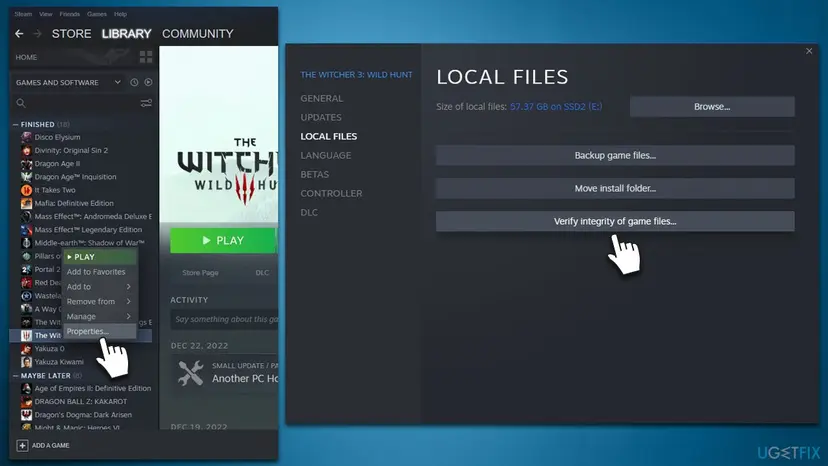
- Restart and open Steam. Restart your computer and launch Steam.
- Open the game's menu. Right-click the game in your Library, or open the game's Library page and select the gear icon on the far right.
- Open Properties. Select Properties in the menu.
- Verify the files. Select the Installed Files tab and select Verify integrity of game files.
- Wait for the result. Steam checks the game's files. This can take several minutes.
These steps were written for Steam on Windows. The full page with the other versions and what each result means: How to verify game files in Steam, Epic Games, Xbox app, EA app, Battle.net and GOG Galaxy
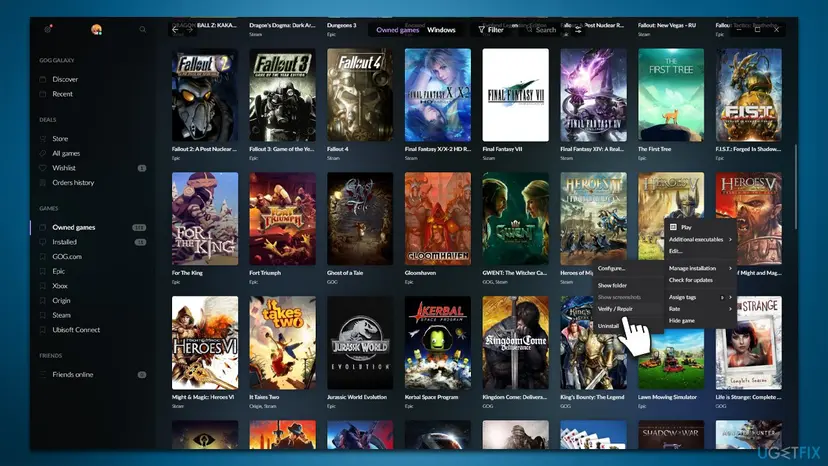
- Move mods out of the game folder or turn them off in the mod manager.
- Turn off overlays for one test: the Steam overlay, Discord overlay and any FPS counter.
- Start the game. If it works, add mods back one at a time.
It worked if: The launcher reports fixed or verified files and the game starts without a new crash entry.
If not: If almost every game crashes, as in the reader's question, the cause is shared: go to Fix 6 and Fix 8.
Fix 5. Run the program in compatibility mode or as administrator
5 to 10 minutesLow riskAn older program crashes, or the maker has not tested it on your Windows version.
A Microsoft support specialist suggested the compatibility settings for KERNELBASE.dll crashes. A user later reported that ATEM Software Control stopped crashing after the compatibility helper set it to Windows 8.
- Run the program as administrator once. Right-click the program in the Start search results, or right-click its shortcut, and select Run as administrator. Select Yes when Windows asks for permission. If the program now works, it only needed administrator rights.
- Open the program's properties. If the program still fails, right-click its shortcut or its .exe file and select Properties.
- Open the Compatibility tab. Select the Compatibility tab. Every setting on this tab applies to this one program only.
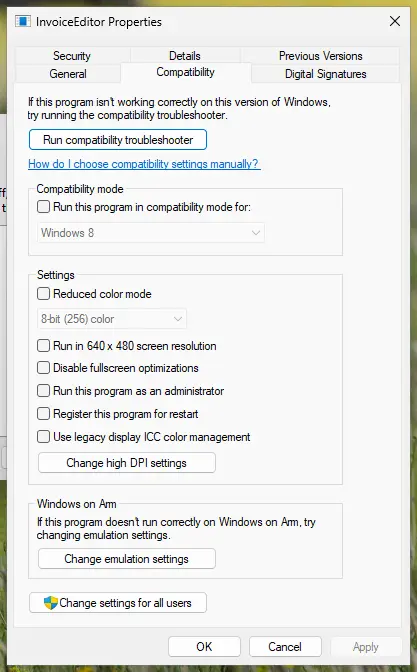
The Compatibility tab. Our test PC runs Windows on Arm, so it has one extra section at the bottom. Screenshot: Windows 11 26H2. - Turn on compatibility mode. Select the Run this program in compatibility mode for check box. In the list below it, select the version of Windows the program was made for.
- Make it always run as administrator. Only if step 1 helped: select the Run this program as an administrator check box. Windows will then ask for permission every time the program starts.
- Save and test. Select OK and start the program again. If it does not help, come back to this tab and try another version of Windows in the list.
- Run the compatibility troubleshooter. If no setting helps, open Start > Settings > System > Troubleshoot > Other troubleshooters. Find Program Compatibility Troubleshooter, select Run and follow the instructions on the screen.
These steps were written for Windows 11 25H2 and 26H2. The full page with the other versions and what each result means: How to run a program as administrator or in compatibility mode
Try compatibility mode first and test. Turn on Run this program as an administrator only if the program writes to protected folders, and turn it off again if it changes nothing.
It worked if: The program starts with the new setting and stays open.
If not: Put the settings back as they were and continue with Fix 6.
Fix 6. Find a conflicting program with a clean boot
20 to 40 minutesLow riskThe exception code is 0xc0000005, or several programs crash and you use overlays, RGB, tuning or security tools.
Overlays, injectors and security tools load their own code into other programs. If that code fails, Windows still logs the crash in KERNELBASE.dll of the program that was running.
- Open System Configuration. Select Search on the taskbar, type msconfig and select System Configuration from the results.
- Hide Microsoft services. On the Services tab, select the Hide all Microsoft services check box. Only services from other companies stay in the list.

With Hide all Microsoft services ticked, only third-party services stay in the list. Screenshot: Windows 11 26H2. - Disable the remaining services. Select Disable all, then select Apply.
- Open Task Manager. On the Startup tab of System Configuration, select Open Task Manager.

The Startup tab only links to Task Manager. Screenshot: Windows 11 26H2. - Disable the startup apps. On the Startup apps tab in Task Manager, select each item whose status is Enabled and select Disable. Write down or take a screenshot of the items you disable: you need the list to turn them back on.

Select an app, then Disable. Screenshot: Windows 11 26H2. - Confirm the changes. Close Task Manager. On the Startup tab of System Configuration, select OK.
- Restart and test. Restart the PC. Windows now starts in a clean boot environment: try again the thing that failed (run the app, install the update, uninstall the program).
These steps were written for Windows 11 25H2 and 26H2. The full page with the other versions and what each result means: How to perform a clean boot in Windows
- Start the program that crashed. If it works, the cause is a service or startup app you turned off.
- Turn half of them back on, restart and test again.
- Repeat with the half that brings the crash back until one item remains, then update or uninstall that program.
If the item is security software, update it or add the program's folder as an exclusion in that tool. To test with it paused for a few minutes, use Turn off Microsoft Defender protection for a moment and turn protection back on right after.
It worked if: The program works in the clean boot, and you find the one service or startup app that breaks it.
If not: If it crashes even in the clean boot, the cause is in Windows or the hardware: go to Fix 7 and Fix 8.
Fix 7. Repair Windows files with DISM and SFC
20 to 30 minutesNo riskMany programs crash, or the crashes started right after a Windows update.
KERNELBASE.dll is a protected Windows file. DISM repairs the store Windows keeps its files in, and SFC then replaces a damaged KERNELBASE.dll with the copy for your exact build. Autodesk names the Windows image as one source.
- Open an elevated command window. Right-click Start and select Terminal (Admin), or type cmd in the search box, right-click Command Prompt and select Run as administrator. Select Yes when Windows asks for permission.

Search for cmd and choose Run as administrator. Screenshot: Windows 11 26H2. - Run DISM first. Type the command below and press Enter. DISM downloads clean copies of damaged components from Windows Update, so it can take several minutes. Wait until it says The operation completed successfully.
DISM.exe /Online /Cleanup-Image /RestoreHealth
DISM /RestoreHealth running. Screenshot: Windows 11 26H2. - Run System File Checker. In the same window, type the command below and press Enter. Do not close the window until the verification reaches 100%.
sfc /scannow
sfc /scannow at 100%. Screenshot: Windows 11 26H2. - Read the result and restart. Compare the last message with the table below this guide, then restart the PC so that repaired files are loaded.

The result line tells you what SFC did. Screenshot: Windows 11 26H2.
These steps were written for Windows 11 24H2 and 25H2. The full page with the other versions and what each result means: Run DISM and SFC to repair Windows system files
The file must match your exact Windows build. A copy from a DLL site can be the wrong version, unsigned or infected. Autodesk mentions copying it from a working PC only for advanced users, at their own risk; SFC does the same job safely.
It worked if: SFC reports no integrity violations or that it repaired files, and the programs start after a restart.
If not: If SFC finds nothing, as in the Logitech case on Microsoft Q&A, Windows files are not the cause: go back to Fix 2 for that program, or test the memory in Fix 8.
Fix 8. Test the memory and undo overclocking
20 minutes to 1 hourLow riskMany unrelated programs crash with 0xc0000005 at random moments, sometimes with blue screens.
An access violation can come from bad or unstable memory, which corrupts data in any program. Windows Memory Diagnostic checks the RAM outside Windows.
- Open Windows Memory Diagnostic. Press Windows + R, type mdsched.exe and select OK. You can also search for Windows Memory Diagnostic and open it from the results.
- Choose when to test. Select Restart now and check for problems (recommended) to test right away. Select Check for problems the next time I start my computer if you want to finish your work first: the test then runs at the next start.
- Let the test run. The PC restarts into a blue screen that shows the progress of the test. You do not have to do anything. When the test ends, the PC restarts by itself and Windows loads.
- Look for the notification. Sign in. After a short while Windows shows a notification with the result, also when no errors were found. If you missed it, read the result in Event Viewer.
- Open the System log. Press Windows + R, type eventvwr and select OK. In Event Viewer, expand Windows Logs and select System.
- Find the result. Right-click System and select Find. Type MemoryDiagnostics-Results and press Enter. Select the event that is found: its text says whether the test detected errors.
These steps were written for Windows 11 25H2 and 26H2, Windows 10 22H2. The full page with the other versions and what each result means: How to test your RAM with Windows Memory Diagnostic
- Overclocked CPU, GPU or memory: set the clocks back to default in the BIOS or the tuning tool and test again.
- Users report that turning off the memory profile (XMP or EXPO) in the BIOS stopped game crashes. This is a report, not a Microsoft statement; try it only as a test.
It worked if: The memory test reports no errors, or the crashes stop with default clocks.
If not: If the test finds errors, the memory needs replacing: see "If programs still crash" below. If not, try Fix 9.
Fix 9. Reinstall Windows in place and keep your files and apps
1 to 2 hoursRead the warningSFC cannot repair files, or many programs still crash after Fix 2 to Fix 8.
A repair install replaces every Windows file, KERNELBASE.dll included, with a fresh copy of your version, while it keeps your files, settings and apps.
A repair install keeps files and apps when you choose to keep them, but a power cut or a wrong choice can cost data. Copy your documents to an external drive or the cloud first: Back up your files (Windows Backup, File History, Time Machine)
- Open Recovery in Settings. Open Settings > System > Recovery. Next to Fix problems using Windows Update, select Reinstall now. This keeps your apps, files and settings.

Fix problems using Windows Update reinstalls the current version and keeps apps, files and settings. Screenshot: Windows 11 26H2. - Start the reinstall. Choose whether the PC may restart on its own 15 minutes after the installation, then select OK.
- Wait and restart. Windows Update downloads and installs a repair copy of your current Windows version. Keep the PC plugged in and online, and restart it when asked.
- If that did not help: Reset PC. Back in Settings > System > Recovery, next to Reset this PC, select Reset PC. This keeps your personal files but removes installed apps and settings.
- Choose Keep my files. Select Keep my files. Do not select Remove everything.
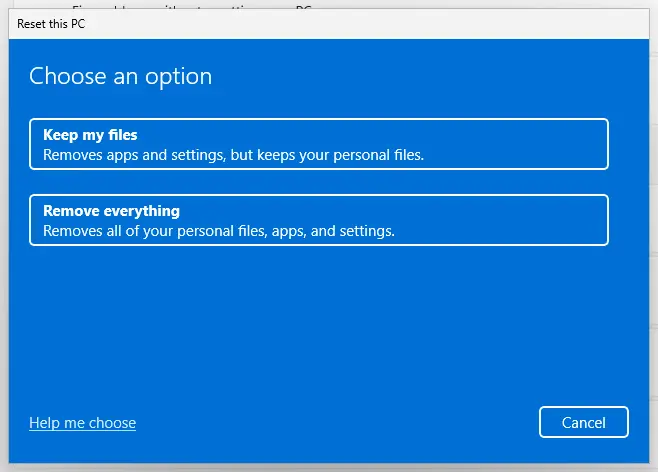
Keep my files removes apps and settings but keeps personal files. Screenshot: Windows 11 26H2. - Choose where Windows comes from. Select Cloud download to download a fresh copy of Windows, or Local reinstall to use the files already on the PC (faster, but may not include the latest updates).
- Reset. Review the summary and select Reset. The PC restarts several times.
These steps were written for Windows 11 22H2 and later. The full page with the other versions and what each result means: Reinstall Windows without losing files
It worked if: Windows starts after several restarts, your files and apps are still there, and the programs no longer crash.
If not: If one program still crashes on a fresh Windows, the problem is in that program: send the crash entry to its maker.
If programs still crash with KERNELBASE.dll
Stop changing things and collect what the program's maker needs. Their support can match the exception code and fault offset with their own crash data, which no general guide can do.
- Copy the full Application Error entry from Event Viewer (Fix 1).
- Press Win + R, type
winver, press Enter and note the version and OS build. - Note the program version and what you did right before the crash.
- Look for a log or crash dump folder of the program itself, often in
%LOCALAPPDATA%under the maker's name. - Send all of this to the program's maker, or ask on Microsoft Q&A if many programs crash.
- When it is hardware: memory errors in Fix 8, blue screens, or files that break again after repairs. Check the disk with Check a disk for errors (chkdsk) too.
- When it is the program: it crashes on a fresh Windows or on another PC with the same steps. Only the maker can fix that.
How to avoid KernelBase.dll crashes
- Keep programs and games updated. Most KERNELBASE.dll crashes are bugs that makers fix.
- Leave runtimes installed. Do not remove Visual C++ redistributables or .NET versions to tidy the app list.
- Add mods and overlays one at a time, so you know which one to remove when a game starts crashing.
- Never replace or register Windows DLLs by hand. DISM and SFC keep KERNELBASE.dll at the right version.
- Keep restore points on. They let you undo a bad driver or program with Undo recent changes with System Restore.
If you still run Windows 10, plan the move to Windows 11 or an extended security option: Windows 10 left support on 14 October 2025 and no longer gets regular fixes.
Frequently asked questions
What is KernelBase.dll?
KernelBase.dll is a core Windows file in C:\Windows\System32. Microsoft added it in Windows 7 and Windows Server 2008 R2 and moved functions from kernel32.dll and advapi32.dll into it. Programs use it for basic tasks like files, memory and error handling. It is not malware and not part of any one program, so you cannot and should not remove it.
Is KernelBase.dll a virus?
No. The real file is part of Windows and sits in C:\Windows\System32, with a 32-bit copy in C:\Windows\SysWOW64. Its version matches your Windows build. A file with the same name in another folder, such as a download or temp folder, is suspicious and worth a scan with How to scan for malware with Microsoft Defender. A crash entry that names KERNELBASE.dll is not a sign of infection.
How do I fix the KernelBase.dll error in Windows 10 or Windows 11?
The steps are the same on both. Read the faulting application and exception code in Event Viewer (Fix 1). Update or reinstall that program (Fix 2), repair Visual C++ and .NET (Fix 3), and verify game files for games (Fix 4). Only when many programs crash do DISM and SFC (Fix 7) and a memory test (Fix 8) make sense. Windows 10 left support on 14 October 2025.
What does APPCRASH with KernelBase.dll mean?
APPCRASH is the problem event name Windows uses for an application crash, and the details list KernelBase.dll as the fault module. It means the same as "Faulting module name: KERNELBASE.dll" in Event Viewer. The program crashed while running code in that Windows file. Look at the application name in the same report and fix that program first.
Can I download KernelBase.dll to fix the crash?
No. A downloaded copy rarely matches your exact Windows build and can carry malware. Microsoft's own support answer and Autodesk both mention copying it from a working PC with the same Windows version, and Autodesk calls that a step for advanced users at their own risk. DISM and SFC (Fix 7) restore the right copy safely. In most cases the file is not damaged at all.
Should I run regsvr32 KernelBase.dll?
No. It always ends in the RegSvr32 message that the entry-point DllRegisterServer was not found, because KernelBase.dll is not a COM component and needs no registration. A Microsoft support specialist called this expected behavior. The command changes nothing, so you do not need to undo it. Start with the crash log instead (Fix 1).
Why do almost all my Steam games crash with KernelBase.dll?
When many games crash, something they share is the cause, not each game. Repair Visual C++ and .NET (Fix 3), turn off overlays and mods (Fix 4), then use a clean boot to find tools that hook into games (Fix 6). Random crashes in many programs point to memory or an overclock (Fix 8). A user who fixed Microsoft Flight Simulator reported that the right Microsoft account in the Xbox app mattered too.
Batman: Arkham Knight crashes with KernelBase.dll. What should I do?
Treat it like any game crash. Verify the game files in Steam or Epic Games (Fix 4), remove mods, and repair Visual C++ and .NET (Fix 3). Older games can also need compatibility settings (Fix 5). If the faulting application is the game's .exe and nothing helps, send the Event Viewer entry to the game's support. We could not confirm a known Arkham Knight issue with KernelBase.dll.
What does kernelbase.dll+c1b6a mean?
It is the file name plus a fault offset: the position inside KernelBase.dll where the crash was reported. Crash tools write it this way, and Event Viewer shows the same thing in the Fault offset line. The offset helps the program's developers, but it does not point to a fix by itself. Read the faulting application and exception code instead (Fix 1).
What is kernelbase.dll.mui?
It is the language resource file of KernelBase.dll. It holds the text of messages in your Windows language and sits in a language folder such as C:\Windows\System32\en-US. It is a normal Windows file and needs no action on its own. If it is damaged, DISM and SFC (Fix 7) restore it like any other system file.
Sources
- Microsoft Learn: New Low-Level Binaries (KernelBase.dll in Windows 7 and Windows Server 2008 R2) (learn.microsoft.com)
- Microsoft Q&A: Faulting module name: KERNELBASE.dll (crash logs and Microsoft support answer) (learn.microsoft.com)
- Autodesk Support: "Faulting module: KERNELBASE.dll" appears in Event Viewer when Inventor crashes upon opening (autodesk.com)
Did this fix work?
One click, no account. It tells the next reader which guides are worth their time.
Questions and experiences: fix KernelBase.dll causes application crashes in Windows
Still broken, or found a fix we did not cover? Ask here: members and our editors answer. Reading is open; writing needs a free account.
…