How to fix Block “Microsoft account unusual sign-in activity” phishing scam on Windows
Protect your Windows 10 or Windows 11 from phishing scams by blocking "Microsoft account unusual sign-in activity." Expert-tested tips inside for enhanc…
Hi guys. I’m a bit concerned if I have recently received a genuine Microsoft alert on my Outlook account or not. The message says “Unusual sign-in Activity.” Although I see Microsoft account team as a sender, the generated URL address seems suspicious. Besides, the location of the sender is Namibia, which also seems questionable for me. Finally, it’s stated that to save my personal information, my Outlook account will be temporarily blocked, so I should not be able to send or receive emails, BUT I do send emails and receive them. I tried that and received a confirmation from my colleagues that they have just received an email from my account. Could you please help me?
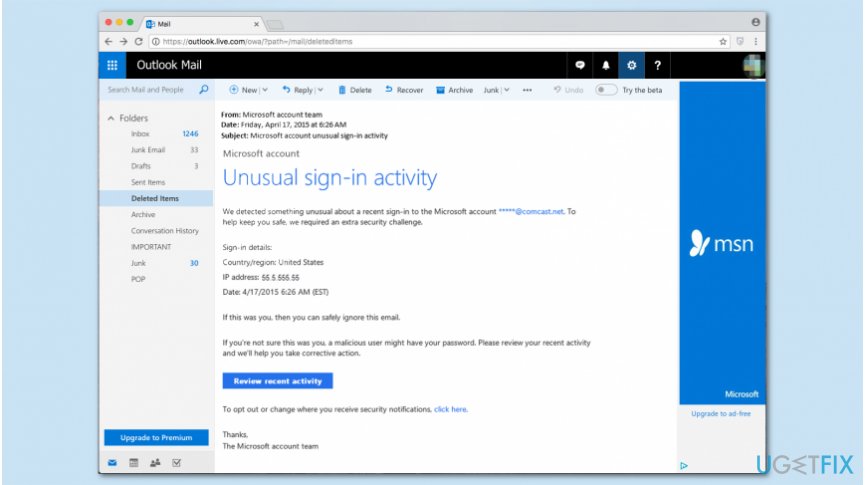
"Microsoft account unusual sign-in activity” is an email letter which informs about a suspicious sing-in to the Outlook account. In most cases, such emails are legitimate and useful to protect you from hackers. However, cybercriminals invented a phishing technique to trick novice users into giving their credentials — they sent fake letter that look extremely similar to the legitimate ones[ref en-1].
"Microsoft account unusual sign-in activity” scam relies on the credulous people who do not pay attention to details. Users should always double check the email address before agreeing to do what is asked or clicking on any contents attached to the letter. Criminals use addresses that are similar but slightly different from the legitimate ones.
Furthermore, you can always contact Microsoft Support directly on their official website, if you wonder whether "Microsoft account unusual sign-in activity” alert is safe or legitimate. Additionally, Outlook often marks safe email addresses with the green shield icon. So, if you cannot see one, do NOT open the email.
How to stop microsoft account unusual sign in activity phishing scam
The scam message says:
From: Outlook Administrator [email protected] Date: March 11, 2017 at 8:46:48 AM EDT Subject: Microsoft account unusual sign-in activity Unusual Activity Detected
We detected something unusual about a recent activity to the Microsoft account. To help keep you safe, we required an extra security challenge. You will need to verify your Microsoft email account below to confirm that the recent activity was yours and to regain access and enjoy our unlimited service.
Verify Now
What happened?
Using a shared computer to access your account. Logging in your microsoft account from blacklisted IP. Not logging off your account after usage.
Thanks for using your Microsoft account to bring the people who matter most together in one place. You can change your connection settings anytime and find more ways to connect at businnesmn.com/content/themes/ fourteen/genericons/font/dirrect.php.
See you online, The Microsoft team
Usually, the link indicated in fake "Microsoft account unusual sign-in activity” message redirects to a counterfeit log-in page to trick you into providing your logins and passwords. Also, there is a possibility that the link can trigger an automatic installation of malware on your system[ref en-2]. So stay away from the content placed in the email!
Finally, once you are sure that "Microsoft account unusual sign-in activity” is a phishing scam, you must protect your email inbox from such fraudulent and potentially dangerous messages. Luckily, Outlook provides a feature to block senders if they are dangerous or annoying.
Instructions showing how to block “Microsoft account unusual sign-in activity” phishing scam on Outlook
Microsoft account unusual sign in activity phishing scam is designed to steal information
In case you have encountered "Microsoft account unusual sign-in activity” phishing messages on Outlook, you can protect your system two ways. The first one is to immediately get a professional malware removal software if you still don't have one. Our top pick would be [d1].
Robust antivirus program is designed to protect your computer from malicious emails that aim to infect your system with malware or lead to fake login sites. Thus, the security software will warn you when criminals are trying to swindle information, money or other sensible data from you.
Another method is to assign the sender of "Microsoft account unusual sign-in activity” email to the blocked list. However, keep in mind that this technique does not protect you against other phishing[ref en-3] scams that might occur right after you get rid of this one. Thus, it would be wise to get a security software.
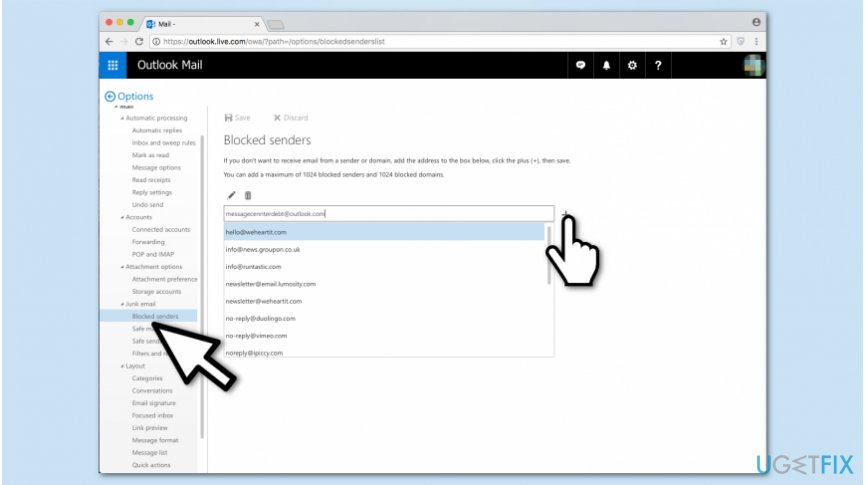
Guide showing how to remove "Microsoft account unusual sign-in activity” phishing scam from Outlook: Microsoft account unusual sign in activity phishing scam removal
Once you change Outlook’s password, sign-in to your account;
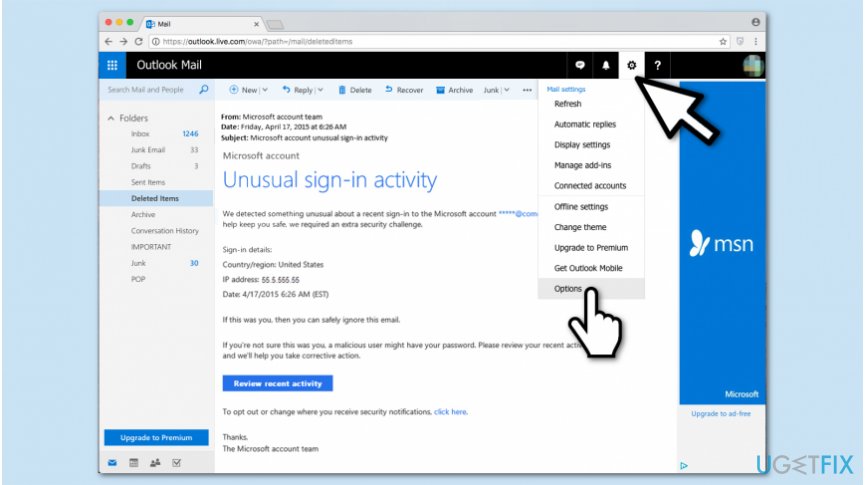
Click the gear icon on the upper right corner of the Outlook homepage;
Press Options. Block microsoft account unusual sign in activity phishing scam
Click Safe and blocked senders;
Select Blocked senders and enter the email address that you want to block in the address bar;
Click Add to list.
If these steps did not help to fix “Microsoft account unusual sign-in activity” scam, please contact a genuine Microsoft account team for additional assistance.
Bottom line
To protect yourself from the 'Microsoft account unusual sign-in activity' phishing scam, always verify the sender's email address and look for safety indicators. If you suspect an email is fraudulent, do not click on any links and contact Microsoft Support directly. If none of these steps work, consider changing your account password and enabling two-factor authentication.
Frequently asked questions
Check the sender's email address for inconsistencies and avoid clicking any links; legitimate notifications will come from Microsoft domains. Always log in to your Microsoft account directly through the official website instead of using links in emails.
Enable Windows Defender and ensure that your firewall is active to block suspicious activities. Additionally, consider using Microsoft Edge with SmartScreen filter enabled to help detect phishing websites.
Yes, you can report phishing emails by forwarding them to Microsoft's phishing email address at [email protected]. Also, ensure to delete the email and avoid any interaction with it.
Julie Splinters is a software and privacy expert who has spent years helping users remove unwanted programs, clean adware-infected browsers, and reclaim their privacy settings. Her speciality is the grey area between legitimate software and potentially unwanted programs — the bundles, toolbars, and browser extensions that users never intentionally installed. Julie's uninstall guides are thorough and sequential, covering manual removal, registry cleanup, and post-removal browser restoration. She also writes about privacy tools and software installation best practices that help users avoid these problems in the first place.



Report an issue
What's wrong with this guide? We review every report and update or remove content.
Report received — thank you. We'll review and fix it.
You need a free account to submit a report.
Be the first to comment