How to fix
Google Chrome Secure Preferences
on Windows
5 minutes Hi! I have run into a problem with Chrome Secure Preferences as it keeps always coming back and started to annoy me. What can I do about it? How to get rid of it? Google Chrome Secure Preferences detection coming back is a problem that occurs after Malwarebytes antivirus detects suspicious content in…

What causes How to fix Google Chrome Secure Preferences?
- Malwarebytes detects suspicious content in Chrome directories
- Presence of adware or browser hijackers
- Older variant of Malwarebytes software in use
- Chrome Sync function is enabled
- Outdated version of Google Chrome
Repairs Windows system files, removes malware, and restores a clean OS state — without reinstalling.
Hi! I have run into a problem with Chrome Secure Preferences as it keeps always coming back and started to annoy me. What can I do about it? How to get rid of it?
Google Chrome Secure Preferences detection coming back is a problem that occurs after Malwarebytes antivirus detects suspicious content in different directories of Chrome web browser such as the home page, settings, and the default search engine.[ref en-3] The suspicious programs mostly appear to be adware, browser hijackers, and similar PUAs.[ref en-1]
Note that, Google Chrome Secure Preferences detection might come back if an older variant of Malwarebytes software has been in use lately. If this is the case, you can solve the irritating problem by installing the latest version of Malwarebytes antimalware.[ref en-2] You can find it on this page. Once you update your antivirus, the issue should be gone.
Additionally, Google Chrome Secure Preferences detection might occur repeatedly if Chrome Sync function is enabled. In this case, you will have to disable this feature to remove the problem. We have provided some fixing steps below that should guide you throughout the process and disable Chrome Secure Preferences from appearing again.
However, there is one thing you should do before continuing with Google Chrome Secure Preferences detection fixes. You should refresh your Google Chrome web browser and even reboot your computer, especially if you are asked to. Sometimes, a good restart is all you need to find out that the annoying problem has vanished. If not, continue with the following.
How to fix Google Chrome Secure Preferences?
You can use the below-given instructing steps to fix Google Chrome Secure Preferences. If it has been bothering you lately, you should try the manual fixes or upgrading Malwarebytes. If none of these methods has helped you (which is very rare), you can try using a different antivirus tool such as [d1] as it might be capable of detecting the issue, for example, some type of threat.
Fix 1. Turn off Google Chrome Sync
As we have already mentioned, problems with Google Chrome Secure Preferences might occur if Chrome Sync has been enabled. Follow the below-given guidelines to turn off this function:
- Launch your Google Chrome web browser.
- Enter the Settings directory.
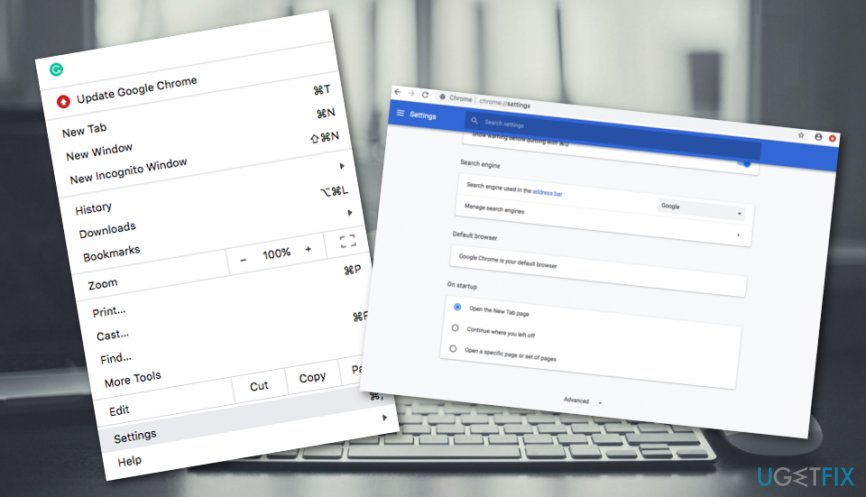
Fix nr - Afterward, opt for People --> Sync and Google services.
- Select Data from Chrome sync from the Sync menu.
- Then, opt to Turn off.
- When a small white window shows up, select Sign out.
- Reboot the browser.
- Sign into Chrome again and scroll down until you find the RESET SYNC button.
- Close Chrome.
- Perform a repeated scan with Malwarebytes BEFORE enabling sync again.
- Restart if necessary.
If this method is not working for you and you still keep dealing with Google Chrome Secure Preferences problem, there is another fix you can try. You will find it below.
Fix 2. Manually remove PUPs from Google Chrome
- Open Chrome and launch Settings (the three dots or an arrow in the upper right corner of your browser window).
- Look for New Tab page beneath Appearance and Show Home section. Make sure that it is chosen.
- Additionally, ensure that Search engine used in the address bar (under Search engine) is set to a trusted search engine.
- Choose Manage search engines and remove any other options except Google or the reliable ones.

Fix nr - Also, get rid of engines that are placed beneath Other search engines.
- After you finish these actions, return to On start-up and ensure that the Open the New Tab page option is selected.
We hope that these methods have helped you to deal with Chrome Secure Preferences issues. If you failed in the process, you can try repeating both fixes. However, if this does not help also, the last option is to try a different antivirus program and scan the entire computer system for potential threats that might be preventing you from fixing the problem.
Bottom line
To fix Google Chrome Secure Preferences, you can update Malwarebytes, disable Chrome Sync, and refresh your browser or reboot your computer. If these methods do not resolve the issue, consider using a different antivirus tool to detect the problem.
Frequently asked questions
You can try deleting the 'Secure Preferences' file located in the Chrome user data directory, then restart Chrome to generate a new file. Make sure to back up your bookmarks and settings before doing this.
Yes, you can reset Chrome settings to default by going to Settings > Advanced > Reset and clean up, which may resolve the Secure Preferences issue without requiring a reinstall.
Regularly check for updates by clicking on the three-dot menu in Chrome, selecting 'Help', then 'About Google Chrome', and install any available updates to keep your browser running smoothly.




Report an issue
What's wrong with this guide? We review every report and update or remove content.
Report received — thank you. We'll review and fix it.
You need a free account to submit a report.
Be the first to comment