How to fix
Windows 10 BSOD DRIVER_IRQL_Not_Less_Or_Equal (mfewfpk.sys)
on Windows
Resolve the Windows 10 BSOD DRIVER_IRQL_Not_Less_Or_Equal error effortlessly. Expert-tested solutions ensure quick fixes with zero traces left.

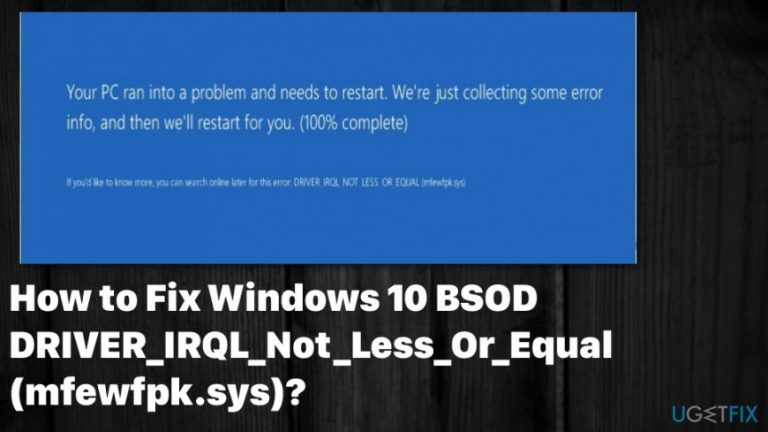
What causes How to Fix Windows 10 BSOD DRIVER_IRQL_Not_Less_Or_Equal (mfewfpk.sys)?
- Upgrade from Windows 8.1 to Windows 10
- Installation of new software or hardware
- Presence of McAfee Total Protection
- Corrupted mfewfpk.sys file
- Incompatibility of drivers
Repairs Windows system files, removes malware, and restores a clean OS state — without reinstalling.
Hi everyone. Yesterday I upgraded my mom’s PC from Windows 8.1 to Windows 10. Well, at the moment she is a little bit angry on me as the PC does not work due to the BSOD. I told her I know how to upgrade Windows, but the problem showed up unexpectedly. The upgrade actually run smoothly and it seemed that it has installed fine, worked fine, etc. but the PC worked OK just for a half an hour or so. I’ve installed a couple of programs on the system and tried to restart it. However, during the startup, immediately after Windows logo window, the screen went black and stayed so for some time. After that, a BSOD showed up reporting about a driver_irql_not_less_or_equal (mfewfpk.sys) error. I’ve tried to reboot the system again, but that did not help. Please tell me what should I do to access the desktop! Thank you.
DRIVER_IRQL_Not_Less_Or_Equal (mfewfpk.sys) is the error code, which appears as a part of the Windows Blue Screen of Death (BSOD). It states that a problem got detected and Windows has been shut down to prevent further damage to the computer. The particular file mfewfpk.sys supposedly is the reason for the error. Other messages may show the particular STOP error code and other combinations. However, in most cases, blue screen errors occur when you install new software or hardware.
This issue prevails in Windows 8.1 systems users of which attempt to upgrade to Windows 10.[ref en-1] Usually, it does not prevent PC owners from installing the upgrade. Windows 10 update might be installed smoothly, but during the boot phase the system gets stuck and the BSOD DRIVER_IRQL_Not_Less_Or_Equal (mfewfpk.sys) appears.
Even though the message claims that the PC needs to restart, that’s not the solution. The core of this issue is related to the mfewfpk.sys file, which is associated with McAfee Total Protection.[ref en-2] Therefore, people who are using Windows 8.1 OS and have McAfee antivirus installed on it are at the biggest risk of encountering mfewfpk.sys error.
These SYS files are critical data needed for various third-party software and can be called kernel mode device drivers that are sued to power the Windows OS. Files contain different configuration settings and specify what device drivers need to be loaded by the OS. Without such driver files like mfewfpk.sys programs cannot perform simple tasks and error messages or even BSOD DRIVER_IRQL_Not_Less_Or_Equal shows up.
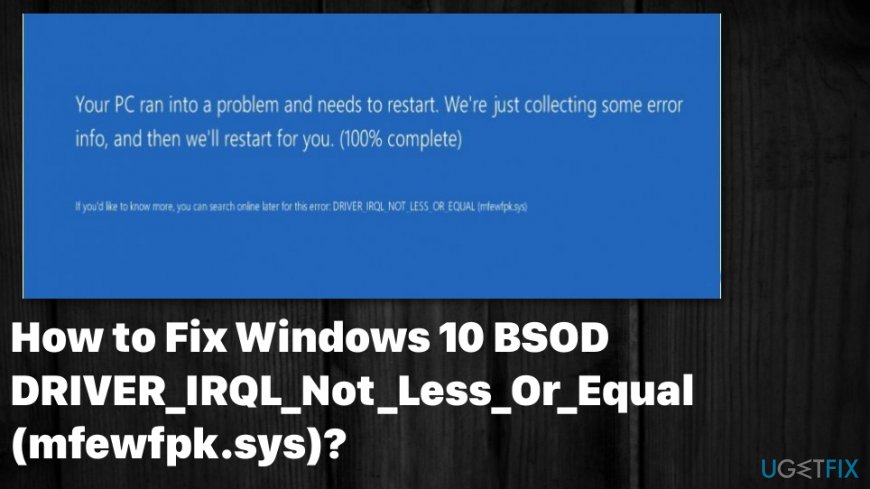
The full error message says:
Your PC ran into a problem and needs to restart. We’re just collecting some error info, and then we’ll restart for you. (100% complete).
If you’d like to know more, you cans search online later for this error: DRIVER_IRQL_Not_Less_Or_Equal (mfewfpk.sys).
How to fix DRIVER_IRQL_Not_Less_Or_Equal (mfewfpk.sys) BSOD?
To get rid of DRIVER_IRQL_Not_Less_Or_Equal BSOD, you should install a PC optimization tool, such as [d1] to find third-party software or malicious applications that can cause such messages and errors.[ref en-3] Leftover files from any software, especially antivirus can lead to issues like BSOD or system errors. SO clean the machine automatically and fix possibly corrupted files before trying any manual methods.
Uninstall MacAfee
As we have already pointed out, the core of the problem might be mfewfpk.sys file, which belongs to the MacAfee antivirus package. Therefore, our recommendation would be to uninstall this antivirus and try to run Windows 10 update again. To uninstall this software, you have three options:
- First of all, you can download [rev id="Perfect Uninstaller"] or similar application for software removal and set it to uninstall MacAfee automatically.
- You can also download a specific MacAfee removal tool by clicking on this link. Run the downloaded file and let the process to finish.
- Finally, you can delete this antivirus via Control Panel and then eliminate its leftovers via Registry Editor. It’s up to you which way to choose.
Check software compatibility
In case you prefer MacAfee antivirus to be running on Windows 10, it’s important to remind you that Windows 10 has a built-in security tool, which is Windows Defender. It means that the reason why you received mfewfpk.sys but might be an incompatibility between these two programs. To check that, you have to:
- Click Win key and type troubleshooting.
- Click on the search results and select Program Compatibility Troubleshooter.
- Wait for the scan to complete.
Boot the system in Safe Mode
- Click the Power button and press Shift key.
- Select Restart and then click Troubleshoot.
- Click Advanced options and select Startup Settings.
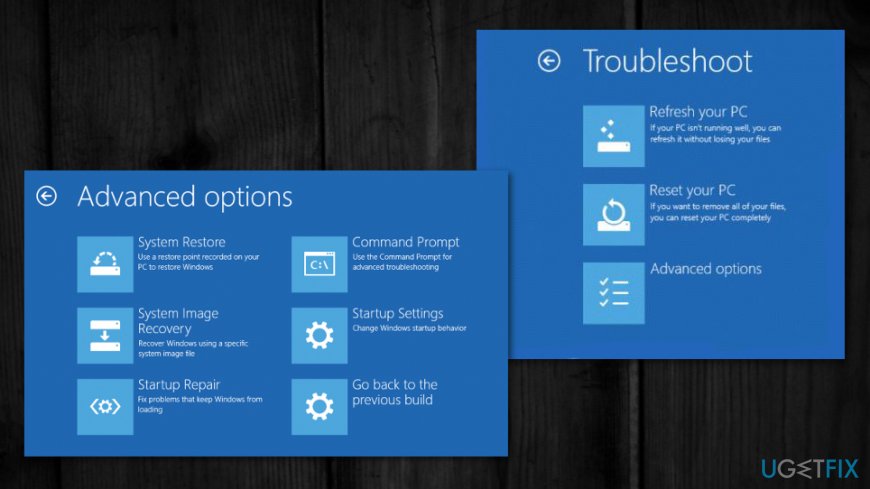
How to fix windows 10 bsod driver irql not less or equal mfewfpk sys troubleshoot - Finally, select Restart.
- When the system boots up, select Enable Safe Mode with Networking.
- In case the system booted up normally without DRIVER_IRQL_Not_Less_Or_Equal (mfewfpk.sys) error on the screen, then we would recommend performing a clean boot.
Run commands via Command Prompt to check the file and drive corruption
- Open Command Prompt with administrative rights and type the following, press Enter after each one:
chkdsk /f
sfc /scannow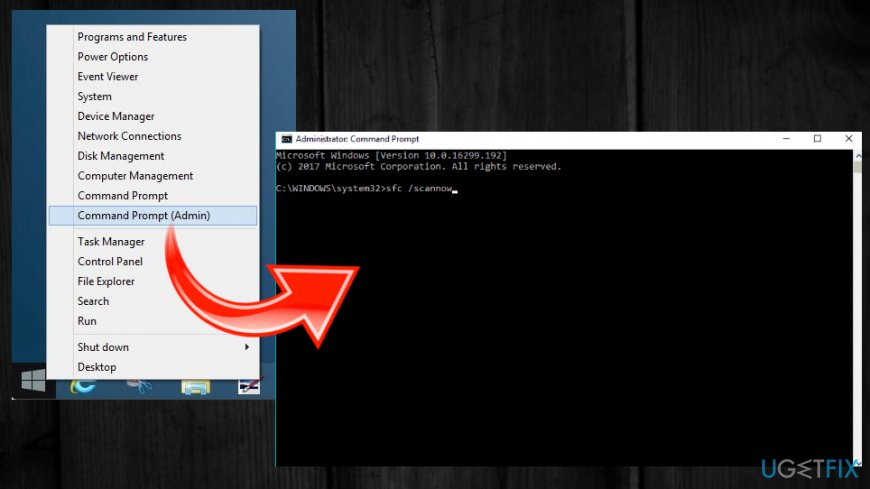
How to fix windows 10 bsod driver irql not less or equal mfewfpk sys command prompt
Perform a clean boot
- Click on Win key + S and type msconfig in the search bar.
- Select System Configuration from the search results and click on Services tab.
- Place a tick on Microsoft Services box and then select Disable all.
- After that, click Ctrl + Alt + Delete to Open Task Manager.
- Open Startup and disable all programs that are set to boot along with Windows system automatically.
- Once done, restart your PC.
Bottom line
To fix the DRIVER_IRQL_Not_Less_Or_Equal (mfewfpk.sys) error, you can try uninstalling McAfee Total Protection, updating drivers, or performing a system restore. If these solutions do not work, consider seeking professional help or reinstalling Windows.
Frequently asked questions
This BSOD error is typically caused by faulty drivers, particularly network drivers, or issues with installed software that is incompatible with Windows 10.
You can update drivers by going to Device Manager, right-clicking on the problematic driver, and selecting 'Update driver' or using Windows Update in Settings.
Yes, uninstalling the mfewfpk.sys driver can resolve the BSOD issue, but ensure you have a backup and check for alternative drivers or updates after uninstallation.




Report an issue
What's wrong with this guide? We review every report and update or remove content.
Report received — thank you. We'll review and fix it.
You need a free account to submit a report.
Be the first to comment