How to recover
Data from erased hard drive
from Windows
Recover erased data from your Windows 10 or Windows 11 hard drive effortlessly with proven techniques. Expert-tested for fast results, zero traces left.

What leads to How to recover data from erased hard drive?
- Accidental deletion using Shift + Del command
- Files placed in Recycle Bin and removed
- Data corruption or failure to load
- Physical damage to the hard drive
- Issues with connecting wires or components
Repairs Windows system files, removes malware, and restores a clean OS state — without reinstalling.
Hello guys. I accidentally marked a portion of files (in addition to those that I actually wanted to delete) and removed them completely. They are no longer accessible via the Recycle Bin... Is there a way to recover the erased data from my hard drive? Please help!
Storage devices such as hard drives, solid-state drives,[ref en-3] DVDs, flash drives, etc., are vital for our day-to-day use of the computer, as they store everything in them - from the operating system files to personal data, to web browser cookies. Unfortunately, when the data on those drives gets delete by accident, it can bring a lot of frustration to users. Once that happens, many users start wondering, is it possible to recover data from erased hard drive? The short answer is yes - most likely.
There are several ways how information on the HDD or another storage device can be deleted seemingly permanently. Usually, users accidentally mark the data that was not meant to be deleted and use Shift + Del command, which skips the Recycle Bin. In other cases, files might be placed in the Bin by accident and removed as well. The easiest way to recover data from erased hard drive is to get it back from backups that can be located on the cloud storage like OneDrive or Dropbox or external devices like USB flash drive, DVDs, external hard drives, etc.
Unfortunately, we can say in advance that data recovery from erased/damaged hard drive is not possible manually; therefore, you will have either to use data recovery software or pay a large sum of money for data recovery service.
Recover your data: check if your hardware is not damaged
Missing data on the hard drive might not necessarily mean that it was accidentally deleted. In some cases, the files may simply disappear or fail to load. The first course of action should be checking the hard drive for damage visually:
- check for broken pins or other damaged components
- damage to the wires connecting the HHD to the motherboard (SATA, ATA, SCSI) or to the PSU[ref en-2]
If there is visible damage to hardware, you should take it computer repair technicians who would be able to restore the damage and make the device fully functional once again.
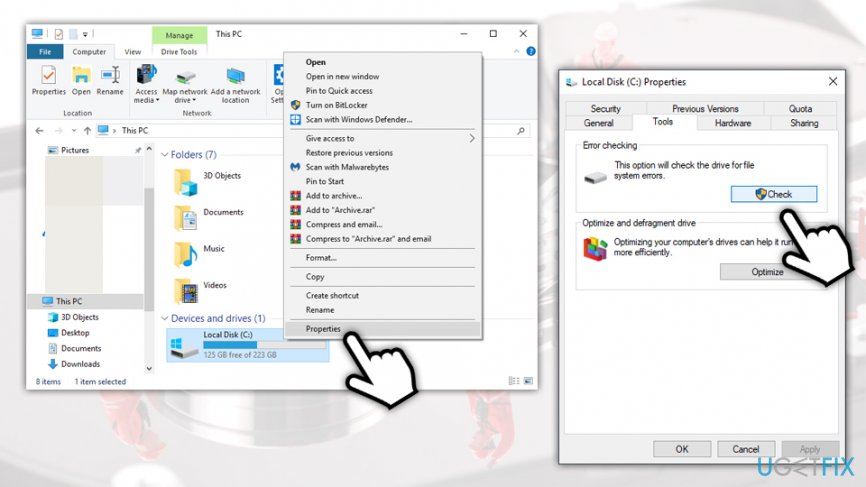
Additionally, a hard drive might be failing. To check if that is the case, you should run had disk error check as follows:
- Press Win + E on your keyboard
- Go to This PC (left pane)
- Right-click on the C Drive and select Properties
- Select Tools tab and then Check
If you found out that your hard drive is OK, move on to the next solutions that would help you recover data from erased hard drive.
Recover your data from erased hard drive using data recovery software
Once the data is placed into Recycle Bin, it can be quickly recovered simply by right-clicking and selecting Restore. Once the Recycle Bin is emptied, the data becomes no longer accessible to users. However, in reality, the data is not permanently deleted - only the path that leads to it is. The designated space, in the meantime, is marked as available for other data to be written, and, as long as that space is not overwritten by other information, the seemingly removed data will remain intact and still recoverable.
To recover data from erased hard drive, users should employ recovery software. Where there are plenty of options available, we believe that Data Recovery Pro is among the best options, as it is capable of recovering a wide variety of files from different storage types, including cameras, iPods, MP3 players, flash drives, hard drives and so on. Besides, it is user-friendly: allow to preview files before restoring them, allows them to sort files into certain categories, and so on. Generally speaking, it offers a full pack of services that make data recovery an easy task.
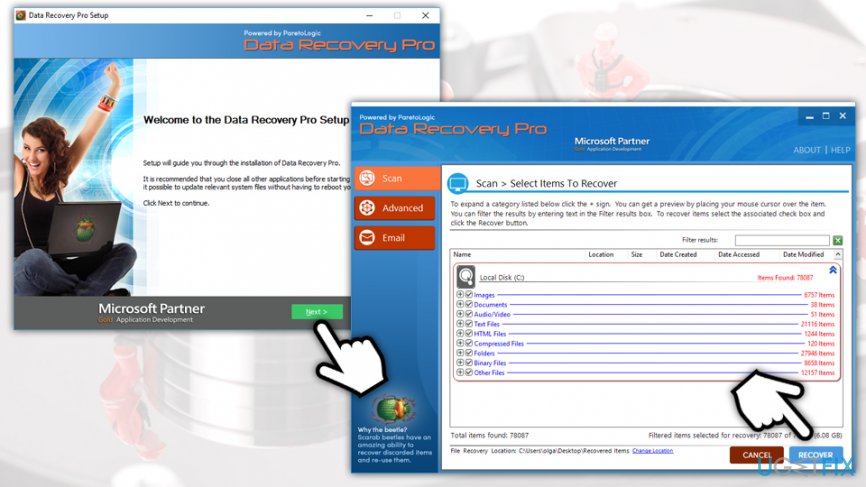
Here's how to use Data Recovery Pro:
- Download Data Recovery Pro [download link]
- Open the executable and proceed with the on-screen instructions to finalize the installation
- Once done, click on Data Recovery Pro shortcut on your desktop
- Pick Full Scan option and click on Start Scan
- Once done, you can select which files to recover and then click on Recover button
Note: the more you use your computer and write more data on it, the less of the data you will be able to recover. Therefore, if you are aware that your files are erased from your HDD, you should immediately stop using your machine in order to get the best results when using data recovery software - you should download the software on an external device even and not your PC.
Extra read: can you recover files from the hardware that were encrypted by ransomware?
Ransomware[ref en-1] is file locking malware - it uses sophisticated encryption methods to lock files. In other words, certain components of data (it highly depends on cipher type and the way hackers programmed malware) are replaced, and, to unlock them, a unique key is required. To get it, victims are asked to pay a ransom in Bitcoin or another cryptocurrency, and it can reach anything between $20 to $10,000 or even more. Currently, ransomware is on the rise, and Djvu, Phobos, Dharma, and other crypto-malware families earn millions to its developers.[ref en-4]

Technically, users who get their files locked face exactly the same problem - is it possible to recover data from the hard drive? The answer is very complicated, as it highly depends on many factors. In some cases, security researchers managed to develop decryptors that can recover all user files for free.[ref en-5] However, decryptable ransomware variants soon get updated, and the problem persists for users who infect their machines with those new versions.
When it comes to recovery software, it is one of the most commonly offered alternatives for ransomware-locked files. However, recovery tools like Data Recovery Pro or ShadowExplorer require special circumstances for them to work. Nevertheless, users should be aware that they need to remove the malware before attempting file recovery - we suggest using [d1] for the job.
All in all, if your files got encrypted, we still suggest you try using data recovery tools before giving up or paying the ransom to cybercriminals. To avoid the unpleasant situation, make sure you backup your files regularly!
Bottom line
To recover data from an erased hard drive, check for backups on cloud storage or external devices. If the hardware is not damaged, consider using data recovery software or professional data recovery services. If none of these methods work, it may be challenging to retrieve the lost data.
Frequently asked questions
Yes, you can recover data from an erased hard drive in Windows 10 using data recovery software or by restoring from a backup if available.
For Windows 11, tools like Recuva, EaseUS Data Recovery Wizard, and Stellar Data Recovery are recommended for recovering lost files.
Yes, you can restore system settings in Windows by using a system image backup or by accessing the recovery options if you have previously created restore points.




Report an issue
What's wrong with this guide? We review every report and update or remove content.
Report received — thank you. We'll review and fix it.
You need a free account to submit a report.
Be the first to comment