How to fix “Windows Store Cache may be damaged” on Windows
Resolve the "Windows Store Cache may be damaged" error on Windows 10 with our expert-tested solutions. Get your apps running smoothly again in minutes!
It’s not the first time when I get the “Windows Store Cache may be damaged” error message on Windows Store. I’ve noticed that it indicates a different error code in each case. Anyway, the outcome is always the same – I’m not able to download apps from the store. Could you please help?
Windows Store is one of the most important parts of Windows OS, which is visited by millions of Windows 10 every day. Unfortunately, but Microsoft enthusiasts count tens or even hundreds of Windows Store errors, which occur while trying to download/install/launch apps from it. The “Windows Store Cache may be damaged” error is probably the most common out of them. Typically, it emerges when downloading or updating apps and this may be a fatal error for those running the new Windows 10 S version, which allows running the apps downloaded from the Windows Store only. The culprit of this bug is explicitly indicated by the error message itself – damaged Windows Store cache. Therefore, it would be expedient to reset Windows Store to resolve the issue and check if that helped. If, however, resetting the store did fix “Windows Store Cache may be damaged,” we would recommend you to modify Windows Store cache folder or reinstall the Windows Store app. Since these fixes require some specific knowledge, we'll provide the instructions down below.
TIP: before performing any fixes below, we would recommend running Windows Store Troubleshooter. This tool may identify the culprit of the “Windows Store Cache may be damaged” error and provide more technical information about it.
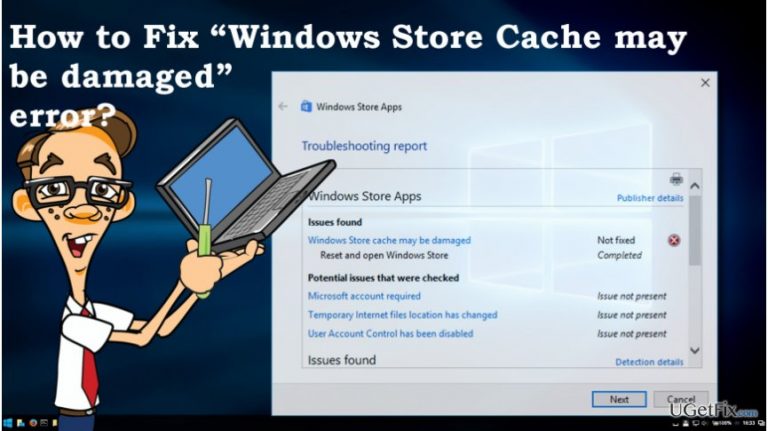
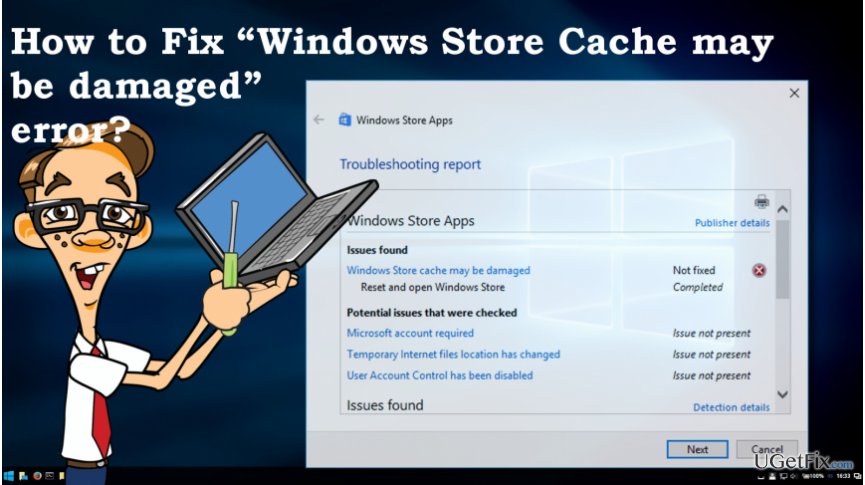
Windows store cache may be damagedFixing “Windows Store Cache may be damaged” error on Windows 10:
Solution 1. Reset Windows Store
Press "Windows key + R," type "C:\Windows\System32," (without quotes) and press "Enter." (C: stands for the root driver, so change the letter if needed).
Find the "WSReset.exe" application in the System32 folder.
Right-click on it and select "Run as administrator."
Press "Yes" on the UAC window and close everything.
Restart Windows Store app and try to download the app you needed.
Solution 2. Rename the Windows Store Cache folder
Press "Windows key + R," type "C:\Users\\AppData\Local\Packages\Microsoft.WindowsStore_8wekyb3d8bbwe\LocalState," (without quotes) and press "Enter." NOTE: replace the C: with the letter of your root drive and with your user account name.
Once you access the LocalState folder, look for the Cache folder.
If you found it, rename it to "Cache.old."
Then right-click on the empty space in the LocalState folder and select "New" -> "Folder."
If it finds that Windows Store cache is still damaged, it should fix it autoamatically.
Solution 3. Reinstall Windows Store
Click "Windows key + R," type "PowerShell," (without quotes) and press "Enter."
Right-click on the search results and select "Run as Administrator."
Type "Get-Appxpackage –Allusers" and press "Enter."
Find "Windows Stor"e entry and copy the package name. For this purpose, mark it and press "Ctrl + C."
After that, type Add-AppxPackage -register “C:\Program Files\WindowsApps\” –DisableDevelopmentMode command. NOTE: replace PackageFullName with the Windows Store package name by pressing "Ctrl + V." Besides, instead of C: type the letter of the root driver of your system.
Reopen PowerShell with administrative privileges as explained above.
Paste Add-AppxPackage -register “C:\Program Files\WindowsApps\” –DisableDevelopmentMode command and press "Enter."
Finally, reboot the system to execute all changes.
If none of the steps listed above helped to fix “Windows Store Cache may be damaged” error on Windows 10, the last couple of things that we can offer is to uninstall/reinstall the problematic application or run a scan with [d1], [rev id=”RegCure Pro”] or an alternative optimization tool to check the overall PC’s condition.
Bottom line
To fix the 'Windows Store Cache may be damaged' error, you can reset the Windows Store, rename the Windows Store cache folder, or reinstall the Windows Store app. If none of these solutions work, it is advisable to run the Windows Store Troubleshooter for further assistance.
Frequently asked questions
To clear the Windows Store cache, press Win + R, type 'wsreset.exe' and hit Enter. This will reset the cache without affecting your installed apps.
Go to Settings > Update & Security > Windows Update and click on 'Check for updates' to ensure your system is up to date, which can help resolve the cache issue.
If the error persists, consider running the Windows Store Apps troubleshooter found in Settings > Update & Security > Troubleshoot > Additional troubleshooters.
Gabriel E. Hall is a malware removal expert and cybersecurity researcher with over ten years of hands-on experience analysing threats and writing removal guides. She has documented hundreds of malware families — from browser hijackers and adware to ransomware and rootkits — providing step-by-step cleanup instructions tested against real infections. Gabriel's work combines deep technical analysis with clear, actionable language that readers without a security background can follow. Her guides consistently appear among the most-referenced resources for malware removal on Windows systems.





Report an issue
What's wrong with this guide? We review every report and update or remove content.
Report received — thank you. We'll review and fix it.
You need a free account to submit a report.
Be the first to comment