How to fix
Administrative Templates not showing
on Windows
Resolve the issue of missing Administrative Templates in Windows Group Policy effortlessly. Quick, expert-tested solutions for Windows 10 and 11 await you!

What causes How to fix Administrative Templates not showing in Windows Group Policy?
- Missing Administrative Template files
- Absence of PolicyDefinitions folder in SYSVOL directory
- Group Policy settings restricting access to Administrative Templates
- Improper permissions for the user account
- Incorrect group memberships for the user account
Repairs Windows system files, removes malware, and restores a clean OS state — without reinstalling.
Hello. I tried to access components using Gpedit but the Administrative Templates are missing. What should I do?
The Group Policy Editor is a vital administrative tool within the Windows operating system, particularly in a networked environment using Active Directory. It serves as the primary user interface for managing user preferences, security policies, and various system settings across numerous Windows machines. The Group Policy Editor is a crucial tool for ensuring a Windows network's stability and security since administrators rely on it to enforce uniform configurations and security guidelines.
Administrators may face a lot of difficulty with the "Administrative Templates not showing in Windows Group Policy" problem. A crucial component of the Group Policy Editor, Administrative Templates provide a broad range of policy settings and preferences. According to organizational requirements, they enable administrators to standardize and adjust the behavior of Windows components and apps. When this problem arises, the Group Policy Editor's expected Administrative Templates settings are missing, making it difficult or impossible to build policies efficiently.
This problem may have a significant effect on both users and the system as a whole. A lack of uniformity in security settings, application behavior, and user experiences can result from inconsistent configurations. Due to the possibility that key security policies are left unconfigured or are configured incorrectly, this inconsistency might lead to security vulnerabilities. Users may encounter unforeseen difficulties and restrictions when utilizing Windows computers, which can cause dissatisfaction and decreased productivity.
Examining the presence and integrity of administrative template files, confirming the existence of the PolicyDefinitions folder within the SYSVOL directory on the Domain Controller, reviewing Group Policy settings that may restrict access to Administrative Templates, and ensuring the proper permissions and group memberships for the user account in question are all necessary steps in dealing with the issue of missing administrative templates.
In this guide, you will find 2 steps that should help you fix Administrative Templates not showing in Windows Group Policy. If you experience any OS issues you can run a repair tool like [d1] that can fix most system errors, BSODs, corrupted files, and registry issues. Otherwise, follow the step-by-step instructions below.
Solution 1. Update Group Policy
- Left-click the Start button.
- Type Command Prompt in the search bar.
- Right-click Command Prompt in the search results.
- Select Run as administrator from the context menu.
- Click Yes on the User Account Control (UAC) prompt that appears.
- In the Command Prompt window, type the following command:
gpupdate /force
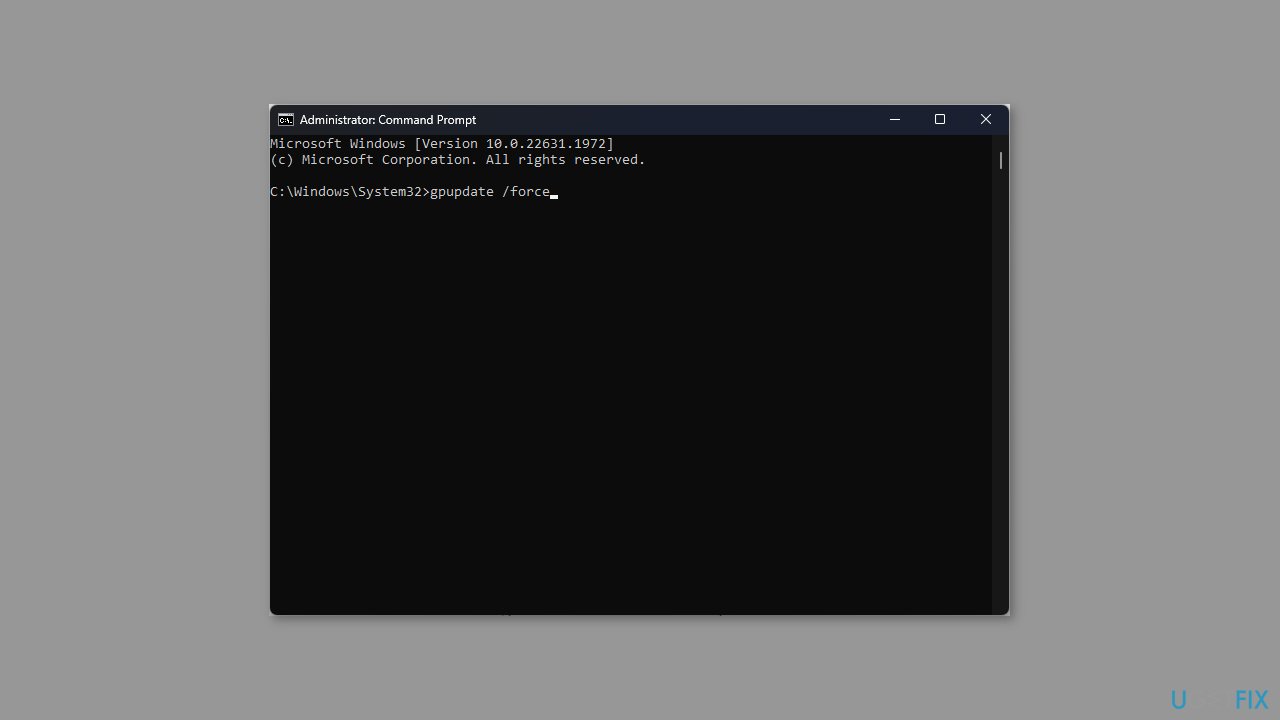
- Press Enter to run the Group Policy update command.
Solution 2. Set up a Central Store for Group Policies
- Press the Windows key + E to open File Explorer.
- Navigate to the following directory:
C:\WINDOWS\SYSVOL\sysvol\{your_domain_name}\Policies

- Inside the Policies folder, right-click and create a new folder named PolicyDefinitions. This folder will serve as the central store for administrative template files.
- Navigate to the following directory:
%SystemRoot%\PolicyDefinition
- Copy all the files and folders within the PolicyDefinitions folder.
- Paste the copied files and folders into the PolicyDefinitions folder you created.
- Press the Windows key + R keys to open the Run dialog box.
- Type gpmc.msc and click OK to open the Group Policy Management Console.
- Expand the Group Policy Objects folder.
- Select an existing Group Policy Object (GPO) or create a new one as needed.
- Right-click the selected GPO.
- Choose Edit from the context menu to open the Group Policy Editor.
- Within the Group Policy Editor, you will now see the administrative template settings for various Windows components under the Administrative Templates node.
Bottom line
To address the issue of missing Administrative Templates in Windows Group Policy, you should examine the presence and integrity of administrative template files, confirm the existence of the PolicyDefinitions folder, review Group Policy settings, and ensure proper permissions and group memberships. If these steps do not resolve the issue, consider running a repair tool to fix potential system errors.
Frequently asked questions
Administrative Templates may be missing due to a corrupted Group Policy installation or missing files. Ensure that the Group Policy Management Console is properly installed and that your system is updated.
You can restore missing Administrative Templates by reinstalling the Group Policy Administrative Templates from the Microsoft website or using the Local Group Policy Editor. Make sure you have the latest updates installed for Windows 11.
If Administrative Templates are not showing after a Windows update, try resetting the Group Policy settings or running the System File Checker tool to repair any corrupted files. Additionally, check for any pending updates that may resolve the issue.




Report an issue
What's wrong with this guide? We review every report and update or remove content.
Report received — thank you. We'll review and fix it.
You need a free account to submit a report.
Be the first to comment